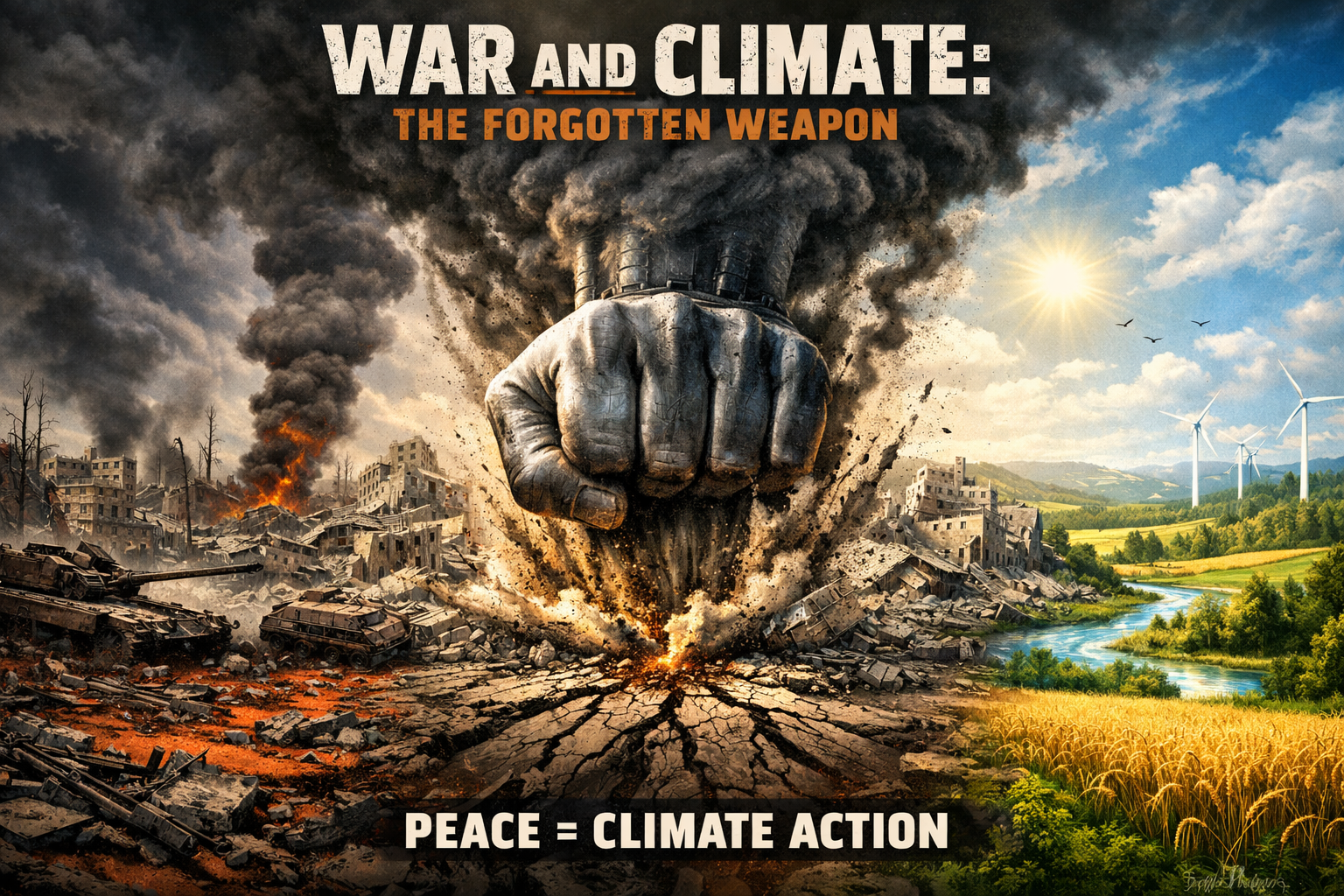

How Russia-Ukraine and Israel-Palestine Conflicts Are Accelerating Climate Catastrophe And Why World Leaders Stay Silent
The Smoking Gun Nobody Talks About
Another discussion is missing in all climate conferences, all climate pledges, all net-zero by 2050 promises. It is the talk concerning war. I have never felt more helpless than I did when I understood this fact: And we are discussing carbon credits and clean targets, but the real bombs are destroying the climate.
In August 2024, South Korea’s court ruled on climate rights. In Paris, negotiators drafted new adaptation policies. In New York, climate leaders celebrated commitments. Meanwhile, in Ukraine and Gaza, the single largest sources of emissions weren’t wind or coal they were explosions. This is the story nobody wants to tell. But it’s the most urgent climate story of our time.
The Numbers Which Must Terrify Us.
We will begin with fact, since facts, unlike politicians, do not lie.
War in Ukraine (3 years): 230 million tonnes of CO2 equivalent.
Conflict (15 months) in Gaza: 31 million metric tonnes of CO 2 (with newer UNEP estimates of 61 million tonnes of debris alone equal to 25 Great Pyramid of Giza and 25 Effil Towers in volume)
World armies (per annum): 5.5 percent of the world greenhouse gas emissions (=2,750 tCO2e)
Expenditure on the military in the world (2024): 2.7 trillion USD.
The emission of the Ukraine war is to be put in perspective: The emissions of the Ukraine war alone are as much as the annual emissions of Austria, Hungary, Czech Republic, and Slovakia combined. Within 15 months, more greenhouse gases were generated in Gaza, than 20 climate vulnerable countries produce in a year.
Recent peer-reviewed research demonstrates that for every 1% escalation in global military expenditure as a percentage of GDP, CO2 emission intensity increases by 0.04 kg/USD, accounting for 27% of total changes in emission intensity from 1995 to 2023. This statistical relationship is undeniable and deeply troubling.
Here’s the most damning fact: Military emissions were deliberately excluded from the Kyoto Protocol and treated as “voluntary reporting” under the Paris Agreement. In other words, the nations most responsible for climate destruction have a legal loophole to hide it. Even more troubling, most IPCC climate scenario modeling does not distinctly categorize military sector emissions, creating a massive blind spot in our understanding of true climate trajectories.
The implications are catastrophic: If global military spending exceeds 12% of global GDP, the 1.5°C climate target becomes mathematically unattainable by century’s end, even under the most optimistic scenarios. We are not just losing time on climate action we are actively funding our own extinction through military expansion.

The Silent Soil: Chemical Contamination Nobody Discusses
But CO2 is only half the horror story.
The contemporary war does not only burn carbon, it pollutes the earth. In Ukraine, there are reports of heavy metal contamination (cadmium, lead, chromium) in the soil which are much higher than the maximum permissible legal limits of these heavy metals. Munitions residue and depleted uranium are transferred to the ground by explosions. Agricultural land that is needed to produce food turns into toxic waste.
The chemical contamination resulting in the Kakhovka dam burst spread hundreds of square kilometres of chemicals, and the disfigurations of the environment will only be recuperated, possibly not at all, in decades. The ICRC approximates that cleaning up of polluted areas may require 50-100 years based on the levels of contamination and accessibility of the involved areas.
The devastation is even worse and more pronounced in Gaza:
- 97 percent of the crops that were destroyed are trees (as of May 2025, updated UNEP statistics)
- 61 million tons of waste (with dangerous materials, unexploded bomb, asbestos) produced.
- Decline in water storage capacity (84percent) and only 9 out of 54 water facilities are still operating.
- All the sewage systems utilized to treat the wastewater were grossly damaged and discharged untreated sewage into the groundwater.
- Agricultural land was destroyed (two thirds), munitions, solid wastes, sewage had ruined the soil.
- Food production cannot be practiced at large scale because of soil degradation and vegetation loss.
According to the UN Environment Programme (UNEP), long-term erosion of soil leads to the risk of desertification of Gaza. A desert will be created out of a soil that was once fertile. It will take decades before the contamination gets rid of in the soil, water, and food chains. Munition elements that are both radiological and chemical will bioaccumulate in the tissues of the human beings resulting in long term health crises such as cancers, developmental disorders as well as collapse of their immune system.
It is not climate change, it is ecocide environmental destruction on an enormity level, the kind of many levels that the international lawyers have already termed it a possible war crime committed under the Rome Statute of the International Criminal Court.
The Policy Failure: Why World Leaders Stay Silent
The following question is the one that must make us feel enraged: When the 4th largest emitter of the world (after USA, China, India) is represented by militaries, why not make this the focus of every climate negotiation?
The solution lies in geopolitical cowardice based on structural power.
The exemption is enjoyed by countries with the highest military (USA, Russia, China, France, UK). They do not tell the truth on military emissions. They are quite prolific in their lobbying to see that climate negotiations do not entail military spending. The problem of conflict and climate was also massively protested and had side events in COP28 but not discussed in the official agenda. The civil society was sidelined, and the diplomatic silence was tumultuous.
This is not just an oversight, it is a policy with a purpose to advance the military-industrial interest. According to the reports of the Stockholm International Peace Research Institute (SIPRI) military aircraft and ships are indeed gas guzzlers, and the production of arms is so carbon- and resource-intensive that it depends on rare-earth metals that are mined in a manner that destroys ecosystems.. The U.S. military industry alone produces emissions with an intensity nearly double the U.S. national average.
Meanwhile, adaptation finance to vulnerable nations is capped at $120 billion (and delayed to 2035), but military expenditure globally reached $2.7 trillion in 2024, a 9.4% increase year-on-year. We are funding the destruction of the planet at a faster rate than we fund its protection.
There is such a law as international humanitarian law (IHL): Protocol I, which is an additional protocol to Geneva Conventions (1977) and the ENMOD Convention (1976) forbade wholesale, protracted and extreme ecological devastation in warfare. According to the Rome Statute of the ICC, causing such damage is a war crime on the violation of the principle of proportionality. But these laws remain unenforced. The ICRC continues to advocate for better implementation, calling the current enforcement record “inadequate.”
CRITICAL STATISTICS TABLE
| Metric | Value |
| Ukraine War CO2 Emissions (3 years) | 230 MtCO2e |
| Gaza Conflict CO2 Emissions (15 months) | 32 MtCO2e |
| Gaza Debris Generated | 61 million tonnes |
| Global Military Emissions (% of total) | 5.5% |
| Military Ranking (by emissions) | 4th largest emitter |
| Gaza Trees Destroyed | 97% |
| Gaza Water Facilities Active | 9 of 54 |
| Gaza Farmland Damaged | 2/3 |
| Heavy Metal Exceedance in Ukraine Soils | Multiple (Pb, Cd, Cr) |
| Russia’s Climate Liability (Ukraine) | $42 billion |
| Military Spending Increase (2024) | 9.4% YoY |
| Global Military Spending (2024) | $2.7 trillion |
| MILEX Threshold for 1.5°C Unattainability | 12% of global GDP |
| Nuclear War Climate Impact | 2-3°C global cooling |
The Reconstruction Trap: Building Our Way Into Crisis
Here’s the cruelest irony: Reconstruction will emit MORE carbon than the wars themselves.
The reconstruction of Ukraine is estimated to produce 56 MtCO2e which is basically one more year of direct warfare. The reconstruction in Gaza will involve sweeping off 61 million tonnes of rubble, most of it poisonous, and rebuilding water, sanitation and agricultural infrastructure that was destroyed. Devoid of climate aware measures, these reconstruction emissions will be astronomical.
We are not only destroying infrastructure, but we are setting ourselves a decades-long effort of rebuilding that requires decades of carbon-intensive construction to cement in the same pattern of emission. Unless the reconstruction focuses on the low-carbon materials, recycling of the demolition waste, and sustainable methods, we will have forever changed the course of climate.
The ICRC and UNEP have introduced the From Crisis to Recovery framework that ensures that all reconstruction projects in the aftermath of conflict should be climate and environment-conscious since its inception. It is an acknowledgement that without a fundamental reform of the system, we merely create the road back to extinction.
War – Emissions – Destruction – Reconstruction Emissions – More Carbon Debt – Deep Climate Crisis.
Nuclear Winter: The Disaster everybody is silent about.
Even darker scenario has to be addressed here. Although a standard war would lead to enormous emission, nuclear war would result in the phenomenon of nuclear winter a worldwide cooling phenomenon that might destroy agriculture and lead to a worldwide famine.
Nuclear weapons alone will destroy the climate due to uranium mining, manufacturing, and disposal of waste. Radiation pollution lasts a thousand years.
Weapons testing has left sites “uninhabitable to this day.”
A limited nuclear exchange between just two regional powers could kill billions indirectly through climate impacts, not direct blasts. Models show that even a “regional” nuclear war (under 100 megatons) would cause a 2-3°C global cooling, crop failures, and famine affecting 2 billion people. It is a fundamental risk that exists in climate modeling that is given little consideration.
According to the Arms Control Association, the risk of unintentional or intentional nuclear employment grows exponentially with the number of nuclear powers as the number of nuclear-armed countries grows and the geopolitical tension grows. However, this danger does not appear anywhere in the majority of the climate policy discourse.
The Way Forward: Why I am Still Optimistic.
I know this sounds hopeless. And in my life too I even almost gave up. I could see, however, three reasons to feel optimistic:
1. Accountability is Possible:
Russia’s liability for Ukraine’s climate damage is calculated at $42 billion (at $185/ton of CO2). This creates a legal precedent: nations can be held financially accountable for war’s climate costs. International courts are listening, and the doctrine of “environmental reparations” is emerging. The UN Compensation Commission has already processed $52 billion in environmental damage claims from the 1990 Gulf War, proving the mechanism works.
2. Recognition is Spreading:
Countries like Kenya and South Korea are embedding environmental rights in their constitutions, giving courts the power to mandate emissions reductions including military ones. The UN Environment Assembly has passed resolutions (6/12 in 2024) specifically mandating support for conflict-affected regions’ environmental recovery. If climate courts can audit military budgets and emissions reporting becomes mandatory, accountability becomes enforceable.
The ICRC’s new framework explicitly links environmental protection to humanitarian obligations, creating legal space for courts to intervene. Several countries are piloting “Environmental Justice Courts” that could adjudicate military environmental crimes.
3. We Can Change the Rules Right Now:
The Paris Agreement’s military loophole exists because we accepted it. We can demand and countries can adopt binding military emissions protocols. The ICRC and UNEP are now working together on “From Crisis to Recovery” frameworks to integrate climate considerations into post-conflict reconstruction.
New Zealand’s climate leadership model can be replicated globally. Constitutional climate rights (as I’ve advocated previously) can apply to military-industrial complexes. More importantly, youth climate movements and legal advocates can force governments to close the loophole through litigation.
The technology exists. The legal frameworks exist. What’s missing is political will and political will emerges when citizens demand it.
Conclusion: The Conversation We Must Have
We cannot have genuine climate action while wars rage unchecked, and militaries remain exempt from carbon accountability.
Here’s my call to the global community:
- Close the military emissions loophole NOW: Make military reporting mandatory and binding under all climate agreements. Demand transparency from every defense ministry.
- Link peace to climate as an inseparable project: Frame conflict resolution as climate action. Every bomb prevented is carbon saved, soil preserved, and water protected.
- Constitutional climate courts must audit military budgets: If nations can sue over environmental rights, let them sue over military emissions and demand climate-conscious military operations.
- Demand climate-conscious reconstruction: Nations destroyed by war should not bear the carbon debt of rebuilding. The crisis to recovery framework suggests that the aggressors should finance the climate-neutral, sustainable reconstruction.
- Make ecocide in war a crime: Improve implementation of Rome Statute and IHL. Criminalize the destruction of the environment in war.
- I have worked in the field of eco-social solutions more than ten years, and I can say: We will not develop to the net-zero when there are wars. The math is impossible. The emissions from even one regional conflict exceed the annual savings from most national climate policies.
Peace is not a luxury alongside climate action. Peace is climate action.
The soil of Ukraine will remember. The deserts of Gaza will remember. Nuclear winter scenario is a frozen tundra that we will experience in the future. And when the children of my generation will ask why we have failed them I will want to be able to answer, we tried. We demanded change. We refused to accept exemptions for destroyers. We insisted that every climate negotiation include military accountability. We made it politically impossible to ignore the war-climate connection.”
That time is now. This decade. This year.






 Reston Dennis Juah
 Noor Ul Ain

 Hassan Barrie
 Hoby Nasandratra Andriamiandrisoa
There is perceptibly a bunch to know about this. I believe you made some nice points in features also.
Its such as you read my thoughts! You seem to understand a lot approximately this, like you wrote the e-book in it or something. I think that you just could do with some to drive the message home a bit, but instead of that, that is wonderful blog. An excellent read. I’ll certainly be back.
I simply could not go away your site before suggesting that I extremely loved the standard information a person provide on your visitors? Is going to be back continuously to check up on new posts.
JetXCasino, what’s good? I’ve spent a few evenings testing the waters and I’m impressed with the variety of games you offer!. Keep up the good work! jetxcasino
S777Login, just wanted to say your login process is slick! No headaches, straight to the games. Appreciate that smooth experience. Looking forward to more wins!s777login
Pin77App, hey! Loving the mobile app. Super convenient to get a few games in on my commute or on break. The interface is intuitive. Nice work!pin77app
I like your writing style genuinely enjoying this site.
66b có tính năng “so sánh RTP” giữa các slot – giúp bạn chọn game có lợi nhất trước khi đặt cược. TONY07-03
Heya i am for the first time here. I found this board and I to find It really useful & it helped me out a lot. I’m hoping to give something back and aid others such as you aided me.