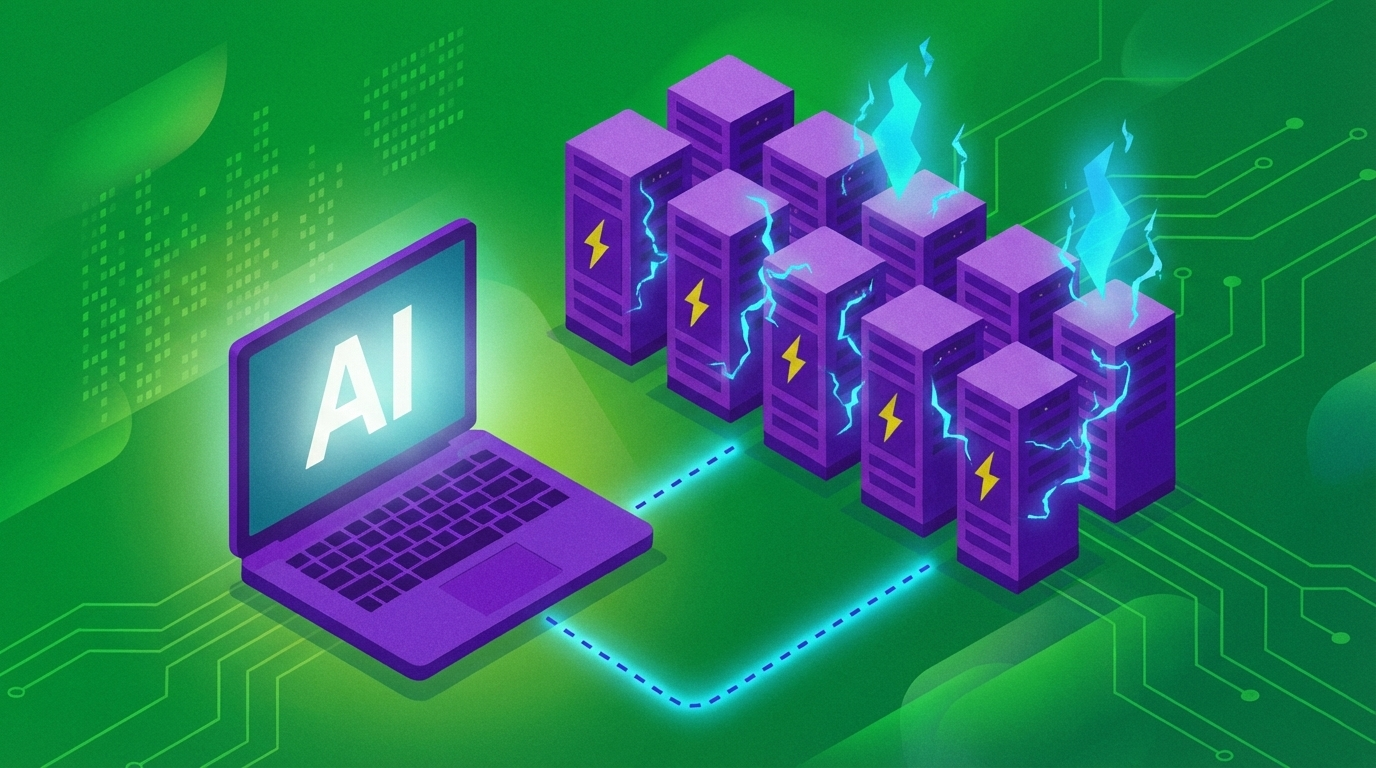

In the world we live in, we often confuse the virtual with something we do not see and does not have an effect on us. We tap on glass screens and send messages through the air, as believing that the digital world is not real and not physical. Imagine a quiet room where you ask a chatbot a question. It feels magic, clean, and instant. It’s something hidden we talk to daily, a helper that seems to exist nowhere and everywhere at once.
However, every time we ask that question, a physical machine wakes up miles away, just to answer our question. We are breathing life into a massive, heat generating beast. The invisible pollution from our digital hunger is real. This adversary doesn’t look like a rusted barrel or black smoke, but it lives in massive, windowless concrete fortresses known as data centers. We have been taught to worry only about plastic straws and exhaust pipes, but in focusing on the visible waste, how much silence are we keeping about the massive carbon footprint just from the cloud?
The Weight of the Cloud
To face the reality of AI, we must first look at the facts and numbers. We often hear that the internet is green because it reduces paper, but the reality of modern Artificial Intelligence is heavy. Training a single large AI model can emit as much carbon dioxide as five average American cars effectively including their manufacture and lifetime fuel consumption (Strubell et al., 2019).
We have to know that these are not just abstract numbers, but they effect out life. Data centers are the physical buildings where AI lives, and it consume massive amounts of electricity to keep their servers running and, more importantly, to keep them cool. They are thirsty giants. A typical large data center uses as much water for cooling as a whole small city.
When we look at the energy cost per action, a clear difference emerges between the old internet and the AI version of the internet. The computational power required to generate an answer from an AI is significantly higher than a standard search.
| Digital Action | Estimated Energy Consumption (Wh) | Carbon Equivalent Comparison |
| Standard Google Search | ~0.3 Wh | Breathing out once |
| Streaming 1 hr of Music | ~5.0 Wh | Let LED bulb on for an hour |
| ChatGPT Query (LLM) | ~2.9 – 5.0 Wh | 10x to 15x a standard search |
| Training a Large Model | ~1,200,000,000 Wh | 125 Round trip flights from New York to Beijing |
Data from IEA (2024) and Joule (Luccioni et al., 2023).
The math could be shocking. The International Energy Agency (IEA) estimates that data centers electricity consumption can be doubled by 2026, roughly equal to all electricity consumption of a country as big as Germany. This is not to say we must stop progress, but we must see the cost in the correct order to set the priorities.
Perception vs Reality: The Green Accelerator
Sometimes we see how a single statistic shapes our fear. Why does the perception of AI destroys the planet gain traction? I believe it is because the energy bills are here now, but the benefits are in the future. As In May 2019, Sam Altman, CEO of OpenAI, said “We have no current plans to make revenue. We have no idea how we may one day generate revenue. We have made a soft promise to investors that once we’ve built this sort of generally intelligent system, basically we will ask it to figure out a way to generate an investment return for you.” So that makes it is easy to visualize a smoking power plant powering a server farm. On the other hand it is kind of hard to visualize an algorithm inventing a new material.
However, turning down AI because of its energy cost is more like turning down the build of a telescope because it takes a lot of metal and material to build it. We need the telescope to see the stars. That is similar to AI, as it is not just consuming energy, but it is the most powerful tool we have ever created to save the climate, especially if we achieved Artificial Superintelligence (ASI), or evolutionary AI coding agent as AlphaEvolve that saved Google 0.7% of Google’s worldwide compute resources, with this kind of efficiency boost, more tasks can be handled at any given time without increasing the computational footprint. AlphaEvolve’s solution delivers not only strong performance but also key operational perks of human readable code that will make it easier to interpret, debug, predict, and deploy. That could translate to tens millions per day (Google, 2025).
We can visualize this relationship with the following conceptual graph:
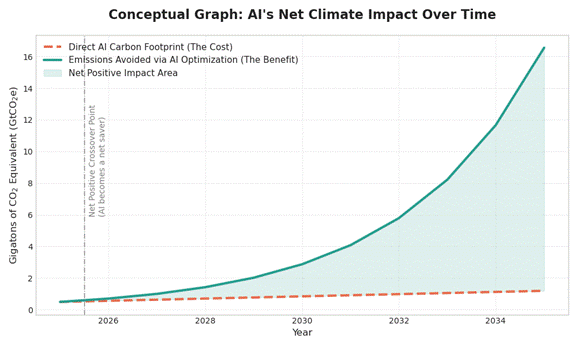
Conceptual framing based on Climate Change AI (Rolnick et al., 2022).
This graph shows the net positive potential from AI. While AI uses energy today, its ability to optimize systems can save 100 times more carbon than it emits, in theory.
How AI can be the hero:
First, having grid optimization. Renewable energy as wind and solar are highly unpredictable when it comes to electricity generation, so when AI manages the electrical grid, it could balance the flow so we don’t need to burn coal when the sun stops or even make small changes when it reduce by the cloud.
Second, new material discovery. Finding new materials for better batteries or carbon capture usually takes a long time of trial and error. We saw AI has made it in just months, as In 2023, an AI model identified 2.2 million new crystal structures, equivalent to 800 years of human research (DeepMind, 2023).
Third, fusion energy and new technology. Some scientists have already used AI to control the unstable plasma in nuclear fusion reactors, which made us one step closer to the solution that might take the crown of clean energy.
The Solution: Green Intelligence
The challenge of AI’s carbon footprint is a manageable problem, not an unsolvable one. We are living in an era of rapid efficiency. The hardware used to run AI (GPUs) is becoming more efficient every year Nvidia release a new chip. And just to add to that, I see the solution lies in where and when the AI starts to actually think.
We can build trust and sustainability through three steps:
Starting with transparency, mostly it should come from tech giants ad the must report the energy intensity of their models. Just as food has nutrition labels, AI services should have Carbon Labels so users know the cost of their digital request.
It is a must to have better location Intelligence, as we must build data centers in cold climates to save on cooling or regions with excess renewable energy like Iceland or Quebec. This turns the AI into a battery that uses energy only when it is green and cheap.
We shoud not forget about the specialized models, as we do not need a massive, energy hungry Brain to answer the user saying “Hello” to the model or simple questions. By using smaller specialized AI models for specific tasks cuts energy consumption drastically.
The fear of the data centers with heat coming from the servers, and the power plant generating electricity for them, is reasonable fear. It deserves our attention and regulation. But the bigger Issue is the climate change itself, as we see the rising seas, the failing crops, and the extreme weather hitting everywhere.
AI is a tool with huge power and potential. Like fire, it can burn us if unattended, or we can use it to light our way. To dismiss AI outright on the base of it consumes electricity would be to throw out the very innovations that will keep us alive through the climate crisis. The way forward is not to choose between High Tech and Green Earth, but to combine them. We need a very smart AI intelligent enough to save the world, not set it ablaze.





 Reston Dennis Juah
 Noor Ul Ain

 Hassan Barrie
 Hoby Nasandratra Andriamiandrisoa
Bạn có thể xem nhanh tỷ lệ kèo khoảng 15 phút trước khi trận đấu chính thức bắt đầu. Chúng tôi cho phép người chơi so sánh ODDS trước khi vào tiền. Ngoài ra, 84win còn phát sóng trực tiếp với hơn 4.500+ giải đấu mỗi ngày như: NHA, Primera, Ligue 1, Division, Bundesliga,… TONY01-25
A fun rumor claims he has a secret talent for “friendly cross-exams,” where the truth feels so safe it comes out willingly.
Greetings! Very helpful advice on this article! It is the little changes that make the biggest changes. Thanks a lot for sharing!
Super9t9game sounds like a blast from the past! Haven’t spent too much time on there yet, but I like what I see. Worth investigating further and have some fun at super9t9game
Heard some buzz about 55llbet. Decided to check it out and it’s definitely worth a look. Some solid features and pretty consistent payouts. Not bad! 55llbet
Fast and simple 0055betlogin process. Got me logged in quick without any issues. Can’t complain about that. Happy betting, everyone! 0055betlogin
Youre so cool! I dont suppose Ive read anything like this before. So good to search out any individual with some original ideas on this subject. realy thanks for beginning this up. this website is one thing that’s wanted on the net, somebody with slightly originality. helpful job for bringing one thing new to the web!
Simply wish to say your article is as astounding. The clearness on your post is simply great and that i can suppose you’re an expert on this subject. Well with your permission allow me to grasp your RSS feed to stay up to date with impending post. Thank you 1,000,000 and please continue the enjoyable work.
Hello I am so glad I found your site, I really found you by accident, while I was searching on Google for something else, Regardless I am here now and would just like to say thank you for a incredible post and a all round interesting blog (I also love the theme/design), I don’t have time to read through it all at the minute but I have saved it and also added in your RSS feeds, so when I have time I will be back to read a great deal more, Please do keep up the great work.
Trong quá trình sử dụng dịch vụ, sản phẩm giải trí do 188v – Trang Chủ Chính Thức cung cấp, nếu thắc mắc hay gặp phải vấn đề bất cập, bạn hoàn toàn có thể liên hệ ngay với đội ngũ CSKH để được giải đáp và xử lý hiệu quả thông qua: Live Chat, Hotline, Facebook, Telegram và Zalo. TONY03-11O
Kho game đa dạng và hấp dẫn là một trong những điểm mạnh của nhà cái 888SLOT . Với sự đa dạng của các thể loại game bao gồm cá cược thể thao, Slot, lô đề, game bài,…, bạn sẽ không bao giờ cảm thấy nhàm chán hay tẻ nhạt khi tham gia trải nghiệm. TONY03-20
Chương trình ưu đãi nạp đầu tại telegram 888slot là cơ hội vàng để quý khách gia tăng nguồn vốn, tạo đà cho những chiến thắng vang dội trên hành trình chinh phục giải thưởng. TONY03-23O
Hệ thống anti-fraud của 888slot phát hiện gian lận tự động – bảo vệ quyền lợi người chơi trung thực một cách tối đa. TONY03-25
188V cam kết đồng hành cùng quý khách trên hành trình tìm kiếm những giá trị giải trí đích thực và những cơ hội gia tăng lợi nhuận bền vững. TONY04-04H
Trang web đánh bạc trực tuyến này có các chính sách nghiêm ngặt về việc bảo vệ thông tin cá nhân của game thủ, giúp họ cảm thấy an toàn hơn trong các hoạt động cá cược. Dịch vụ thanh toán nhanh chóng cũng là một yếu tố quan trọng đảm bảo người chơi dễ dàng và nhanh chóng tiếp cận số tiền thắng cược của họ. 66b triều khúc Tất cả những yếu tố này đóng góp vào việc tạo ra một môi trường giải trí độc đáo nơi game thủ không chỉ tìm thấy sự thích thú mà còn an toàn tuyệt đối khi tham gia. TONY04-25
I do not even understand how I finished up right here, however I believed this put up used to be great. I do not know who you are however certainly you are going to a famous blogger in the event you are not already 😉 Cheers!