
Extreme Weather, Social Vulnerability, and State Capacity
The floods of 2025 are Pakistan’s deadliest climate disaster in recent history due to monsoon rains.It is produced by unprecedented rainfall and accelerated glacial melt coupled with governance failures into a national emergency. The event revealed, on the one hand, how monsoon dynamics have evolved in a warming world. Relatively, in Pakistan, disaster governance, early warning systems and adaptation policies continue to lag behind compounding climate risks.
The Scale and Severity of the 2025 Catastrophe
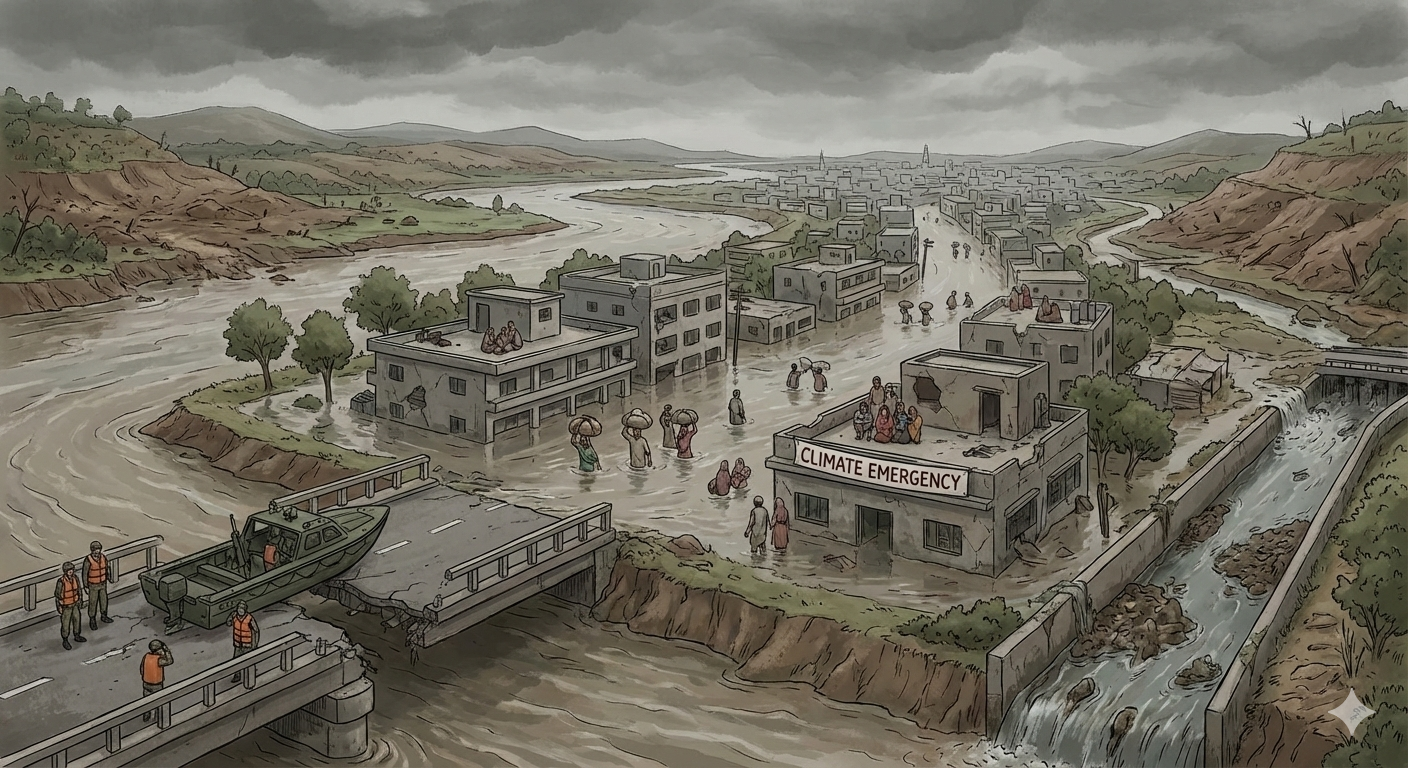
A massive flood in June 2025 caused heavy rainfall which was the reason of pluvial and flash floods, landslides and GLOF. The areas affected include KP, GB, AJK, and some regions of P. Balochistan. By the close of September, Western Non-Governmental Organizations estimated that around 1000 people died, more than 1000 people injured, million people affected and 28-29 lakh people displaced. It also damaged and destroyed almost 9000 houses and washed hundreds of bridge and hundreds of km roads away. Experts state that 2.5 million acres of farmland in Punjab alone have been damaged. This will cause impact on livelihood and food security for a long time to come.
Climate change and extreme weather dynamics
According to meteorological accounts, monsoon rainfall in 2025 was 50-60% excess over the seasonal average in some places. Normally, monsoon cycles have relatively dry periods between the active phases. However, in 2025, the active phases were continuous cloudbursts and heavy rainfall happening over long periods of time. Flooding of rivers, urban drainage and rural landscapes was reported from various parts due to this. Researchers and expert commentary attribute the unusual force to climate change, with background temperature creating more moisture in the air, according to studies. Unusual weather patterns in the Himalaya–Hindu Kush enable unprecedented rain. To add on, glacial melt is also accelerating which is feeding already swollen rivers. An attribution analysis conducted in 2025 determined that climate change likely worsened the monsoon season heavy rainfall over northern Pakistan and increased the risks of urban flooding as well as flash floods, which are now more likely than under a pre‑industrial climate.
Natural forces and human‑made vulnerabilities
The situation in the north was they were prone to flash floods and landslides; this was because of the natural drivers. These included steep topography, rapidly melting glaciers, and other common cloudburst events. Orographic lift and unstable slopes were also significant contributors aside from these two conditions. Yet, the serious nature of the impacts reflected human-induced vulnerabilities including uncontrolled urban expansion and encroachment of river banks, deforestation in the catchments, and placing buildings directly in flood paths which multiplied exposure to hazard. The construction of cities and rural riverine communities along the waterways was poorly regulated or illegal. The sizes of drains were too small and land-use zoning was not enforced. As heavy rains arrived, cities and rural riverine communities had a structural propensity to catastrophic flood inundation. Flooding of Cities and Rural Riverine Communities
Disaster readiness and early warning gaps
Formally, Pakistan began the year 2025 with the updated National Disaster Management Plan and Monsoon contingency planning, focusing on early warning, communication, and response. NDMA, PDMAs, and line departments coordinated. The humanitarian assessments carried out during the floods demonstrate the continuing weaknesses of the “last mile” of early warning. While national and provincial agencies were sending out advance warnings based upon the meteorological forecast, many of the vulnerable communities reported getting either late warnings, or messages not in their local language, or warnings not backed up by any evacuation guidance and support. International and regional disaster networks say Pakistan is yet to establish early warning or early action systems that are truly inclusive, specifically women, children, persons with disabilities, remote mountain communities, and riverine communities poorly served by digital and mass‐media channels.
Coordination between federal, provincial, and local levels
The institutional system places NDMA at top, PDMAs in lead in provincial response and district administration responsible for local implementation. The event process 2025 however, once again highlighted friction across the. Evacuations did take place on a very large scale, allowing the humanitarian community to report that over 2.8 million individuals were evacuated across the provinces. Many of these operations were supported by the military and provincial authorities. However, coordination quality varied by province. Furthermore, the deployment of resources was delayed and mandate overlaps were noted. Overall, there was inconsistent information sharing between federate, provincial and district actors. UNESCO and partners initiated reviews that were aimed at analyzing the entire early warning chain “from hazard monitoring and forecasting to warning dissemination and last‑mile response”, clearly recognizing that institutional fragmentation and uneven local capacities hindered timely and technical forecasts otherwise.
Performance of early warning and evacuation systems
According to evidence from NDMA and humanitarian partners, various warning messages were technically issued ahead of peak floods; however, their effectiveness was constrained through communication channels, trust and capacity for organised evacuation. The IFRC and ReliefWeb documents indicate that while over one million people were evacuated from high-risk areas by late August, a large proportion of fatalities still occurred in flash-flood-prone valleys and landslide areas where cloudbursts gave barely any lead time and evacuation logistics were weakest. Many poor households, especially in informal settlements or remote rural areas, were unable to evacuate due to a lack of transport, fear of looting, gender norms restricting women’s mobility, and a lack of safe and dignified shelters. Hence alerts which were sent often had little value for communities.
Domestic policy responses and international diplomacy
The floods in 2025 were described an outcome of Climate Change-Crisis. This back up Pakistan’s position regarding being a country on the ‘ground zero’ in the context of loss and damage due to climate impacts. Moreover, despite not making a significant contribution to global emissions, Pakistan is making the damage impacts. Humanitarian appeals and operational strategies reaffirmed a commitment to the National Disaster Management Plan 2025, while also calling for a transformative investment agenda in areas such as disaster risk reduction, climate‑resilient infrastructure, nature‑based flood management, and inclusive early warning systems as has Pakistan throughout climate finance negotiations for adaptation and loss‑and‑damage. Experts and international organizations expressed the need for regional discussion on transboundary water and glacier risk management in the context of the Indus basin and cross-border watershed management. However, mechanisms for such cooperation are limited and politically constrained. As such, Pakistan is heavily dependent on domestic coping and humanitarian assistance rather than upstream governance.
Lessons for adaptation policy and disaster governance
The floods during the monsoon season of 2025 have shown how fast and furious climate hazards are able to bump into the slow pace of institutional reform. Both NDMA’s review after the monsoons and external NGOs believe that Pakistan must delve into land use regulation, watershed and forest management, urban planning, and social protection. Along with this, investment must also be done in people-centred, gender-responsive early warnings regarding disasters in order to close the gap between forecast and reality. In this context, Pakistan’s experience of 2025 is just one example of the larger climate-vulnerable countries’ challenges. That is, even with better hazard monitoring and forecasting, the systematic inequalities, under-resourced local governments, poorly integrated multi-level governance, and climate finance deficits means that every new ‘unprecedented’ flood becomes not only a climate story but a governance story. They require better forecasts as well as a rethink of how states anticipate, communicate and share the burdens of climate risk.




 Reston Dennis Juah
 Noor Ul Ain
 Hassan Barrie
 Hoby Nasandratra Andriamiandrisoa
188betthethao is my go-to for sports betting. Best odds around. Check it now here: 188betthethao
Alright, checked out iwinfortune. Pretty decent spot for some online action, you know? The games are solid, and I didn’t have any major problems navigating the site. Could use a bit more of a modern look, but hey, functionality is key, right? Good overall experience. Check them out at iwinfortune.
Was hesitant to try loab52.com at first, but glad I did. The community is active, and the games are fun. A good place to waste a bit of time I’ll be honest. Have a look right here loab52.
Jiliasia888 and their slots. Anyone else find them addictive? My current go-to spot. You might like it too! jiliasia888.
Yo gamers, peraplaygaming is killin’ it with the variety of games. Something for everyone, whether you’re into slots or something more strategic. Check ’em out! peraplaygaming
Ninonggaming is the real deal, folks! Been using it for a while now and the payouts are legit. Plus, the games are actually fun. Give it a shot! Find more information here: ninonggaming