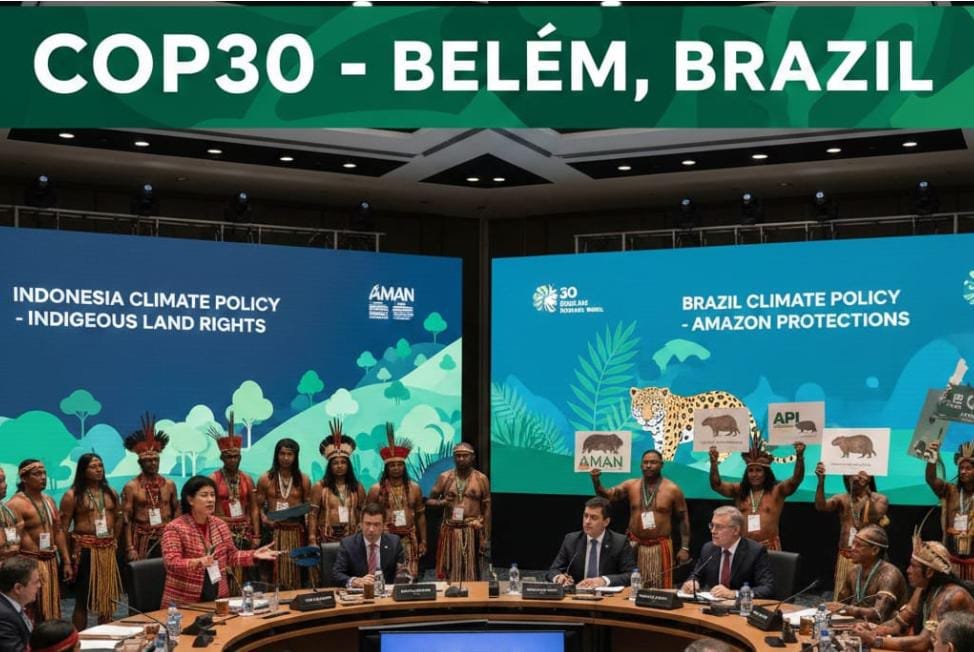

From November 10th to 21st, 2025, the world’s eyes turned to Belém, Brazil, for the 30th United Nations Climate Change Conference (COP30). All the leaders from across the level – local, national, and international – gathered with a clear, urgent mission, to turn the promises of the Paris Agreement into faster, real-world action to protect our planet from the adverse impact of climate change. The climate summit has four major priorities: pushing for more ambitious climate actions, securing adequate funds for mitigation and adaptation, securing forests and wildlife, and discussing energy shifting, which has the ultimate goal of swapping fossil fuels. While the leaders gathered to discuss protecting the planet’s long-term sustainability, the very essential element for the climate policy – the local community or indigenous people, which is most integrated with the land – was protesting at the gates.
Bound by Borders, Linked by Loss: Brazil’s Indigenous People and Local Community in Indonesia
A notable highlight during COP30 is the involvement of stakeholders in addressing climate change, which is largely driven by protests from the indigenous group inhabiting the Amazon rainforest, the Munduruku Tribe. The protests primarily focused on the excessive exploitation of the indigenous land and forest for business and government interests, and sustained deprivation of legal recognition and protection of the indigenous rights. The large-scale exploitation through deforestation has been conducted by the Brazilian Government to support the agribusiness project. Moreover, the indigenous interests are perceived to be disregarded by the government, since the government has projected the development of a 1.000 km railway that will cut through the Amazon Rainforest. Thus, the government’s willingness to protect nature and the people who live in it is questionable; for instance, there is no forceful law enforcement against illegal miners and illegal logging operations in the Amazon areas. The indigenous people believe that the government does not take their voices and interests into account in formulating and determining climate policies, which threatened the survival of the indigenous people
They are fundamentally dependent on natural resources; for example, the community relies on the forest and river for subsistence – hunting, fishing, and cultivating crops – for their food. In other words, nature serves as their sole source of livelihood which pointing out the necessity of preservation. Conversely, the government abuse its authority in order to maximize economic benefit by doing land-grabbing, demonstrates no willingness to provide potent protection for indigenous people from the impact of climate change.
The same phenomenon happened in Indonesia, the government introduced the National Strategic Project (PSN) as the crucial projects to be implemented. For instance, the Food Estate (FE) Project, which is framed as an essential project in addressing systemic challenges in national food security. This project is frequently leading to extreme deforestation and marginalization of indigenous people, which disregard the nation’s commitment to mitigate and adapt to climate change impact. Furthermore, FE project does not take into consideration the degradation of quality and capacity of the crucial production factors, such as water, land, which are more potentially influenced by the climate crisis. The program is planned for some regions in Indonesia, South Sumatra, Central Kalimantan, and South Papua. Furthermore, the initiative is slated for extensive implementation across various regions reflecting a broader strategic rollout.
In Merauke, FE requires approximately two million hectares of land for new rice paddies, sugarcane plantations, and bioethanol production. To underscore the urgency for this program, an increasing number of military personnel has deployed the government in order to protect the implementation of the FE program. But this policies leads to considerable apprehension and fear among the local indigenous community, which presents a high potential for human rights violations against local communities through land grabbing and the destruction of their livelihood ecosystem. Moreover, the program also resulted in the destruction of historical sites and traditional/customary lands. Another relevant example of the impact of the FE Program is located in Central Kalimantan, where a vast deforestation for agriculture has resulted in a significant increase in GHG emissions. The carbon dioxide (CO2) stored in the trees is released during deforestation. Furthermore, the elevated emissions are potentially amplified by the drainage or burning of peatlands, which produces a significant amount of CO2 and methane.
Both Brazil and Indonesia are developing countries that pursue their rapid economic growth at the cost of environmental and ecological sustainability. Historically, both nations have prioritized large-scale industrial expansion and natural resources extraction. For instance, the FE program in Indonesia, and excessive business expansion in Amazon areas which has led to wide and systemic deforestation and the degradation of critical carbon sinks. The countries not only sacrifice their natural resources and their local people for short-term GDP growth, but also trigger adverse climate change impacts.
Shifting Ownership from Global Experts to Local Stakeholders
In Carlos’s writing, entitled Understanding farmers’ perceptions and adaptation to climate change: the case of Rio das Contas basin, Brazil, the phenomenon that occurred in the Amazon areas and some regions in Indonesia not only put the indigenous people or local community as an objective state, but also a socially constructed reality. The local beliefs and perceptions are the essential drivers for successful climate adaptation. When the government ignores the voices that come from the ground, the government will fail to address the psychological prerequisites – mental “must-haves” – for adaptation and mitigation, since the socioeconomic factors are frequently overshadowed by the local beliefs. Furthermore, the exclusion of local insights tends to poorly targeted public policies, which fail to prevent the potential risks faced by the local communities.
Carlos’s perspective is strengthened by the critique of top-down policymaking from Allegretti’s writing, entitled Making Policy: Recrafting Ethnographic Research for Participation. All the stakeholders who come from the national and international levels put themselves as the ones who are experts in making climate policies, and reducing the role of local people in the policymaking process. The governments perceive that the local communities have their limits – knowledge, technologies, and capital – and need assistance from the government in order to address the climate change impacts. In stark contrast to indigenous group perceptions regarding the measures taken by the government to mitigate and adapt to the impact of climate change. They perceive that governments only take the economic benefit into consideration, rather than the public interest, for implementing climate policies. For instance, the carbon market mechanism is generally perceived as a form of land grabbing and human rights violation, which is exercised by the state in order to maintain economic benefit. This method entirely disregards severe ecosystem damage, which carries profound, potentially lethal consequences for indigenous livelihoods. Thus, the measures that are taken by the governments are not genuine climate actions for protecting everyone from the catastrophic impact of climate change. To conclude, for ensuring that policies are for everyone’s interest – regardless of majority or minority groups – there are key components that are required: shifting in political will that values nature over business interest, strong political willingness to involve all stakeholders who come from local to international level, and collaboration between central and regional governments. The components are crucial for preventing the disaster that caused by the climate change.





 Reston Dennis Juah
 Noor Ul Ain
 Hassan Barrie
 Hoby Nasandratra Andriamiandrisoa
Okay, cc7casino, don’t let me down! Initial impressions are decent. Here goes nothing. See what you think: cc7casino
Gave the 43betapp a spin. It’s alright. Seems to have a decent selection of options and the odds are fair. Could use a bit of a design refresh but it works. Check it out for yourself: 43betapp.
Tried bet722 last night. The signup was quick and easy. The site itself is pretty straightforward. Nothing fancy, but it gets the job done. Give it a look at bet722.