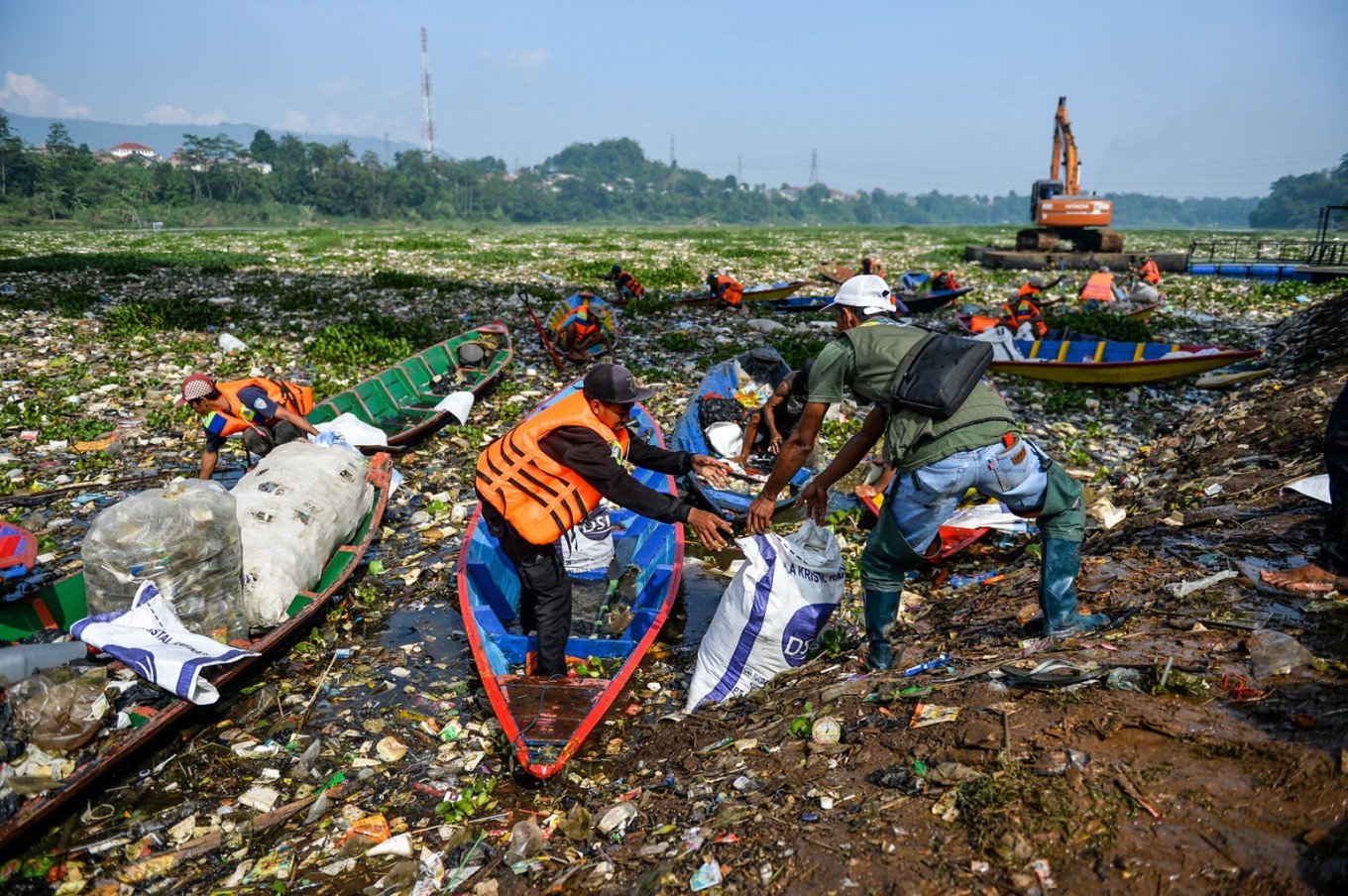

This year, Bandung, the provincial capital of West Java, is mobilizing communities, civil society and institutions in a collective effort to implement lasting solutions to one of our most pressing challenges: Plastic and urban waste pollution.
Aligned with the global #BeatPlasticPollution campaign for World Environment Day 2025, the city aims not only to reduce our environmental footprint but also to redefine how cities like Bandung can lead in circular economy practices.
Yet, the reality remains stark. Bandung still faces a serious waste crisis. Our city produces approximately 1,700 tonnes of waste per day. Of this, only about 1,000 tonnes can be transported to the Sarimukti Final Disposal Site (TPA) in neighboring West Bandung regency. The remaining 700 tonnes overwhelm our neighborhoods, public spaces and waterways.
Some of this uncollected waste is handled through commendable local initiatives such as waste banks, community-run maggot composting and the operation of integrated temporary waste management sites. However, the gap between waste production and disposal capacity persists. As of February 2025, there were 136 waste accumulation points throughout the city, with over 400 tonnes of garbage left unattended, some eventually flowing into our rivers.
Bandung’s rivers, including tributaries of the Citarum River, are now choked with waste. Piles of garbage have blocked waterways in Dayeuhkolot, Bojongsoang and even around the Saguling Reservoir. In some areas, the garbage is so dense it can be walked across. These sights are not just environmental concerns; they undermine Bandung’s identity as a historic, cultural and tourist destination.
This waste problem is not new. In 2023, a fire at the Sarimukti landfill rendered the site temporarily unusable, leaving tonnes of waste uncollected. In 2024 and 2025, limited waste quotas at Sarimukti again triggered logistical bottlenecks, forcing Bandung to divert waste to temporary landfills like Pasir Bajing in the neighboring city of Garut. Our dependency on Sarimukti is unsustainable and exposes our vulnerabilities.
But we are not standing still.
We are expanding the city’s network of waste collection sites. Currently, four temporary sites, Nyengseret, Tegalega, Babakan Siliwangi and Batununggal, are operational. Cicukang Holis will soon commence operations, followed by Gedebage. By early 2026, six fully functioning sites will collectively process up to 500 tonnes of waste per day, significantly easing our burden on landfills.
Furthermore, we are collaborating with the Citarum River Basin Center to operate waste-processing machines (MOTAH) and strengthening our partnership with more than 700 community waste banks. Our maggot composting program now spans 49 subdistricts, with each maggot house capable of processing up to 1 tonne of organic waste per day. We aim to extend this program to all 151 sub-districts.
Earlier this year, we also introduced “Pacman” trucks, specialized compactor vehicles with a capacity of 6 cubic meters (approximately 3 tonnes). These are designed to minimize odor and leachate, making them more environmentally friendly.
Yet, we know infrastructure alone is not enough.
A fundamental challenge lies in the disparity of waste awareness and behavior. In urban areas, we have access to advanced technologies for chemical and toxic waste, but struggle with managing the sheer volume and complexity of organic waste. Meanwhile, residents in rural areas tend to be more adept at processing organic waste through natural decomposition but often lack the tools and knowledge to deal with plastics and hazardous materials. Addressing this urban-rural divide requires targeted solutions.
For instance, biodigesters should be prioritized in urban settings where organic waste volume is high and community space is limited. In rural areas, the focus must be on education and small-scale infrastructure to manage plastics and promote safe disposal of non-organic waste. The principle is clear: localized, context-sensitive solutions are the key.
We are also investing in people. At the end of May, we relaunched Bandung’s flagship waste reduction programs, “Kang Pisman” (reduce, separate, process) and “Buruan Sae” (community farming), using a peer-to-peer learning approach. Successful community units (RW) will mentor others, building a grassroots movement of self-reliant waste managers.
This approach supports the global call for systemic change. According to the United Nations Environment Programme (UNEP), the world is on track to consume 516 million tonnes of plastics in 2025. Already, an estimated 11 million tonnes of plastic leak into aquatic ecosystems each year, and another 13 million tonnes accumulate in soil. Plastics have alarmingly been found in our bodies, in lungs, arteries, breast milk and even brain tissue.
Recycling alone cannot solve this problem. Globally, only 9 percent of plastics are recycled. UNEP estimates that just 21 percent are economically recyclable, meaning the market value of the recovered material covers the costs of collecting, sorting and processing. This underscores the need to move beyond end-of-pipe solutions to a true circular economy.
A circular plastics economy could reduce ocean plastic pollution by over 80 percent, cut greenhouse gas emissions and save governments US$70 billion between 2021 and 2040.
Bandung aspires to be part of this global shift. As the world prepares for the fifth session of the Intergovernmental Negotiating Committee on Plastic Pollution (INC-5.2) in August, we stand at a critical crossroads. A binding global treaty on plastic pollution is within reach, one that could reshape our relationship with plastics and secure a healthier future.
But such global change must begin locally.
The waste crisis in Bandung, like that in many growing cities, is a complex issue rooted in infrastructure gaps, behavioral norms and policy inertia. It requires both top-down leadership and bottom-up engagement. We must tackle this from every angle: reducing consumption, enabling separation at the source, expanding local processing and educating every citizen.
Bandung was once praised for its beautiful urban design, charm and livability. The city is dubbed “Kota Kembang,” which literally means city of flowers, or the Paris of Java during the Dutch colonial era. To preserve that legacy and live up to this expectation, we must evolve, toward a cleaner, circular and more sustainable future.
This is not just an environmental mission; it is a cultural and civic duty. It is about reclaiming our rivers, revitalizing our markets and restoring pride in the places we call home.
During the independence war, Bandung was dubbed “a sea of fire” due to its fighting spirit. As we commemorate World Environment Day today, let us hope the city is not remembered as a sea of garbage, but as a beacon of transformation.

 Reston Dennis Juah
 Noor Ul Ain
 Hassan Barrie
 Hoby Nasandratra Andriamiandrisoa
Playb52club is where the real action is at! I love the variety of games and the rewards are seriously awesome. If you’re looking for a fun and thrilling online gaming experience, this is it. Don’t miss out! More details : playb52club
GGwinapp is alright, alright, alright! Decent selection of games, and haven’t had any issues with deposits or withdrawals. Give it a go: ggwinapp
Alright, folks, let’s talk TP88Casino. I gave it a whirl and honestly, it’s not bad! The games are pretty slick and I had a decent time. Check it out and see what you think! tp88casino
Tính năng “mua vòng quay thưởng” (Buy Bonus) trên nhiều slot tại slot365 apk cho phép bạn bỏ qua phần base game và đi thẳng vào vòng free spin – tiết kiệm thời gian và tăng cơ hội nổ hũ. TONY05-01