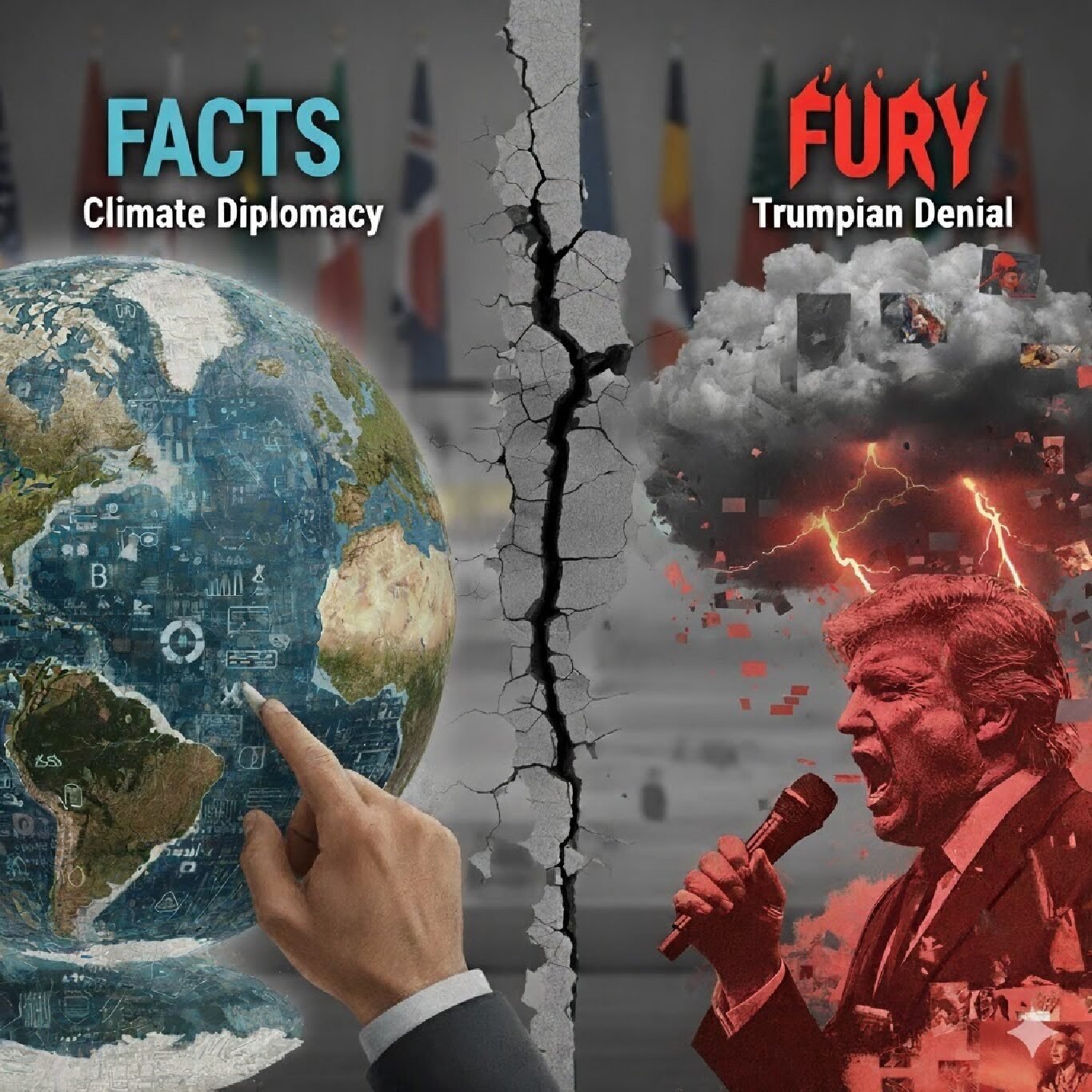

In the marbled grandeur of the United Nations General Assembly Hall during the General Debate on 23 September 2025 under the theme: Better Together: 80 years and more for peace, development and human rights”, a story unfolded that was profoundly very shocking to those who heard it, and revealed fault-lines in global climate diplomacy too. On one side of the lectern, the U.S. president Donald Trump denied climate change saying it is “the greatest con job ever perpetrated on the world, in my opinion.” On the other side, the representatives of countries that were already experiencing the consequences of floods, droughts and rising seas sat in silence, their delegates’ speeches very heavy and strongly filled with a lot of human loss that they faced and also their resilience. One of them, a representative from the small island-state of Palau, explained it in the most direct way that can be applied to the issue, “Not acting on climate change will be a betrayal of the most vulnerable.”
This collision of the two accounts of denial and destruction was more than dramatic theatre. It has revealed a burning question of our time: so what happens to world co-operation when one of the greatest powers simply chooses to make a statement and declare the very foundation of that co-operation a fraud? This moment reflects the acute conflict which exists in our time: in reality and revenge, in science and the lies, in the necessity to act and the desire to do nothing. Climate change is no longer a niche subject in the past decade; it has now become a strategic subject that has left entirely the fringes of the environmental conferences to the centre of the foreign policy. Science does not meet with any serious forums any longer since it is the cost of doing nothing that towers big. In 2024, global temperatures reached approximately 1.55 °C above pre-industrial levels, which is quite a very dangerous threshold that establishes a new baseline for danger and a decade of highly unprecedented heat as well as relentless ocean warming. Such a change is not only meteorological, it is economic, geopolitical, and, most importantly, diplomatic. Rise in the sea level displaces settlements, heat waves scramble the labour markets, and compound risks have insurance markets reeling.
As such, Diplomacy can no longer meaningfully ignore climate. It must integrate it. And as expected it has responded, awkwardly but unmistakably. COP28 operationalized a Loss and Damage fund, with initial pledges of roughly about $700 – 770 million, which is good and very critical as well, but it is also a kind of symbolic progress, as it is very below what is needed by Low-Income Development Countries (LDCs). The COP29 was followed by a new collective finance goal, of $300 billion per year by 2035 (with an overarching target of 1.3 trillion) that its proponents refer to as an insurance policy on humanity) but criticized by many developing countries as inadequate and over-reliant on private capital. It is against that background that the UN system now orients towards the COP30 in Belém, deep in the Brazilian Amazon (a place that is very critical for the survival of the planet) as a symbol and stage for the next round of trust-building. However, when a major actor, in fact, one of the largest historical emitters, openly denies the science and works to describe it as a fraud, the solidarity that underpins diplomacy cracks.
As power still matters, when the U.S. president addresses global audiences on global platforms to deride climate action and scoff at renewable-energy transitions, the ripples will definitely be very profound . It changes the agenda-setting, encourages skeptics and makes the language of consensus. But at the same time, the world is no longer at the mercy of a single country. An example is China, which recently declared a reduction in its greenhouse-gas emissions of 7-10 per cent by 2035, and the economics are also moving very well in the right direction as 81- 90 % of new utility-scale renewables are currently far cheaper than their fossil-fueled power counterparts, with solar PV’s levelized cost some 56% less than the fossil average and onshore wind also around 67% lower than the fossil-fired power alternatives. As such, in many regions of the world, solar and wind are already cheaper fossil fuel alternatives. Similarly reducing methane, which contributes approximately a third of the current warming is one of the most inexpensive, quickest means of cooling the curve with IEA estimating tens of megatonnes of oil, gas and coal methane could be abated at no net cost based on 2024 prices. These are not activist talking points, but instead they are very strong market signals as well as engineering realities. Unarguably, justice matters too, and perhaps more than ever. For many countries in Africa, Asia and the Pacific, climate diplomacy is not voluntary ambition, as it is completely tied to their very survival, fiscal space following disasters, the creation of infrastructure that does not implode when the rains come. Access to adaptation finance, resilience-building and rapid-disbursement mechanisms are not just optional, they are very essential. Hence in all of these, pragmatism has shown and thus remains the bridge: the numbers do not lie as resilience investments deliver returns in avoided losses.
Human aspects of these tensions on the other hand have become quite clear. In the southern state of Rio Grande do Sul, as of 2024, floods that struck the state displaced more than 150 000 people and killed more than 126, inflicted serious damage on infrastructure and it would cost billions of dollars to repair. These are not assumed costs, they are. are budget items that are cost-related, headaches of the mayor, and humanitarian strains. Meanwhile in the Horn of Africa, a five-year drought was destroying crops, leading to migration in the region, destabilization of communities and attribution. science demonstrated that it was due to warming that the incident came about at a very significant rate. In Libya, thousands of people lost their lives, as storm Daniel caused the destruction of aging dams; scientists estimated that climate change had enhanced the chances of the rain by 50 times. Even in India, the extreme heatwave of 2024 drove urban centers and also labourers as well as physical breakdown. Elsewhere on a related terrain, in Nigeria, floods in 2022, displaced more than 1.4 million individuals and killed more than 600. These examples can be seen as the human stakes of diplomacy. The point is quite obvious: climate change is not only an environmental problem, it is a geopolitical, developmental problem and human-rights issue.
And in this sense, the spectacle of a major power proclaiming the global climate business as a con game, in this case, is not only disruptive, it is threatening to destroy, erode, financial credibility and trust, treaties and perverting paths of co-operation. The most effective response is therefore not louder anger but a very clear form of demonstration that shows the economics of renewables are very real; illustrate that investing in resilience has proven strongly in preventing disasters; show also that adaptation is not charity but smart development and also show that methane cuts are low-hanging fruit. Practically speaking, there are two things that are noticeable. First, money must move faster and also fairer through concessional finance, rapid disbursement as well as debt pauses after shocks. The recent OECD confirmation affirmation of the fact that the US had surpassed the goal of over a 100 billion in climate finance in the year 2022 is a step in the right direction, however, it has to be translated into action. Then, methane reduction should be accelerated as a diplomatic fast-win. It lowers the curve, buys us more time and is less expensive than many mitigation alternatives; but it is under-leveraged.
In the meantime, adaptation must be first-line diplomacy and not something seen as an afterthought. Diplomacy must move beyond blame-games and rambling negotiation to delivery, collaboration and joint agency. Leaders in the Global South should not simply continue to be recipients of assistance; they need to be the creators of their solutions, that is, they need to be involved in governance, decision making and design of finances.
Then comes the hard-to-define yet impossible-to-do without, the reconstruction of trust. When politics permits contempt for climate science to go relatively unchecked, when multilateral institutions are treated objects of ridicule and not allowed to carry out their mandates, the cement of collective action is breaking loose at a very fast rate. In each of these, diplomacy remains a huge potential since at its finest it is about mutualizing differences, converging interests, and creating structures in which cooperation becomes not only self-interest but also solidarity. Solidarity itself alone is not enough and likewise self-interest alone is also shallow, and as a result the only success formula is delivery.
All things being considered, “Trumpian denial” may not be the loudest or even the last provocation when it comes into issues of climate diplomacy, but the age is unmistakably defined by its presence. The real challenge lies ahead; the provision of the magnitude of finance required, the reduction of the gap between pledge and performance, and also matching the speed of warming with the speed of cooperation. The world will reunite in Belém again in the heart of the Amazon as a witness, under its canopy there lies symbolism as well urgency. The task is very clear to state if yet still very daunting to achieve; match the scale of finance to the scale of risk; match the speed of implementation to the speed of change; and the most important of all, match the tone of our politics to the dignity of those on the front lines. That is how facts can help greatly in rebuilding trust, and how fury can as well give way to cooperation that lasts. That is the most appropriate response to a “Con-Job” label.




 Jonathan Tarnue Payne
 Precious Douglas Maulana
 Eslam Mohamed Elsheikh
 Lutfi Nurachma
 David R.K Brown
 Asef Jafari
Im no longer certain where you are getting your info, but great topic. I must spend a while studying more or understanding more. Thanks for excellent information I was in search of this information for my mission.
When I initially commented I clicked the “Notify me when new comments are added” checkbox and now each time a comment is added I get four e-mails with the same comment. Is there any way you can remove me from that service? Bless you!