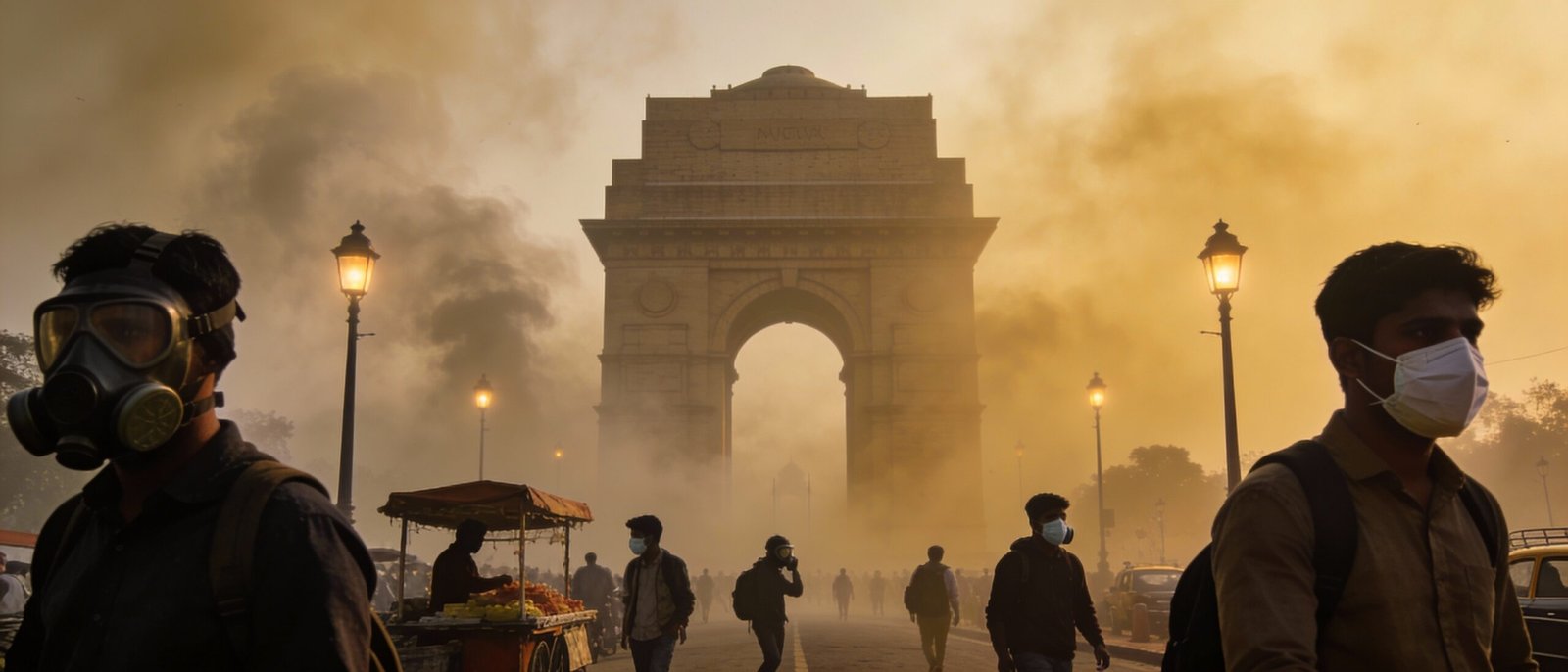

From “Severe Plus” AQI to political denial an insider’s critical look at how clean air became a luxury good in the world’s largest democracy.
The Taste of Toxicity
Have you ever tasted the air?
The moment you walk out of your house in November, it’s the first and most overpowering of all the tastes that your tongue gets deadened to. If you live in Delhi or Mumbai, or almost any big city in Northern India, you can totally relate to the above description. The taste is PM2.5 micro-particles which are not just inhaled into the lungs but also absorbed into the blood, the heart, and even the brain.
I have worked at the grassroots level in India on eco-social innovation for more than ten years and I am now studying the policy mechanisms surrounding this crisis and I can tell one thing for sure: This is not a case of divine intervention, rather; it is a case of human negligence.
We are not just reading pollution levels; we are probing a failure of the system. We are addressing the issue of the Indian population consuming the equivalent of 50 cigarettes daily, without any flames being used, and asking why our leaders are oblivious and passive to this suffocation.
The Silent Massacre: Health Beyond the Haze
We often talk about pollution as a visibility issue “I can’t see the road.” We need to start talking about it as a mortality issue “I won’t see my 60th birthday.”
The numbers not only scream out loudly but also express a nightmarish situation. Air pollution was responsible for more than 1.7 million deaths in India in 2022, as indicated by a new study of The Lancet. This is a substantial number which is even greater than the population of a lot of countries that has been erased in just one year.

But death is only the final statistic. The real tragedy is the “living death” of chronic illness.
- The Children: We are raising a generation with smaller lungs. Research conducted in Delhi registered that the youngsters there had more severe lung issues which could not be cured when compared to the ones living in cities with good air quality.
- Old People: For our old folks every winter stroll turns out to be a risk that one of them would suffer from a stroke or heart attack.
- Mind: Recent scientific studies established the connection between high PM2.5 exposure and the brain getting older and dying because of dementia. We are literally losing our minds to this toxicity.
The “Severe Plus” Reality: A Statistical Horror Story
Let us take a look at the numbers because, unlike politicians, they are always honest.
In the month of November 2024, the AQI or Air Quality Index in Delhi was record breaking at 491, and according to the WHO it is considered as “Severe Plus”. Also WHO has the record-breaking AQI in Delhi for November 2024 was recorded at 491, which is considered the highest in the world and classified as “Severe Plus”. The WHO has already stated that any rating exceeding 15 is considered unhealthy. We are living in an environment 30 times more toxic than the safety limit. Just a few weeks back, on January 1, 2026, Delhi experienced its worst air quality in years which led to the renewal of public outrage and disappointment.
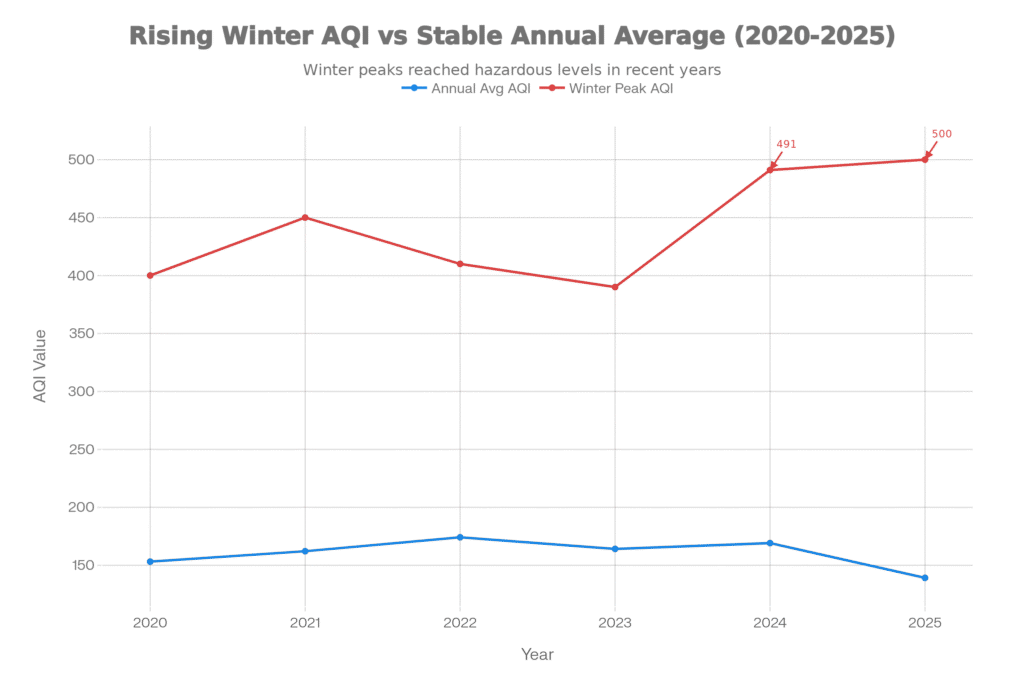
Uptrend: Delhi’s AQI Crisis (2020-2025)
The chart above exposes a critical truth: While the government claims “annual averages” are improving (a convenient cherry-picked stat), the peak toxicity during winter remains lethal. We are not breathing better; we are just suffocating differently.
The Absurd Theatre: Policy Failures and Political Denial
And the question has to be asked, why is this happening? Is it just the wind?Is it just the farmers burning stubble?
No. It is a failure of Climate Policy and governance.
1. The NCAP Failure:
India’s National Clean Air Programme (NCAP) was launched with great fanfare to reduce pollution by 20-30% by 2024. The result? Most cities have missed their targets completely. The funds meant for fighting pollution are lying unspent or diverted to cosmetic “dust control” measures like road sweeping, while the real sources transport and industry continue to spew venom.
2. The “Stubble Burning” Scapegoat:
Every year, we blame the farmers of Punjab and Haryana. Yet, we provide them with no viable economic alternative to manage crop residue. We expect a farmer earning barely enough to survive to pay for expensive machinery, while we refuse to subsidize it effectively.
3. The “Comedy” of Leadership:
Perhaps the most painful part of this crisis is the apathy of our leaders.
When Delhi was choking this season, Chief Minister Rekha Gupta’s response was not a war-room strategy but a defense of water sprinklers and downplaying of data concerns. This statement is not just foolish; it is an insult to the thousands who died last year due to pollution. A child gasping for breath in the ER doesn’t have time for political theatrics.
We see “Anti-Smog Guns” (which are essentially glorified sprinklers) being deployed for photo-ops, while the real policies capping vehicle numbers, shutting polluting power plants, and enforcing industrial norms are ignored because they are politically difficult.
The Missing Parliament: Silence in the House
If a terrorist attack happened that ended with over 1.7 million people dead, the Parliament would be in an unending session. But when the number of people who die due to air pollution gets high, our MPs prefer to be silent. The last winter sitting was marked by a situation where the air quality index exceeded 500, but the debate on air pollution that was supposed to take place was called off. Why? Because political chaos over unrelated issues took precedence. On one hand, the opposition was willing to have a dialogue, while on the other hand, the government aimed to be evasive, and ultimately the “Voice of the People” suffocated from the very air it had been unwilling to talk about. Rahul Gandhi along with the other opposition leaders demanded a full-scale debate but the discussion turned out to be only procedural with delays and fight over who was right and who was wrong.
This silence is dangerous. It sends a message that clean air is a non-issue. It tells the citizens that their lungs are collateral damage in the game of power.
The Way Ahead: From Gas Chamber to Green Horizon
I am an optimist. I have to be. I believe we can fix this, but not with “sprinklers” and “odd-even” schemes. We need a radical overhaul of our Climate Policy.
Here is a 4-point roadmap for a breathable India:
1. A “Right to Breathe” Act:
It is essential to make it legal and write down clean air as a fundamental human right. This type of move would give power to the citizens that they could sue the government for not taking action and as a result, the judiciary would have to intervene in cases where the executive was not doing its job.
2. Airshed Management (Not City Limits):
Air doesn’t respect city borders. A “Regional Airshed Authority” is needed that can supersede the powers of the various states. The states of Delhi, Punjab, Haryana, and UP cannot engage in separate battles over this issue. They must be managed as one ecological zone.
3. Hyper-Local Data & Health Advisories:
We need to treat AQI like a weather forecast. Every school and hospital should have a digital pollution board. On “Red Days,” schools should legally be mandated to close or shift online not as a reaction, but as a pre-set protocol.
4. The “Source-Point” Revolution:
We must stop blaming the wind and start capping the chimneys. Heavy industries must implement Source-Point Carbon Capture (as I argued in my previous analysis). If you pollute, you capture it. Period.
A Story We Must Rewrite
Picture a morning in Delhi where the first thing you do is lift the window and instead of a grey filter, a blue sky greets you. Imagine letting your kid go out to play football without first checking an app for air quality.
This is not a dream; it was the case a couple of decades ago and it could be our case again. However, it will take our stopping the smog from being labelled “normal” as a condition. It requires us to get angry, to demand answers, and to understand that Climate Policy is essentially Health Policy.
The air we breathe is the one thing we all share rich or poor, politician or citizen. It connects us in our vulnerability. Let’s use this as the glue that binds us in our determination.
My involvement in this sector for over a decade has allowed me to see how communities change when they realize their power to demand change. Local NGOs have made city officials close down illegal brick factories, demand improved public transport, and create air quality monitoring systems in the neighbourhoods through their advocacy. To me, such accomplishments are a proof that even though the failure of policies is a universal problem, so is the opportunity for change. But here’s the hard truth: individual action alone will not save us. We cannot “personal responsibility” our way out of a crisis manufactured by institutional negligence. We need every citizen to become a Climate Policy Advocate someone who votes based on environmental platforms, attends public hearings, files RTI requests about unspent pollution control funds, and refuses to let their elected representatives hide behind excuses.
The next generation is watching us. They will inherit the lungs we damage today and the policies we fail to pass tomorrow. We have given them more than just polluted air and unfulfilled pledges. We have given them a government that considers their right to clean air as a precious thing, which is not to be negotiated.
There is a solution to this crisis. A solution has always existed. What it doesn’t have is the political will. And the political will comes into being only when the price of doing nothing is higher than the price of change. Let’s make pollution a politically expensive issue.


 Jonathan Tarnue Payne
 Precious Douglas Maulana
 Eslam Mohamed Elsheikh
 Lutfi Nurachma
 David R.K Brown
 Asef Jafari
Today, I went to the beach with my children. I found a sea shell and gave it to my 4 year old daughter and said “You can hear the ocean if you put this to your ear.” She placed the shell to her ear and screamed. There was a hermit crab inside and it pinched her ear. She never wants to go back! LoL I know this is totally off topic but I had to tell someone!
As I web site possessor I believe the content matter here is rattling wonderful , appreciate it for your efforts. You should keep it up forever! Good Luck.