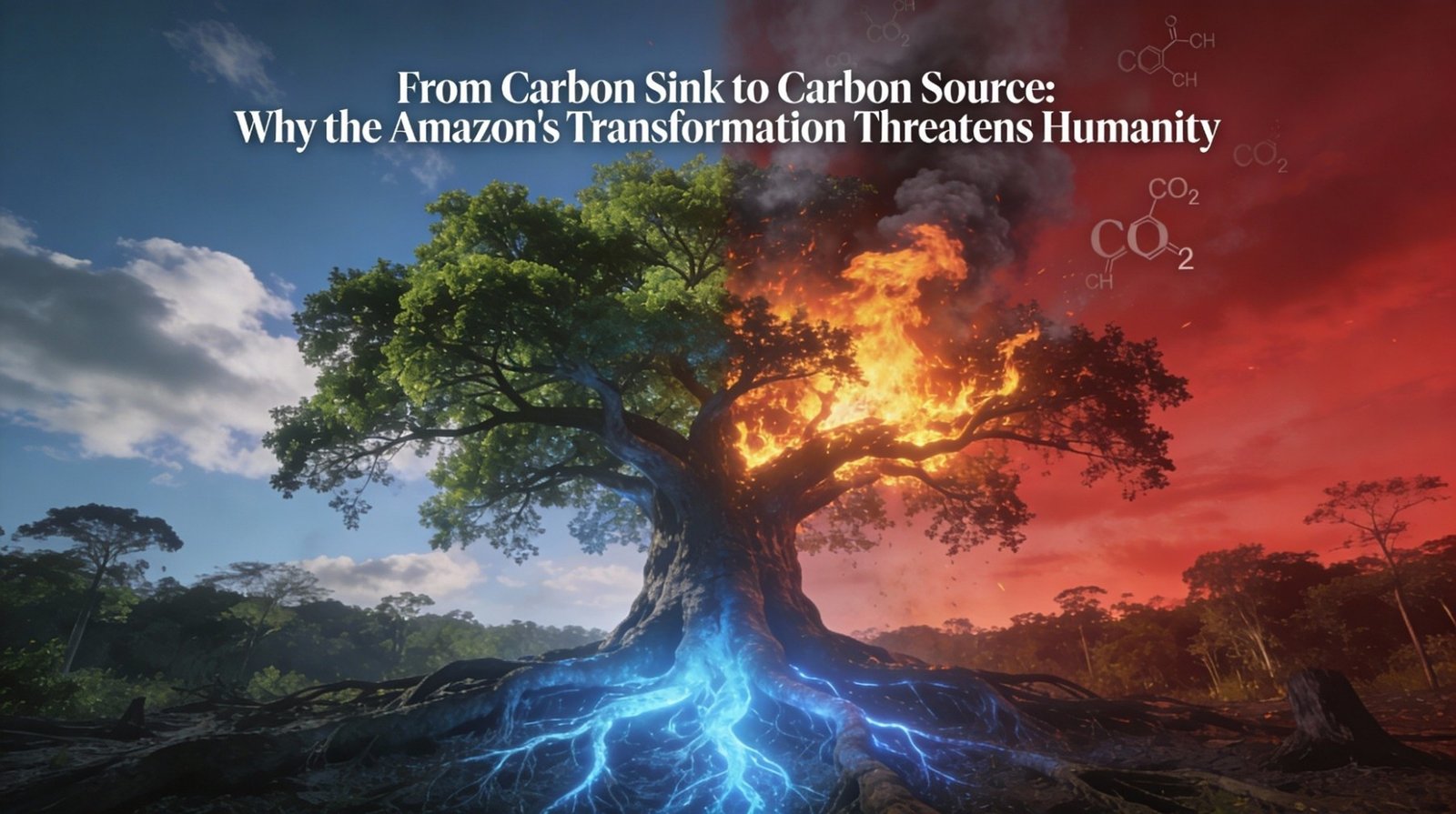

Why the Amazon Transformation is a Menace to Man.
The Amazon rainforest is popularly referred to as the lungs of the earth and has a long history of being the greatest carbon keystone to the human race. This massive eco system has been capturing billions of tonnes of carbon dioxide in the atmosphere over the decades and storing it in trees, soil and under ground root systems. However, in 2024, something disastrous took place. Amazon has, in the recent past, been turned into a net carbon emitter – releasing more CO2 than it absorbs. Average annual CO2 emissions from 2024 wildfires alone amounted to 791M tons of CO2 released, which is the equivalent amount of CO2 emitted by Germany alone in the same year, and is seven times as much as was emitted by the same region in the previous two years. Meanwhile, the southeastern Amazon is already converted into a carbon source as fires and degradation are now the order of the day. It is one of the most dangerous tipping points that humanity can have due to the transformation of climate solution to climate threat. It is important to understand why and how this is occurring in order to know more about the future of our planet.
The Amazon as a Carbon Sink: A Climate Saving Powerhouse.
In order to appreciate the seriousness of what is occurring we must comprehend what the Amazon has been doing on millions of years. The Amazon rainforest alone has an estimated 56.8 billion metric tons of aboveground carbon on its own- when including underground biomass, the figure amounts to 71.5 billion metric tons which is almost two years of global carbon dioxide emissions at the 2023 levels. This carbon is stored in the tallest trees, thick vegetation and fertile soil which typify the largest tropical rainforest in the world. The Amazon in fact increased carbon in the air by 64.7 million metric tons above ground between 2013 and 2022 proving that indeed it was a carbon sink- that is, it absorbed more CO2 than it emitted.

But local difference is a more disturbing tale. The indigenous populations have been able to control forests that cover about 61 percent of the dense Amazonian carbon zones and save the lands against deforestation and degradation. These forests that are under Indigenous Land management eliminate an equivalent of 340 million tonnes of CO2 per annum that is equivalent to the annual fossil fuel emission of the United Kingdom. However trees beyond Aboriginal land make a different story. The estimated CO2e emission of non-indigenous forest on account of forest loss and degradation is 270 million tonnes/year which is a source of carbon, not a sink- equivalent to that of the entire of France on fossil fuel emissions. This territorial separation brings into the limelight the brutal truth: the Amazonian carbon sink activity is failing to work beyond the reserves of Indigenous territories.
In The Evidence of Collapse: 2024’s Catastrophic Turning Point, we find the reference to it.
The statistics of 2024 are bleak depictions of a rapid change. Fire degradation became the largest contributor to Amazon carbon emissions in record by far exceeding deforestation, indicating a breakdown of the basic forest resilience. The fires burnt 3.3 million hectares of forest, and the effects of the fires were devastating in various countries. The year was the worst in Brazil as 1.9 million hectares were burned the highest amount recorded in the history compared to the 2.5 million hectares that were burned during the prior year. Bolivia set its fire records by burning 779,960 hectares, almost three times the record. Annual fire records are also set concurrently in Peru, Guyana, Suriname, and Colombia.
The carbon Emission of 2024 (fire and deforestation) stood at 1,416 million metric tons of CO2, which is higher than the yearly carbon emission of Japan. This is the start of the worst thing that scientists dread, which is a shift in carbon sink into carbon source. This transition is now fully achieved in the southeastern Amazon which encompasses large portions of Brazil and Bolivia. This region was at once a carbon consuming giant; it is to-day a net carbon emitter. It is not by chance that the process of this change occurs; the root cause of this change can be traced to the systematic loss brought about through deforestation, logging, fire and drought stress, a cascade of upheavals which the forest is currently struggling to cope with.
The Broken Rainfall Machine: The Amazon Makes its own Rain.
To see the reasons behind the Amazon collapse, it is necessary to understand one of the most important ecological processes, namely the transpiration-rainfall feedback loop. The Amazon does not merely absorb carbon but it also creates its own climatic conditions in order to survive. The trees in the forest take in water by their root system and excrete it by sprouts in a process known as transpiration. This vapor into the air causes precipitation which is later condensed into rain. Amazingly, about 20 percent of the annual rainfall received at the Amazon is a result of the recycling of moisture produced in this forest.
This mechanism is highly crucial during dry season. In the Amazon, dry-season rainfall up to 70% is caused by transpiration of trees and not liquid inflow brought by the Atlantic Ocean. The forest has developed a very impressive way of adapting, in times of dry seasons, trees will tap the water of shallow layers of soil, which has fallen recently, and it is not wasted on unproductive soil, but it is recycled to come back to the atmosphere, and create new rainfall just when it is most needed by the forest. This forms a self-sustainable hydrological cycle that is critical to the existence of the Amazon.
However, with deforestation, less vegetation can be used to release moisture into the atmosphere by means of transpiration. It has been shown that the deforestation of trees due to the Amazon will result in a 13% reduction in atmospheric water vapor, although this will result in a 55-70 percent reduction in annual precipitation, which is relatively disproportionate. Such a nonlinear relationship implies that the loss of forests has disastrous cascading impacts on rainfall. The forest becomes unable to control its water level, causing a vicious cycle starting with less rainfall, weaker forest, less transpiration, thus, less rainfall. The consequence is gradual drying which predisposes the forest to further fires, the forests that seemed too wet to be fired are now shriveled tinder-dried.
Synergistic Disturbances and the Acceleration of the Collapse.
Fire, deforestation, degradation, and drought do not work alone, they tend to enhance each other, a phenomenon known as synergistic effects by scientists. Deforestation disintegrates the forest leading to the inability to transpire enough moisture to produce rainfall. This tendency towards drying predisposes the leftover forests by increasing their flammability. As fires destroy degraded forest, they produce enormous amounts of carbon and annihilate the capacity of the forest to grow and re-absorb carbon dioxide. Also, climate change has increased temperatures in the southern and central Amazon by 2degC higher than in 1980s during dry seasons, placing physiological stress on the trees, which has reduced their photosynthetic rates and increased their respiration rates essentially, becoming more carbon emitting and less carbon capturing.
The very process of storage of a carbon by the forest is impaired. It would require 30 + years to restore the carbon storage potential of degraded forests after the forest is damaged, and new fires are common before this restoration process is finished. In the southern eastern Amazon where the deforestation is already over 17-20% and fires have become the order of the day, the two and more disturbances have already set the forest on the other side of the recovery threshold. The degradation of forests in isolation will become the source of 5 times as much carbon release than deforestation in certain areas since the trees which are dying due to stress and fires will directly produce the carbon that is stored but will not be compensated by the regeneration.
The Tipping Point: Baripping to Irreversibility.
According to scientists, in case Amazon deforestation exceeds 20-25 percent there is a threat that the forest will pass irreversible changes to a savanna-like ecosystem. The Amazon is already having 18-20 percent of the initial forest cover and more 6-17 percent in the advanced degradation. The difference between the state of affairs and the collapse of the system is very thin.
In case of passing the tipping point, the outcome would be disastrous to the global climate system. The Amazon holds 650 billion tonnes of carbon dioxide; in case this forest was changed to a savanna, and released a large portion of this carbon, the effect would be much greater than all the other attempts to cut carbon emissions. It was estimated that 90 billion tonnes of CO2 will be discharged- which is about 2.5 times of the yearly world fossil fuel emissions- the conservative estimates. There are even more drastic scenarios which project 200-250 billion tonnes of release by 2100. This release would cause strong positive feedback loops that would cause global warming to increase faster than it could be stopped.
The chronology is horrifyingly condensed. It has already increased Amazon by 30 times a region susceptible to fire compared to decades earlier because of climate change. According to modeling, half of the territory of the Amazon will be under the threat of compound disruptions by 2050. The situation is developing even at a quicker pace than scientific projections indicated that the tipping point could come even before 2050 as the estimation suggested earlier.
The Way Ahead: Aboriginal Forests Our Final Hope.
The data has one ray of hope. The forests that are under the control of the indigenous people continue to be very effective carbon sinks as they have very low rates of deforestation and degradation. The conservation priority is not necessarily to support the Indigenous land rights, extended networks of the protected areas, and lower the deforestation in the non-Indigenous lands but a climate imperative. The Amazon is already near breaking its neck. It simply comes down to the question of whether humanity can stop the world transformation of the most vital ecosystem within the next few essential years or not.




 Jonathan Tarnue Payne
 Precious Douglas Maulana
 Eslam Mohamed Elsheikh
 Lutfi Nurachma
 David R.K Brown
  Asef Jafari
Hey mate, looking for 7m.cn ma cao odds? This is the place. Been using it for years and never had an issue. Good luck with your bets! Get started at 7m.cn ma cao.
Okay, so I stumbled upon jljl77ph the other day, and honestly? Not bad! It’s got a good vibe, and I actually won a bit (don’t tell my wife!). Definitely worth checking out if you’re looking for something new.
Jljl3login- alright, got my login sorted easy enough. Now onto the fun part- lets see what this place has to offer! Gonna explore all day haha. jljl3login