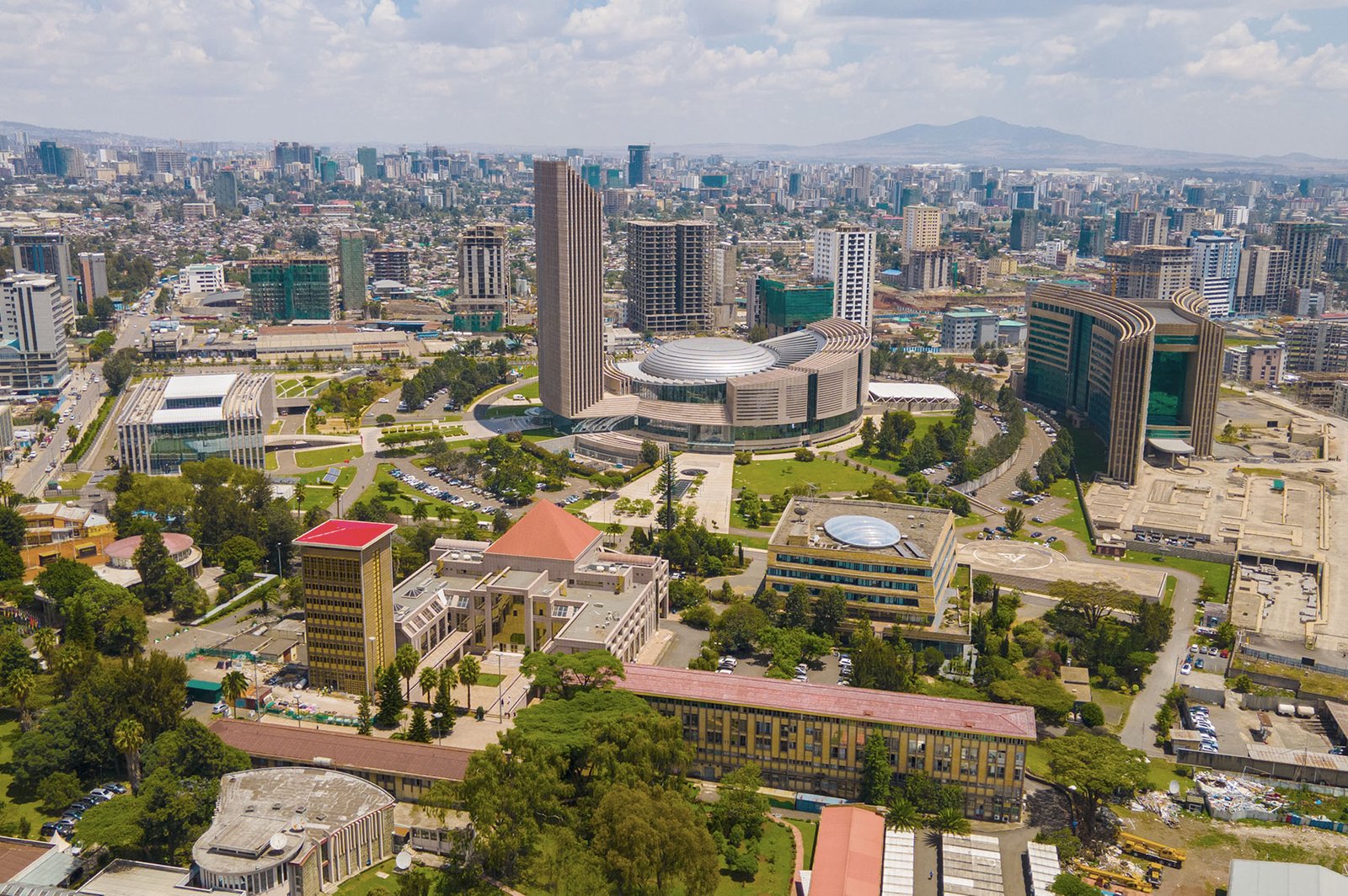

Ethiopia boasts of being the climate leader of Africa. However, a more detailed examination of its flagship strategy of Climate-Resilient Green Economy suggests a different story, of aspiration and non-realization. One of the most ambitious climate plans in Africa on the state level is the Climate- Resilient Green Economy plan that was initiated in 2011. The plan was to make Ethiopia a carbon-neutral, middle-income economy by the year 2030.
The strategy placed Ethiopia at the centre of climate policy making, coordination and financing of the energy, agriculture, forestry and industry. However, the CRGE with its visionary organization and initial momentum has proved extremely ineffective in practice. Despite its effectiveness in planning and agenda-setting, Ethiopia has remained dependent on external financing, lack of subnational capacity and low levels of inclusiveness. As such, its CRGE has failed to accomplish its transformative goals.
CRGE was created in the context of the developmental state of the country, headed by Prime Minister Meles Zenawi. He tried to balance the economic modernization and the environmental sustainability. The policy was institutionalized by the government with the help of CRGE Facility of the Ministry of Finance and integrated into the Growth and Transformation Plans (GTP I and II). These measures showed early effectiveness of states in policy making and coordination. Nevertheless, design strength does not ensure the success of the implementation. The CRGE has been enacted in a haphazard and disjointed way, which is indicative of the constraints of such a highly centralized governance model to operationalize national objectives on local levels.
The greatest hindrance towards successful implementation of CRGE is the issue of financing. The Ministry of Finance (2020) estimated that domestic resources comprised less than 20% of the estimated USD 150 billion of the total costs of the implementation of the CRGE. This was prone to evolving global agenda since it largely depended on bilateral donors and international climate funds. This has seen the stalling of numerous initiatives especially community level adaptation actions. This reliance on external subsidies supports the fact that the country of Ethiopia had a budgetary insecurity and restricted the sustainability of the climate programs. The fact that the state is unable to locate funding in the domestic sphere means nothing other than that it is unable to translate the strategic vision into the visible, long-term results.
Implementation has been further hampered by subnational institutional flaws. Regional administrations frequently lacked the technical knowledge, human resources, and monitoring systems needed to conduct CRGE initiatives, despite the central government’s coordination. For instance, despite Ethiopia’s Green Legacy Initiative achieving record tree-planting campaigns, poor local follow-up and monitoring procedures have resulted in a low seedling survival rate . The state’s limited administrative reach is reflected in this gap between national goals and local execution. Multi-level governance is necessary for effective climate policy implementation, but Ethiopia’s centralized model has limited regional learning, adaptability, and flexibility.
The ineffectiveness of the state is also pointed out by social and environmental trade-offs. Although increasing the renewable energy capacity, large hydropower projects have created displacement, ecological disturbance, and tensions in the region. A flagship project of the CRGE, the Grand Ethiopian Renaissance Dam (GERD), has led to the resettlement of people and diplomatic conflicts with the downstream state. These results demonstrate that the developmental priorities of the state tend to prevail over the environmental justice principles and participatory governance. The Ethiopian government did not focus on social inclusivity and long-term environmental balance as a priority of a sound climate policy by prioritizing technical efficiency and speedy output.
Although the CRGE increased the Ethiopia’s popularity on the global scene, it has failed to generate much visible outcomes. Even though over 95% of the power generated in Ethiopia comes as a result of renewable sources, it has been possible through the years of hydropower development, as opposed to the policies implemented under CRGE. This demonstrates that the green image of Ethiopia is mostly due to the investments in hydropower in the past, rather than effective implementation of the CRGE.
Despite the fact that what happened to Ethiopia is not exactly unprecedented in Africa, the scale, and the ambitions of the CRGE are particularly educative. As compared to Morocco and Rwanda, the institutional design and financing models made a great impact on the results of the implementation. Morocco relies more on the public-private collaboration of renewable energy whereas Rwanda emphasizes decentralized and performance-based climate response. Both of which enhance the accountability and reduce the dependence on external investments. The centralized system of Ethiopia only provides the regional and local governments with limited incentives to implement climate policies active. This comparison reveals that a balance of power, risk, and resources is as significant to good climate leadership in Africa as ambition. Even highly ambitious climate plans risk doing poorly without institutional flexibility and diversified funding.
The institutional barriers also define the renewable energy diversification in Ethiopia. The CRGE has not been diversified to wind, solar and geothermal energy as expected. This is due to financial setbacks, delays in procuring the appropriate technology and absence of investor confidence. As a result, Ethiopian government has been grappling to transform the symbolic leadership into the quantifiable actions in reducing the emissions and strength against the climate change. This is a reflection of the risk-allocation issue in the climate policy debate in the Global South, in which developing countries can hardly get the attention of the private sector finance without committing themselves to unrealistic amounts of risk.
The minimal participation of the business actors and civil society has weakened the effectiveness of policy implementation. State-controlled approach of Ethiopia impaired information sharing, diverse investment and innovation. Inhibiting regulatory barriers inhibited joint ventures that could have amplified the social resources and deterred autonomous electricity generators. This application therefore became excessive on already overloaded and financially constrained government agencies. This lack of participatory governance inhibited the adaptive policy learning and accountability which are two key factors to successful climate transitions. This undesirable absence of the involvement of the private sector in which the state plays the role of de-risking of the agents on the part of the private investors is disadvantageous to the project in Ethiopia.
Ethiopia demonstrates that successful implementation of climate policies needs to be accompanied by more than just ambitious planning and a solid-state authority. The centralized nature of the government ensured speed in setting of agenda, but it also reduced sustainability, inclusiveness, and flexibility. Though the CRGE has gained ground in creating the low-carbon pathway, it failed to generate significant and measurable implementation outcomes. The implementation deficit whereby the ambition is not translated into action can be defined as this gap between ambition and execution where the institutional capacity and resources are not suitable to achieve the goals that are set out in the strategic documents.
Ethiopian was to a larger extent ineffective to deploy Climate-Resilient Green Economy (CRGE) strategy. Though the policy is a visionary initiative of merging climate and development goals, the policy results have not been able to achieve the expectations. The financial dependency has been the obstacle to its success. The absence of local capacity and the social inequities and the top-down, state-dominated, climate governance have shown its limitations.
Ethiopia can make its climate strategy more efficient by decentralizing its implementation through the following ways: Firstly, by empowering regional and local governments. Secondly, encouraging domestic funding since green bonds and public-private initiatives would help to eliminate reliance on external funding. Lastly but not the least, by the participatory governance that is supportive, in which civil societies, the private sector and the local people in climatic planning and monitoring are involved. The proposals are consistent with the alternatives to the Wall Street Consensus that emphasizes the balance between the role of the state, the market, and the possibility to enhance the domestic ownership of climate initiatives.
In this framework, Global South states are supposed to accept substantial financial and political risks to make climate projects appealing to the private investors. The case of Ethiopia demonstrates the constraints of this strategy in the context of the tight domestic fiscal space and unequal institutional capacity. The lack of credible de-risking of investments by the state has caused investors to hold back, delay projects and under-subscribe renewable energy projects other than hydropower.
This reveals a paradox in the very nature of the modern climate finance: countries are encouraged to be in the forefront, but they are denied the policy space and resources to do so in a productive manner. The CRGE therefore demonstrates that global financial standards may inadvertently affect policy implementation especially in nations where climate ambition exceeds structural economic capacity.
Ultimately, Ethiopia shows that, effective climate policy transformation in the Global South cannot be achieved by politics and strategic planning alone. It has to be handled in a decentralized manner, and involve domestic financial.




 Jonathan Tarnue Payne
 Precious Douglas Maulana
 Eslam Mohamed Elsheikh
 Lutfi Nurachma
 David R.K Brown
 Asef Jafari
xn88 đăng nhập có hệ thống xếp hạng người chơi – thi đua công bằng, nhận thưởng theo thứ hạng mỗi tháng. TONY01-29O