
Overview of Climate Policy Approaches
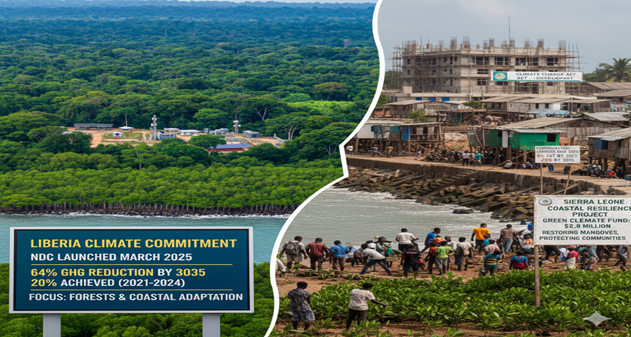
Liberia and Sierra Leone are two countries with opposite methods of climate policy in West Africa, even though they are countries in the same geographic position and have common developmental issues. Liberia has adopted an ambitious forest-based mitigation plan that has been supplemented with certain coastal adaptation plans as compared to Sierra Leone which has implemented a broad-based adaptation, with a small mitigation objective. Such conflicting strategies can be seen as a sign of radically different economic systems, institutional capabilities and priorities in climate risks.
The Liberia has a climate commitment anchored on its Nationally Determined Contribution (NDC), which was launched in March, 2025. It is hoped to achieve a 64 percent reduction of greenhouse gas emissions in the economy below standard business as usual levels by 2035. It is a grandiose commitment, and the country has already taken a giant step, and the reduction of emissions has already reached by 20 percent in 2021-2024 (848 megatons of CO2e). The commitment consists of 10 percent unconditional cuts Liberia will make using its own resources and 54 percent conditional cuts that will take place given international assistance. The mitigation policy of Liberia comprehensively involves nine major areas such as agriculture, forests, coastal areas, fisheries, health, transport, industry, energy, and waste, but the forests take the centre stage of the policy. The cost associated with the implementation of Liberia’s NDC up to the year 2025 as estimated is 490 million, which is divided into mitigation (90 million) and adaptation (400 million), indicating an implicit preference towards climate adaptation.
The policy path of climate in Sierra Leone takes a significantly different direction. In 2021, the country reported another updated Nationally Determined Contribution with a progressive reduction target of 5% in 2025, 10% in 2030, 25% in 2050 (all relative to 2005 baseline emissions). Having an estimated total of 6.3 billion in the 2021-2030 strategy, the strategy of Sierra Leone is considerably larger in terms of financial scope and comparatively smaller in terms of emissions goals. Adaptation has been the key policy agenda of Sierra Leone since long before, with a National Adaptation Plan and mass-level international projects like the Sierra Leone Coastal Resilience Project, a $26.8 million Green Climate Fund project that targets to reach 260,000 people directly and restore 1,500 hectares of mangrove ecosystems. By 2024, Sierra Leone hasn’t even got a full-blown Climate Change Act, and there are still critical coordination gaps among the governmental bodies responsible in climate action.
Why Different Policies? Structural and Economic Factors
The differences in the forest-oriented, high-ambition approach of mitigation in Liberia and the approach that is mainly based on adaptation, but with lower ambition in Sierra Leone are indicative of the different economic structures and subsequent climate vulnerabilities. Such differences can be explained by looking at how the endowment of natural resources and economic dependencies in each country determine the priorities of climate policies.
Economic Structure and Forest Mitigation Focus of Liberia
The economy of Liberia is majorly relying on primary commodities (rubber, timber, and iron ore) exports, which have been the sources of growth and government income since the country’s establishment. Forestry is the fourth largest economic driver that comes after services, agriculture, and fisheries. This forest-dependent economic structure creates powerful incentives to develop forest protection into a global climate asset. Rather than viewing forests solely as a timber resource to be exploited, Liberia’s NDC increasingly conceptualizes forests as carbon repositories central to global climate mitigation. This reframing can also be seen in the specific targets of the forest sector strategy: by 2030, restoring 25 percent of priority degraded forests, transforming timber sales contracts into carbon concessions by 2030 and limiting forest management concessions to 1.6 million hectares. The explanation is quite straightforward, Liberia possesses one of the largest remaining forest patches in West Africa, thus conservation and restoration of forests is a well-compensated mitigation investment. Each hectare of forest protected or restored generates measurable carbon credits that contribute to global climate goals and potentially to Liberia’s international financing. This explains why Liberia’s 64% emissions reduction target is substantially higher than Sierra Leone’s 10% target; the forest sector provides a mechanism to achieve deep emissions reductions at a scale matching few other developing countries. The Reduced Emissions from Deforestation and Forest Degradation (REDD+) framework has become central to Liberia’s strategy, with the development of a National Forest Monitoring System enabling precise tracking of forest carbon dynamics. The conditional nature of much of Liberia’s ambition (54% of mitigation contingent on international finance) reflects confidence that forest protection can attract substantial international climate finance from donors prioritizing mitigation.
Sierra Leone’s Economic Structure and Adaptation Imperative
In comparison, the economy of Sierra Leone has always been mineral based in extraction of diamonds and iron ore which gave the country 71 percent of the total export earnings at its highest. The mining process is capital-intensive, but capital-depleting: the mined minerals cannot be replenished, which poses a threat to the country’s economy as the prices of world commodities are unstable. The cost of mining is also very harsh to the environment and the sector was found to be one of the leading sources of biodiversity loss and degradation of ecology. Most importantly, mining activities cannot be naturally linked to climate mitigation as forests. A diamond mine does not bring any quantifiable climate co-benefits, it creates jobs and income but cannot be used as a global climate asset. This type of economic organization creates varied priorities of climate. Instead of attempting to be tough on its strategy of reduction of emissions by changing the sector, Sierra Leone is grappling with a more urgent problem of attempting to reconcile the agricultural and coastal systems with climate change. The last effects of climate in Sierra Leone confirm this necessity: the disastrous floods in September 2024 were succeeded by critical displacements, crop loss, and destruction of infrastructures. Since 1980s, temperature in the country has been rising drastically. Projections also indicate that extreme events of rainfall may increase even though the average levels of precipitation may remain relatively steady. In a country where most of the population rely on subsistence farming and the sea fisheries, these changes pose a direct source of danger to survival and livelihood. This vulnerability is exhibited by the policy position of Sierra Leone (adaptation-oriented). The project on coastal resilience of $26.8 million that seeks to boost the community planning capability and mangrove ecosystems within the coastal districts is a direct reaction to the experienced climate risks. The project targets women, youth, and marginalized people since adaptive capacity is not distributed equally; the most vulnerable groups has fewer resources. In the same vein, the National Adaptation Plan that aims at halving the vulnerability by the year 2030 by increasing the awareness of risk, enhancing compliance with rules, and increasing institutional capacity is a pragmatic evaluation that Sierra Leone needs to first develop a rudimentary institutional capacity to respond to the looming climate threats before it can embark on achieving the ambitious mitigation goals.
Implementation Dynamics and Institutional Capacity Constraints
A second critical factor explaining policy divergence concerns institutional maturity and financing access patterns. The NDC framework in Liberia has an advantage of better institutional architecture especially in the Environmental Protection Agency (EPA) which is the coordinating body of climate action within the government, development partners and civil society. This coordination capacity has been achieved over time through previous NAP processes and capacity development supported by the international community and is one that allows Liberia to express ambitious sectoral goals and monitor their achievement. The fact that Liberia has been able to achieve 20 percent of the emissions cut by 2024 is an indication of its ability to implement despite the resource limitation.
The institutional structure of Sierra Leone, in turn, has a lot of loopholes. The lack of a comprehensive Climate Change Act was explicitly cited by IMF technical assistance report as a severe institutional weakness, and this legislation is necessary to create an institutional framework and meet UNFCCC mitigation commitments. The climate agencies in Sierra Leone do not have a consistent mandate, budget allocation and coordination authority to implement mitigation practices effectively without a clear legislative authority. This institutional vacuum is one of the reasons as to why the emphasis is on adaptation initiatives, especially those that are funded by international sources such as the Green Climate Fund. Such initiatives can be executed via bilateral cooperation between particular government bodies and international actors, without the requirement of the enactment of broad national climate laws. Mitigation, in its turn, generally involves the systematic sectoral change, which is energy, transport, industry, and necessitates the coordinated and sustained policy action across ministries, which is compromised by institutional fragmentation.
The financing dimension reinforces this pattern. The dependence of Liberia on conditional financing (54% of mitigation subject to international assistance) is an indication of optimistic fundraising that serves as an open up of the country to international climate finance mechanisms. The Green Climate Fund, bilateral development partners and REDD+ financing systems have been open to forest protection plans by some countries such as Liberia and they have developed incentive frameworks that support forest-based policy formulation. Sierra Leone has various financing constraints: adaptation projects are eligible to grant-based funding through various sources such as the Green Climate Fund (witness the approval of the Coastal Resilience Project at 26.8 million dollars), mitigation financing is usually provided on a concessional basis. Since Sierra Leone has debt limitations and low domestic revenues, this source of financing difference has a significant impact on policy preferences in adaptation.
Performance and Unfulfilled Difficulties
The ambitious mitigation targets and forest-protection approach of Liberia has serious problems with its implementation. The change in the base year used to calculate the emissions, which almost tripled the measured GHG emissions (5695 to 12471 GgCO2e) with the improved methodology, implies both problems and opportunities: it provides more accurate baselines but implies that absolute reduction percentages will have to be achieved with deeper reductions in emissions than originally envisioned. To translate the targets of forest protection in to quantifiable climate effects, this requires a long duration of enforcement against strong economic forces of timber harvesting and agricultural development (a governance responsibility that most tropical nations failed to achieve). Monitoring and enforcement is resource-intensive due to the decentralized nature of deforestation which is caused by the large number of smallholders and the presence of industrial concessions.
The adaptation strategy of Sierra Leone is not as ambitious, but it faces other implementation difficulties. The institutional failures underlying the adaptation focus may also tend to constrain the effectiveness of adaptation: unless sectoral planning is achieved, adaptation investments can be stampeded and may not generate systemic resilience. An example such as the Coastal Resilience Project focuses on particular coastal districts but fails to cover the national-level institutional changes required to institutionalize the risk of climate change into development planning at all levels. In addition, the dependence of Sierra Leone on international sources of funding adaptation projects raises sustainability questions; once the international sources of finance stop, the local sources of finance might not be adequate to sustain and maintain the adaptation infrastructure.
The two countries have a common challenge; how to translate climate commitments into quantifiable development outcomes. The modalities of the NDC implementation in Liberia are still not finalized as at the beginning of the year 2025 and it has to be addressed urgently so that the policy framework can be translated into the action plans in the sectors with the activities budgeted, and the agencies responsible. The institutional fragmentation of Sierra Leone indicates that commitment to mitigation, though small, might be hard to realize unless a legislative reform and sector-wide planning.
Conclusion
The differences in climate policy approach taken by Liberia and Sierra Leone are not due to differences in the global climate values but rather, the economic structure of the two nations, climate vulnerabilities, and institutional capacities all result in different optimal policy responses. The forest wealth of Liberia allows high-ambition mitigation strategy with focus on forest protection and REDD+, which is funded by substantial amount of international mechanisms ready to pay for mitigation. Sierra Leone on the other hand, which is mineral-based and has proven to be susceptible to climate change, creates greater incentives to invest in adaptation and pursue smaller mitigation goals that can be accomplished within the existing institutional limitations. Both approaches reflect rational adaptation to countries’ specific circumstances. The effectiveness of these strategies will depend not on ambition level alone but on whether implementation institutions (regulatory capacity, monitoring systems, and sectoral coordination) can keep pace with policy goals which happens to be a challenge in both nations.


 Jonathan Tarnue Payne
 Precious Douglas Maulana
 Eslam Mohamed Elsheikh
  Lutfi Nurachma
  David R.K Brown
  Asef Jafari
Sau khi điền xong các thông tin cần thiết, bạn cần kiểm tra lại để đảm bảo không có sai sót. app xn88 Tiếp theo, bạn sẽ nhấn vào nút “Đăng ký” để hoàn tất quá trình. Một số trường hợp, hệ thống có thể yêu cầu xác minh qua mã OTP gửi về số điện thoại hoặc email để tăng cường bảo mật. TONY02-21
Truy cập bắn cá xn88 , bạn có thể nhận ngay tiền thưởng từ giải Jackpot khi hạ gục boss thành công. YL, JDB, BBIN,… cung cấp hơn 1.000+ sinh vật biển bí ẩn đi kèm với hơn 55+ loài cá đặc biệt sở hữu hệ số nhân cực cao, cho phép bạn hốt gấp 750X tiền thưởng về túi. TONY03-11O