
Contrasting Causal Stories in Sumatra’s Devastating 2025 Floods
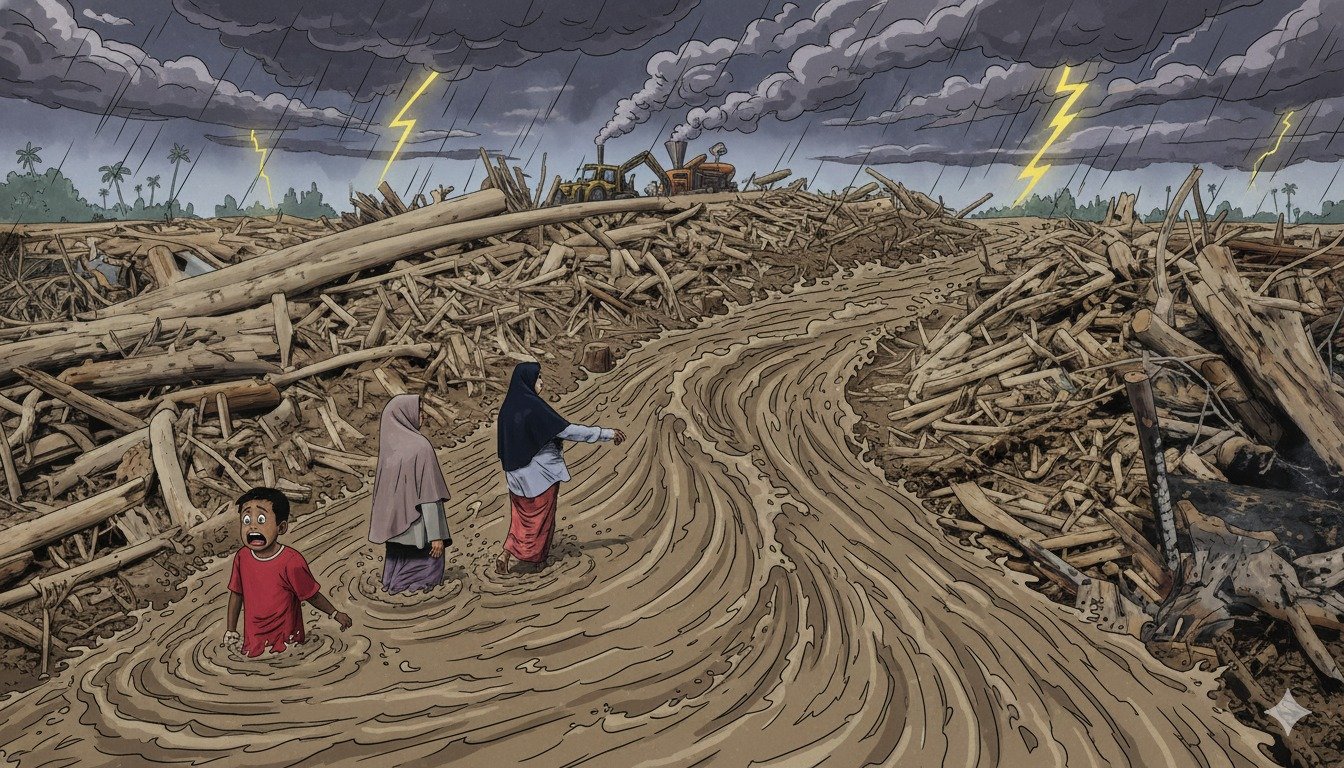
At the end of 2025, flooding struck the Island of Sumatra, which was worst in decades. Aceh, North Sumatra, dan West Sumatra lumpuh. A total blackout occurred with hundreds dead, thousands buildings destroyed and much more damage. The immediate aftermath focused on the “cause” of the disaster. There are a few sides: one side, which is the government narrative, emphasized “extraordinary atmospheric dynamics.” They only blamed it on the weather and talked about “heavy rainfall,” specifically referencing Tropical Cyclone Senyar. They told us that nature is “angry.” On the opposite side, environmental activists, local leaders, and journalists tell a different story. They directly pointed to the bald hills upstream. The water should have been held in place by tree roots. They blamed it on the “chainsaw.” The disaster was man-made; it emerged from years of deforestation to grow palm plantations and mining concessions. The way we talk about the problem determines how we solve it. If we are told or tell the wrong story, the problem will never be fixed. The different narratives are fighting for the soul of Sumatra’s environmental policy. Each blames different sides, one on the heavens and the other points a finger at the earth. If we only talk about the floods as an “Act of God” beyond our control, not only Sumatra but other places are destined to keep drowning.
The Act of God (Government’s Tale)
If we see the news on television or online, we hear stories that come from government agencies. The disaster response teams (BNPB) and the local governors are often responsible as storytellers. The news tells a narrative with the setting of “A Dangerous Planet.” In this narrative, we always hear stories about how Indonesia is a victim of geography. Statements such as “Indonesia is on the Ring of Fire,” “Indonesia is a tropical archipelago,” or simply “this storm is so powerful,” imply that everything is natural. The narrative focuses on the atmosphere, not the lithosphere (land). We can see the characters in this narrative. The villain is Tropical Cyclone Senyar. It is non-human, portrayed as unpredictable, powerful, and malicious. The narrative removes human factors from the cause. The victims are the people of Sumatra and their homes. In the end, the government is the hero, portrayed as the aid team or rescuers (government agencies) who distribute help and the brave officials who visit the disaster zone. They are framed as protectors doing their best against the overwhelming power of Mother Nature.
The plot in this narrative is about starting off powerless, then getting power again. The action begins with a force which can not be stopped. It can be a natural disaster or a major problem which no one can control. In the end, it is the government or authorities who perform damage control and take over once things go out of hand. This type of cooperation is like the transition from chaos to a controlled climate. The narrative explains that flood is caused due to events attributed to weather, any such disaster is termed as a hydro-meteorological disaster. The cause is external to the political system. Lastly, the moral of the story leads to the solution. Because the story says the problem was caused by “weather,” the solution is adaptation and simple engineering measures such as higher levees, river normalization, which is concrete channeling, and better weather radar. Land reform is implicitly rejected as a remedy because land use was not the “cause.”
The Ecological Crime: Blame it on the Chainsaw
The opposite story, using the “Advocacy Narrative,” emerged roughly 48 hours after the initial flooding, utilizing social media and independent journalism to counter the official story. This story’s setting, “A Broken Landscape,” describes how the disaster is more than geographical; it portrays Sumatra as a “crime scene.” The narrative illustrates mountains stripped bare, forests turned to dirt, and rivers choked with mud. It is a “critical landscape” or a “raped ecosystem.” The villain in this narrative is “The Greedy Plantation,” specifically palm oil and mining companies responsible for cutting down forests to plant monocultures that cannot absorb water. Additionally, there is a second villain: the corrupt government officials who signed permits allowing deforestation. Environmentalists, indigenous leaders, and journalists who act as whistle-blowers become the “heroes” of the narrative, fighting back to expose the truth. The moral of the narrative states that the weather is not the problem; deforestation is. This means the solution is political, including fixing policies such as revoking permits, stopping plantation expansion, and replanting forests.
How Does Narrative Matter to Policy?
In policy-making, narratives are far more than mere stories. They serve as tactical guidelines that specify how society handles a crisis. According to Shanahan’s framework, policy actors create dramatic narratives with settings, victims, and villains. This gives the impression that their preferred solution is the only sensible option. It connects to Deborah Stone’s concept of “causal stories,” in which the primary goal is to categorize an issue as either human-caused or an accident resulting from fate or nature. For instance, those in authority avoid responsibility if floods in Sumatra are seen as a natural disaster. If a narrative relates to human error or bad decisions then it requires a moral response such as major reforms and political consequences. In the end, whether we put a band-aid on things or make a real change depends on who is called the “villain.”
Comparing the two narratives, we find what is called the “Devil Shift.” In political storytelling, both sides try to make the other the “devil.” One narrative paints corporations and governments as groups that care only about profit rather than human lives. The other paints activists as anti-development troublemakers who do not understand economics. However, this does show that the government has a weapon complexity. The climate change story is real. Scientific research mentions that rainfall this year 2025 in Indonesia is 30 percent higher than the average due to cyclone. Nonetheless, historical evidence suggests that Sumatra has endured such levels of rainfall without catastrophe in the past and the difference has been more land cover. When the Government focuses 100 percent on the rain, it is State the truth but the other half of the truth it conceals. Using confusing meteorological science might shut down conversations about deforestation. The government communication shows that they wash their hands of deforestation being the root cause. Stone’s theory proposes that the acceptance of a “human causal story” generates political risks. As such, the Indonesian government faces a large political risk in admitting that human activity caused floods in 2025. If the government admits that deforestation caused the floods, it means it disregarded logging regulations. It also means that private firms put profits ahead of the public. We cannot continue to offer “Acts of God” to explain “Acts of Negligence.” We must change the narrative to prevent another Such tragedy. We can control the chainsaws but we can’t control the clouds. True change begins with the fixing of what keeps us safe – our forests, instead of building walls that have only restricted the physical worth of the land. The year 2025 experienced a devastating flood disaster. What’s worse: that we are busy blaming the rain, not learning what they teach us.


 Jonathan Tarnue Payne
 Precious Douglas Maulana
 Eslam Mohamed Elsheikh
 Lutfi Nurachma
 David R.K Brown
 Asef Jafari
Yo, check out 23win8bet. It has been solid to me. Plus all the games make you feel like you got to be on 23win8bet
PH365 Online Casino – sounds promising! Is this the place to catch some heat and win some dough? Gotta check out the slot selection first! ph365onlinecasino
Win777slots? Dude, the name alone is worth a try. Hoping for some lucky spins over there! I’m ready at win777slots.
Một trong những lý do khiến xn88 link được yêu thích là tốc độ nạp rút nhanh chóng qua nhiều phương thức phổ biến tại Việt Nam. Giao dịch minh bạch, xử lý tự động giúp người chơi an tâm khi tham gia lâu dài. TONY01-29O