
Making the Tragedy of August 2025: A Story of lost Bridges, drowned Harvests, and lost Classrooms.
It started with a scream of mountains, and it came to a pause in the whimpering in the plains. It began with a scream in the mountains and finished with a whimpering in the plains. In August, as the world continued to scroll their headlines, three distinct heartbeats of India’s Uttarkashi in the north, Punjab in the west and Bihar in the east stopped. The damaging 2025 floods in August were not “yet another monsoon event”. It was a collapse: of our geography, of our infrastructure, of our future. We must take off our rose-tinted glasses when looking back at these things four months later for the Mankind Planet Pioneers community. We should not see this disaster as a misfortune but rather reproof for failure of foresight.
The Triple Threat: A Story of Destruction.
The catastrophe occurred in three tragic acts where each of them was different.
Act I: The Mountain Tsunami (Uttarkashi)
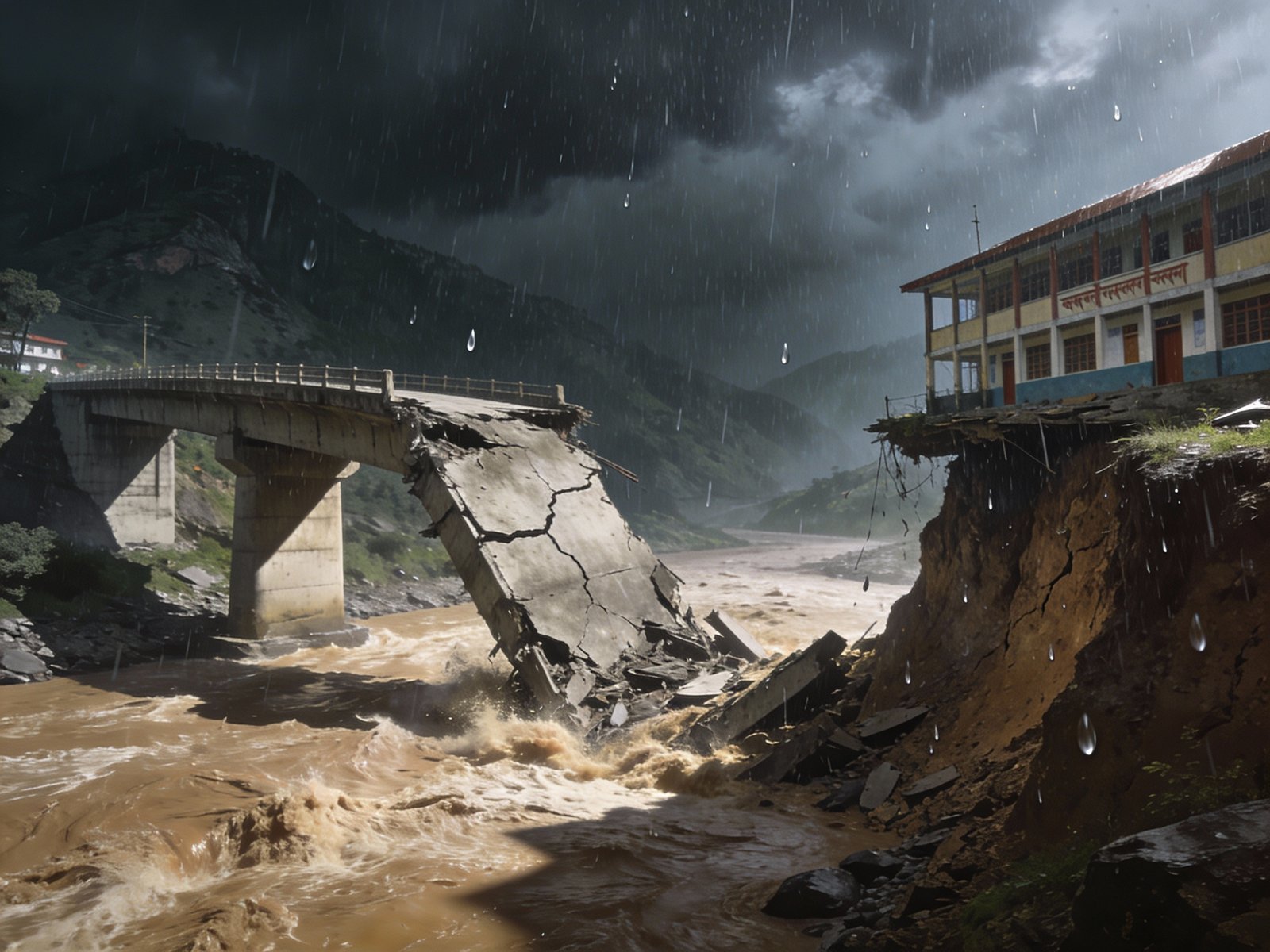
On August 5, 2025, it didn’t just rain in Dharali village, Uttarkashi, it poured and poured. The people of the Gangotri valley could not afford any of this debate as meteorologists termed it a ‘cloudburst’ while some cautioned of a huge ‘ice-chunk/rockfall’. In minutes, the Kheer Ganga and Bhagirathi rivers turned into battering rams. The West Nayyar and Kalgarhi bridges lifelines for thousands snapped like twigs, isolating entire blocks like Thalisain and Pabo. But the cruelest cut was to education. Schools that stood as sanctuaries for children were either swept away or left hanging precariously on eroded cliffs. In a single night, the “future” for hundreds of children was erased from the map.
Act 2: Artificial Ocean (Punjab)
Approximately two weeks later, between August 19- 20, the carnage moved on to Punjab in India. The catastrophe which occurred in Punjab was not induced through the heavens but rather it had burst out of our doorsteps. Owing to heavy downpour in the catchment areas, the Bhakra and Pong dams have become full to their capacity. As per the condition of the dams’ authorities open the gate and released overs 75000 cusecs of the water into Sutlej River. The result? The river regained its flood area vengefully. Such a village as Maliwala was covered not with rain, but with a wall of water which we had not managed well. This was a man-made flood, which made 300,000 acres of standing crops a drowned cemetery.
Act 3: The Eternal Sorrow (Bihar)
In Bihar, the script was familiar but no less deadly. Due to heavy rains in upstream areas, the Kosi and Gandak rivers breached their embankments rendering villages in floodwaters an island. Thousands were forced into relief camps, their lives reduced to a plastic tarp and a waiting game for food packets.
By the Numbers: The Scale of Loss
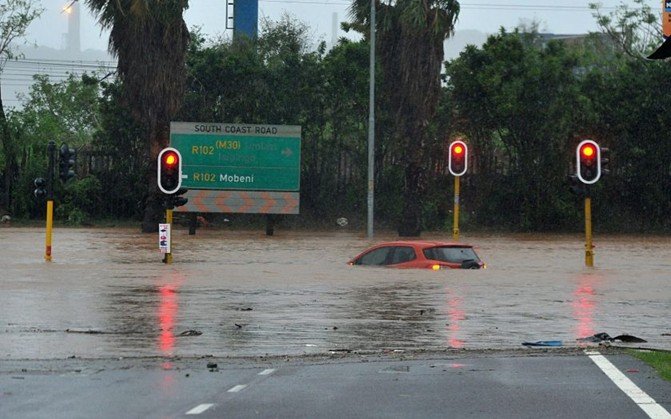
To understand the magnitude, look at the data. The impact wasn’t uniform; it was targeted. Devastation by the Numbers: August 2025 Floods Impact.
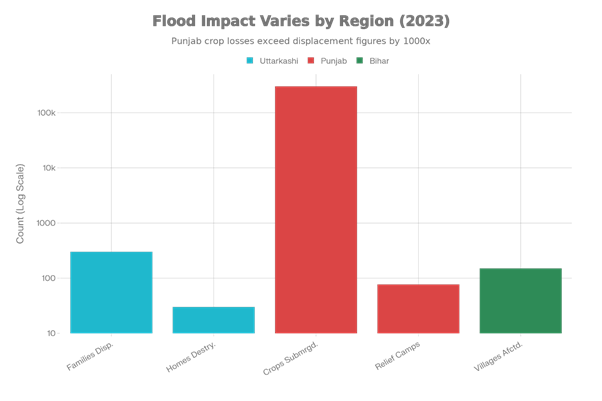
While Uttarkashi lost connection (bridges, roads, schools), Punjab lost sustenance (crops). The destruction of 300,000 acres of crops in Punjab isn’t just a statistic; it’s a food security crisis that we are likely feeling in the market prices today, in December.
Critical Analysis: The “Why” Behind the Water
What caused this occurrence? The answer is only half correct if you said climate change. The rest part 50% is uneasy.
1. The “Cloudburst” Confusion & Early Warning Failure
In Uttarkashi, professionals are yet to debate on whether it was a cloudburst or a flood caused by a landslide.This uncertainty poses threats. Unless we know what hit us, we cannot prepare for next time? Our Doppler radars in the Himalayas are either insufficient or their data isn’t reaching the “last mile” the village headman in time.
2. Dam Management: Protection or Weapon?
The Punjab floods were because of the dam releases. Dams are supposed to calm down floods and not to generate them. This points to a failure in Integrated Reservoir Management. Why were the reservoirs allowed to fill so high before the release? Why wasn’t the release staggered? When we prioritize maximum power generation (keeping water levels high) over flood safety, we turn our dams into loaded guns pointed at downstream villages.
3. Education as Collateral Damage
The catastrophe that went most underreported in the month of August 2025 is the “Educational Washout”. In India, most schools are constructed on the cheapest land which is usually the most hazard-prone. It is not the school in Uttarkashi being swept away and it happens not to be a building. It means a year of education will be wasted and hundreds of children will be deprived of a secure environment and a lunch break. We are building our future on sinking sand.
Fields of Damage: What Bleeds?
- The Classroom: Millions of student hours were lost. In remote areas, “online classes” are a myth when the mobile towers themselves have collapsed.
- The Farm: The submerged tractors in Punjab represent generational debt. Farmers who invested in the Kharif crop lost everything just weeks before harvest.
- The Psyche: The “Climate Anxiety” among the youth in these regions is palpable. How do you focus on a textbook when you fear the rain?

“It is not in our hands to stop monsoons but we can prevent the disaster.”
Strategies: A Plan for Survival.
1. Infrastructure Characterised by Avoidable Failure.
The infrastructure we need should not be weak. It is necessary that the bridges built in the Himalayas are made for a “100-year flood” and not the “10-year averages”. The school must be relocated to the “No-Flood Zones” with multi-purpose shelters.
2. Dams with digital twinning.
Our river basin systems need Digital Twins viz. AI-driven hydrological. By predictive modelling of inflows, it is possible for dam managers to release water slowly and effectively days in advance and not in panic.
3. The Village of SpongeBob.
The indigenous water bodies (ponds, wetlands) should be revived in Bihar and Punjab, as these act as good sponges in the area. We moved too quickly into the river’s life space. We must redress that.
4. Hyper-Local Alerts
A “Red Alert” for a whole district is useless. We need location-specific alerts sent to mobile phones in the local language, telling people exactly which stream is rising and where to run.
Conclusion: The August Lesson and The Pioneer’s Mandate
The floods in August 2025 taught us a hard lesson! Our concrete’s weak, our planning shortsighted, our relationship with nature quite poor, was what they taught us. As the mud dries, the news cycle finds a new trending topic, but the one thing we should not forget is AMNESIA – a worse threat than the flood.
We have a toxic habit of romanticizing ‘resilience’. The farmer who replants his washed-out field gets applause. Or the student who studies by candlelight in a relief camp. But we must question ourselves: Why must they be so strong? Why we call their suffering as a “spirit of survival” instead of a “failure of governance and planning”. Resilience is not to suffer pain that could have been prevented. It should be the ability to adapt such that pain does not come.
For the Mankind Planet Pioneers of tomorrow the future architects, planners, and engineers this disaster is a mandate. We can’t bear the burden of previous generations’ indifference. When designing a bridge, we must not think of the river as something to cross but something quite living wanting space for itself. While drafting any policy, we must keep the displaced families of Bihar in mind. We must ensure that in development will not equal displacement. We must advocate for “Ecological Patriotism”. It must mean that if you love your country, you must stave away the destruction of soil, water and air.
We must act now otherwise our lack of action would bankrupt our future. The pledge of $300 million for flood mitigation is simply an initial payment for a debt we have been owe for years. Every wetland we paved, every forest we hacked down to build a resort, every river channel we constricted was a loan from nature. In August 2025, nature came to collect the interest. If we don’t change the system, next time, it will come for the principal.
As we move into 2026, the question is not “Will it flood again?” The physics of a warming planet guarantees that it will. The real question is, “Will we be ready?” Will we have the ‘sponge villages’? Will we have the Digital Twins? Will we have the bravery to back off from the riverbank?
The students in whose schools disappeared in Uttarkashi as well as those farmers who watched their harvest wither in Punjab do not need relief packets and sympathies alone. They are calling us to renew our basic modes of occupying this planet. And not only may the high water mark of the walls of our cities remind us of the past, but act as the starting point of the better, smarter, kinder world we must make.
“The water has decreased but the urgency has to be increased”




 Jonathan Tarnue Payne
 Precious Douglas Maulana
 Eslam Mohamed Elsheikh
 Lutfi Nurachma
 David R.K Brown
 Asef Jafari
Hey guys, 777king99 is where it’s at! Been having some real fun lately. The games are decent, and the payouts are pretty good too. Give it a shot if you’re looking for something new! 777king99
Alright, so 555wincom is alright. Site navigation is alright. You know what i mean? If you are looking for a simple game to play, just give them a shot: 555wincom
Sodo.pro? Nghe tên cũng pro phết nhỉ. Có ai giàu lên nhờ chơi ở đây không? Confess! Access here: sodo.pro
I really appreciate this post. I?¦ve been looking all over for this! Thank goodness I found it on Bing. You have made my day! Thank you again