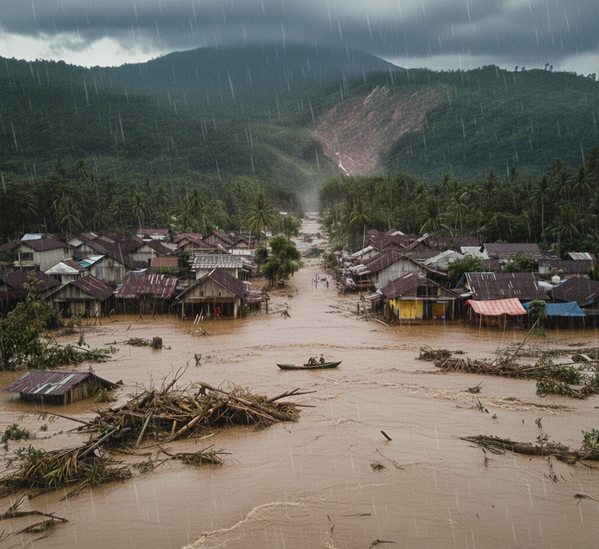


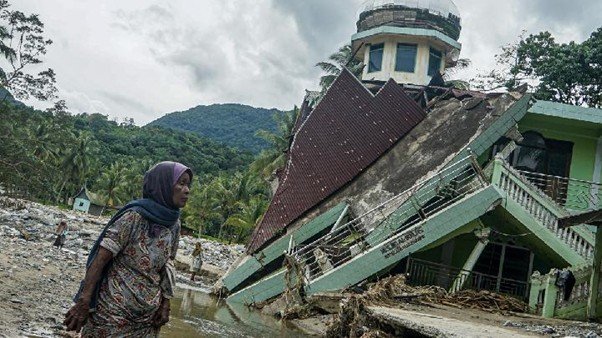
A series of catastrophic floods and landslides occurred at the end of November 2025 in Sumatra Island, which precipitated a significant human crisis across the provinces of Aceh, North Sumatra, and West Sumatra. The disaster’s footprint is widespread across numerous administrative districts, devastating 25 regencies and municipalities: approximately 12 regencies/municipalities in Aceh Province, 8 regencies/municipalities in North Sumatra, and 5 regencies/municipalities in West Sumatra Province. To date, officials have confirmed 1.071 fatalities, and 185 people remain missing, and displacement for more than half a million, which requires large-scale aid and temporary housing. This disaster has not only caused casualties, but also material losses in the form of the loss of people’s homes, fields, gardens, livestock, and places where residents earn their daily living. Although the number of victims of this disaster has reached thousands and continues to grow, and the affected area is quite extensive, the disaster status in the three provinces with a total of 25 regencies/municipalities is still at the emergency response level (status tanggap bencana).
National Disaster Status Indicators According to Law No. 24 of 2007
Law No. 24 of 2007 (Law No. 24 of 2007) on Disaster Management defines a disaster as an event or series of events that threaten and disrupt the lives and livelihoods of the community, caused by natural and/or non-natural factors or human factors, resulting in human casualties, environmental damage, property damage, and psychological impact. Natural disasters are specifically defined as disasters caused by events or a series of events caused by nature, including earthquakes, tsunamis, volcanic eruptions, floods, droughts, typhoons, and landslides. This law also regulates the authority of the government in disaster management, one of which is regarding the determination of the status and level of a national disaster. The status of a disaster is determined based on the scale of its impact and is carried out in stages, namely the president has the authority to determine the status of a national disaster, while at the provincial level it is determined by the governor, and at the regency/city level it is determined by the regent/mayor. There are five indicators determining the status of a national disaster based on Article 7 of Law No. 24 Year 2007: the number of victims, property losses, damage to infrastructure and facilities, the extent of the area affected by the disaster, and the socio-economic impact caused.
In the context of floods in Sumatra, the number of indicators based on Article 7 Law No. 24 Year 2007, have been met for declaring a national disaster. First, the number of fatalities has reached thousands and hundreds of people are missing. Second, property losses projected by the Center of Economic and Law Studies (Celios) have reached 68.67 trillion rupiah, consisting of damage to residents’ homes, loss of household income, damage to infrastructure, and loss of community farmland or plantations. Third, the devastation of facilities and infrastructure – road, bridges, no power/electricity, no communication network – has left many areas isolated due to disrupted access. Fourth, the affected area is very massive, which consists of approximately 25 regencies/municipalities, and extends beyond the administrative boundaries of provinces. Fifth, the impact of socio-economic factors, a potential risk of poverty is increasing since people lost their agricultural and plantation, which were their resources of livelihood. However, the government is still reluctant to declare a national disaster status, even though all the indicators have met the requirements.
The Urgency of Declaring a National Disaster in Sumatra
From the government’s perspective, there will be a significant impact from declaring a national disaster status for the floods in Sumatra, particularly in terms of disaster management.
When a national disaster status is declared, several changes will be made in handling the disaster, in accordance with the provisions of Article 50 of Law No. 24 of 2007. First, there will be a transfer of command, with the leading sector shifting to the central level, namely the National Disaster Management Agency (BNPB). Second, the BNPB can deploy human resources, in this case the TNI/Polri, related institutions, and even more structured and massive foreign assistance. Third, ease of access to deploy human resources, logistics, equipment, immigration, customs, quarantine, licensing, and procurement of goods/services. Fourth, the BNPB has other sources of funds for national disaster management, namely the Ready-to-Use Funds (DSP), which originate from the state budget (ABPN).
The urgency for declaring a national disaster is essential, since it will allow international aid to come to Indonesia in order to accelerate the disaster response process and reduce the number of victims, and increase the number of essential facilities and infrastructure. Since the government has not yet declared the national disaster status, international aid has not come to help the victims. Furthermore, the Indonesian government has stated that it does not yet need assistance from abroad on the basis that it will optimize its national capabilities to overcome the impact of the disasters that have occurred in the three provinces. Assistance or aid from other governments or countries is not allowed to enter the Indonesian area, but the government welcomes assistance or help from non-governmental organizations (NGOs), such as humanitarian organizations. The local governments faced tough situations in addressing the impact of the disaster since the Indonesian government was reluctant to accept international aid. However, the local government considered that the measures taken by the Indonesian government have not been effective and efficient enough in addressing the impact, thus Aceh Provincial Government requested foreign aid by writing to UN agencies in Indonesia.
Conversely, when the tsunami struck Aceh in 2004, the government decided to implement an open door policy and opensky policy for Aceh and Nias, so that the international community would immediately assist to mitigate the impact of the tsunami in the region. With these policies in place, all international aid, including ships and aircraft carrying aid, as well as NGOs and international humanitarian workers, were able to enter Indonesia with the aim of helping tsunami victims.
Bridging the Gap: Substantive Policy in Indonesia’s Disaster Response
Mitigating the impacts of climate change requires placing local and central governments on an equal footing. This is because local governments have authority over land, natural resources, and regional infrastructure. Flood disasters are not only caused by tropical cyclones, but also by large-scale deforestation and land conversion for business interests, for which the central government has the authority to grant permits. The central and local governments must integrate disaster risk reduction into every policy or regulation they make, including in the granting of permits for land conversion and deforestation. As mentioned by Moinuddin in his article entitled Integration of climate actions and SDGs at the sub-national scale: Results from stakeholder consultation in West Java, there are challenges to integrating climate action and SDGs, especially in terms of governance, which includes integration between government agencies (horizontal interaction) and vertical interaction between various levels of administrative decision-making. If the central and regional governments do not integrate their climate actions with applicable policies or regulations, it will be difficult to achieve the SDGs. For example, with permissive permits for forest land conversion, extreme weather due to climate change can cause flooding disasters, as happened in Aceh. What then happens is that floods and landslides increase the risk of poverty (SDG 1: No Poverty), as well as potentially threatening food security (SDG 2: Zero Hunger), worsening sanitation, and increasing the need for clean water (SDG 6: Clean Water and Sanitation).
In addition to integrating disaster risk reduction into every policy and regulation that is made, collaboration between the central and regional governments, climate change management also requires strong political will and leadership, as mentioned by Endalew in his article entitled Ethiopia’s effective climate diplomacy: lessons for other nations. The strong political will and leadership of its leader are essential elements in driving Ethiopia’s policies in mitigating and adapting to the impact of climate change. This is in stark contrast to Indonesia, where the government still does not consider climate change a top priority. As a result, many policies do not take into account the disaster risks that may arise from climate change. The disaster in Sumatra illustrates how the government is not serious about addressing the root causes of disasters that constantly threaten its people due to the government’s greed in prioritizing business interests over the safety of its people.







 Jonathan Tarnue Payne
 Precious Douglas Maulana
 Eslam Mohamed Elsheikh
  Lutfi Nurachma
 David R.K Brown
 Asef Jafari
+ There are no comments
Add yours