
How Lead Poisoning from Battery Recycling is Ravaging Public Health in Nigerian Communities
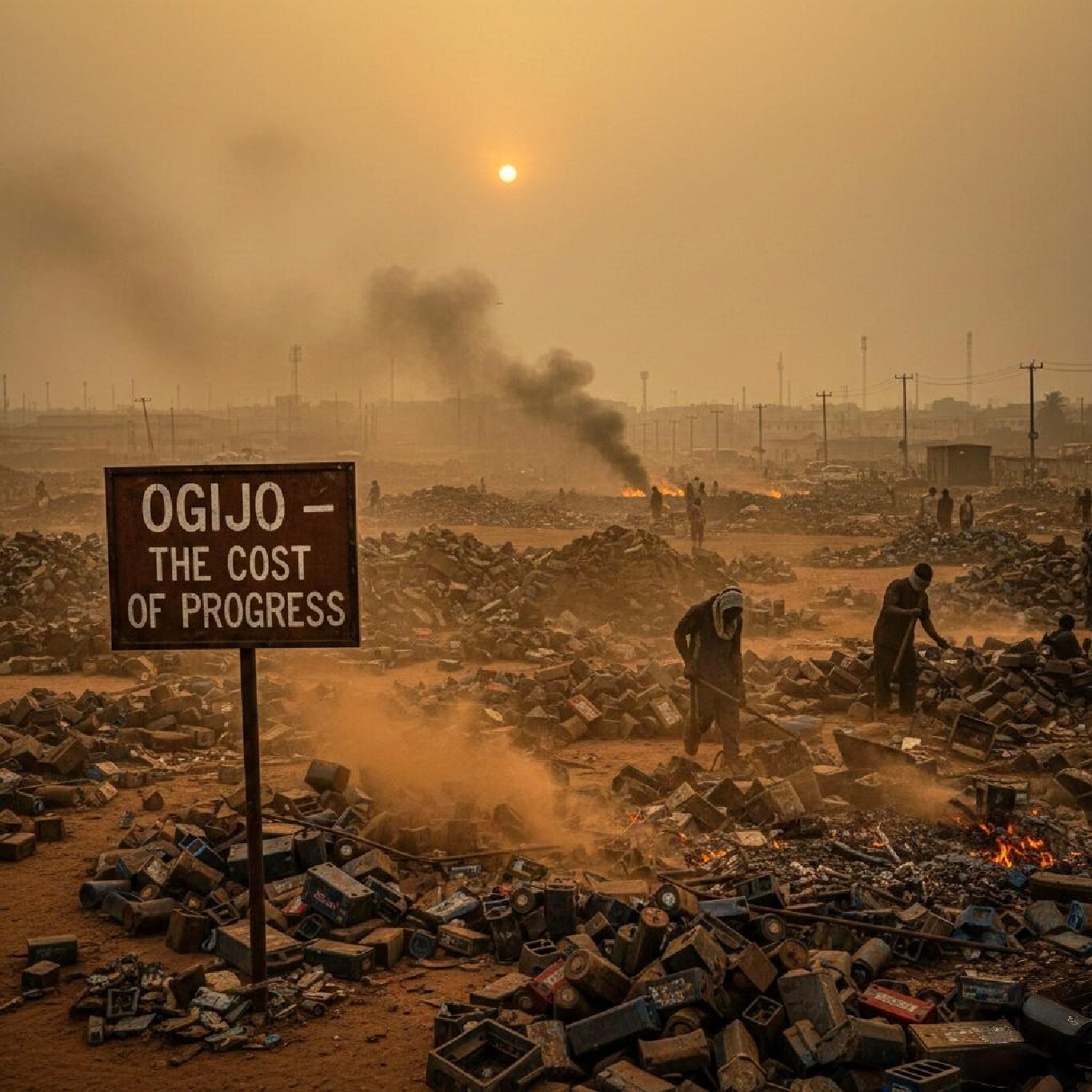
In the dust-filled exuberations of the industrial-town of Ogijo, which spans across the borders of Lagos and Ogun states in Nigeria, a ghastly scenario is being played as children are presently playing amidst the haze of metallic lead clouds that drift like a silent plague that is taking away the future and lives of thousands of children. As the leaders of the world celebrated the COP30 results in Belém, Brazil, in November 2025, promising to do more on the issue of just transitions to net-zero economies, the irony on the ground stings a lot. The yearning toward electric cars and renewable energy, which are essential to reducing emissions, has led to a very big boom in the demand of recycled lead, turning locations such as Ogijo, into some form of incidental hotspots of public health crises. This is not a coincidence, it is a warning that climate diplomacy needs to be reconsidered so that it does not become the battery that imparts the toxic flavour of Northern desires on the Global South.
Climate communication and diplomacy, as we have studied during this semester, aim at promoting cooperation in the face of asymmetry. International forums such as the UNFCCC insist on common but differentiated responsibilities, acknowledging that the industrialized countries that have historically contributed have to take the lead in helping the developing ones. However, with the demand on critical minerals in clean technology soaring, with forecasts by the International Energy Agency that this number will skyrocket in terms of battery components by 2040, this principle is put to test. In Nigeria, this gap is filled through informal recycling of used lead-acid batteries (ULABs), which are usually imported. These batteries are used to power EVs and solar systems, and unsafe processing of these batteries emits dust, which contaminates air, soil, and water. The World Health Organization estimates that lead exposure causes approximately 1.5 million deaths worldwide each year with cardiovascular impact being the most common, and low-income areas being the most affected. Diplomacy in this case is not only limited to emission agreements; it is also about negotiating ethical supply chains as high-level promises such as the just transition mechanism under COP30, which is intended to facilitate equitable transitions between fossil fuels, should be concerned with downstream harms.
These tensions can be explained by what we could say is a power, justice, and pragmatism playfield. Power imbalances are created when the developed economies impose rigid domestic regulations, exporting hazards to the south. An example is the U.S and European car manufacturers who obtain recycled lead at very low costs, knowing the dangers of doing so but concentrating more on cost savings. Justice would demand recognition of this as a kind of environmental inequity with communities in the Global South de facto serving as buffers to global development. Nevertheless, pragmatism requires a certain degree of subtleties: recycling industry in Nigeria offers employment in an economy with one out of three people unemployed before recent change in recalculation methods, and it is counterproductive to ban them since it exposes some contradictions that emerge when it comes to choosing between livelihood and exposure to health risks. It also has a lot to do with the manner in which the media may perceive and frame. The pragmatic perspective of the Economist would place more emphasis on market motives of safer technology, whereas the Foreign Affairs approach to strategy emphasizes strategic partnerships, such as technology transfers in the Paris Agreement. The human appeal of Al Jazeera shall not fail to remind us of the stakes: the neurotoxic impacts of lead, which depresses IQ, will be perpetuating poverty cycles. To strike a balance between these, diplomacy that incorporates the rights-based strategy, as observed in COP30 in its capacity-building focus on the vulnerable populations, is needed.
These dynamics are vividly depicted by recent occurrences in Nigeria. In the city of Ogijo that falls between Lagos and Ogun states, The New York Times and the Examination investigations in November of 2025 found that lead levels in the soil were up to 186 times the U.S. EPA limit of lead in soil, and 70 percent of sampled residents, including children under two, had high blood lead levels that represent permanent brain damage. Factories providing lead to manufacturers such as Tesla and GM were associated with rampant poisoning, which motivated the Nigerian Senate to declare a nationwide national public health emergency on December 5, 2025, and order national crackdowns. By December 18, a number of the facilities had been closed, and the government-led testing and cleanup was ongoing. Citizens complain of dust that covers food and gardens, causing seizures, organ failure, and developmental delays- a familiar recurrence of what I have been hearing about people living in the area who have been expressing how their future is being slowly eroded. Economically, Chen et al., analyses in 2025 estimate that exposure to lead will cost the world $3.4 trillion per annum due to childhood effects alone, which is approximately 4% of GDP in some parts of Africa considering some of the broader sources. This crisis inverted the fact that green transitions were already considered to be fair and equitable, showing the role of unmonitored supply chains in increasing the vulnerabilities.
The same trends are also occurring around the world. In the Agbogbloshie district of Ghana e-waste recycling, the world’s largest dumpsite for such products which frequently involves batteries, has contaminated groundwater and had an impact on a lot of individuals, with a high level of lead. Similarly, Bangladesh shut down 16 illegal lead smelters near Dhaka in April 2025, amid reports of 40% of children exceeding safe blood lead thresholds. In Mexico, there have been interventions to reduce exposures by removing lead in pottery, but informal battery recycling remains, and leads to increased miscarriage. These cases highlight a lack of systemic oversight: COP29 in Baku (November 2024) focused on finance, but skimmed supply-chain ethics; COP30 advanced just transitions for workers in coal regions, yet overlooked recyclers in places like Ogiji. This particular situation completely challenges the dominant view of climate action as win-win, exposing how it can further entrench divides without inclusive mechanisms.
Going forward, it is important to establish trust with inclusion and shared responsibility. The just transition scheme of COP30 provides an example: to support sustainable changes, it is highly essential to increase technical assistance and the exchange of knowledge. Efforts such as UNFCCC-proposed traceability schemes, which are based on fashion industries pledging to use ethically sourced materials, may require blockchain to be used in green minerals, which would hold them responsible. Richer countries may spend money, such as through the climate finance goal of $100 billion a year, to upgrade infrastructure, as the alliances that Nigeria has with NGOs show that this is a possibility. As a student in the field of public policy, I interpret this as paradigm-shifting: the redesign of diplomacy as reactive settlements to proactive equity, in which the quantification of consequences, such as the prevention of the loss of the $3.4 trillion, leads to action. Empathy implies giving voice, such as that of Ogijo; pragmatism here, is transforming risks into green jobs. As a result, Ogijo’s dust calls on all of us to move toward a diplomacy where progress lifts all, not at the expense of the vulnerable.




 Jonathan Tarnue Payne
 Precious Douglas Maulana
 Eslam Mohamed Elsheikh
 Lutfi Nurachma
 David R.K Brown
 Asef Jafari
Finding the official 188bet login can be tricky, but this link works like a charm. Secure and straightforward. Get to betting quick! Access here: 188betlogin
Used bong88org for a bit. It’s not bad, easy enough to use. Check it here and have fun: bong88org
Giving props to jl9casino for their great selection of games. Something for everyone, really. I especially enjoy the insert game type, if known, otherwise just leave as ‘specific games’. Great experience all around. jl9casino
Thinking of playing? Abjilicasino is super smooth. Signup was quick and I already cashed out a sweet win! Seriously, try abjilicasino.
Yo, been trying out phpgames22 lately, and so far, so good! Nothing groundbreaking, but solid gameplay and fun to kill some time with. Worth a look! phpgames22
It’s actually a nice and useful piece of information. I’m satisfied that you shared this helpful info with us. Please keep us informed like this. Thanks for sharing.
Great line up. We will be linking to this great article on our site. Keep up the good writing.