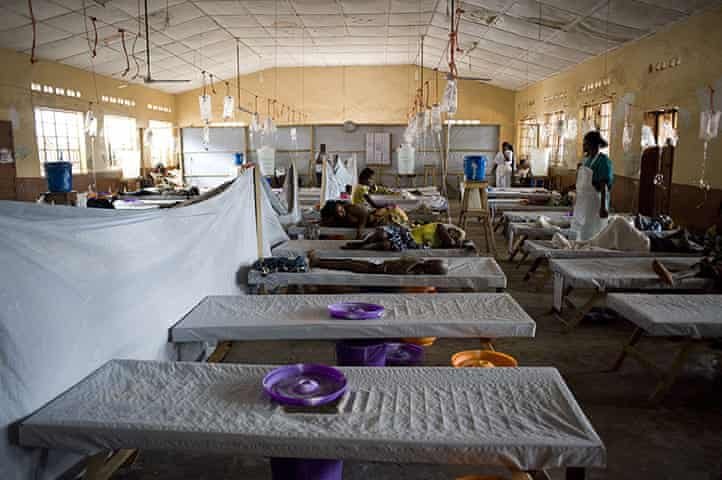

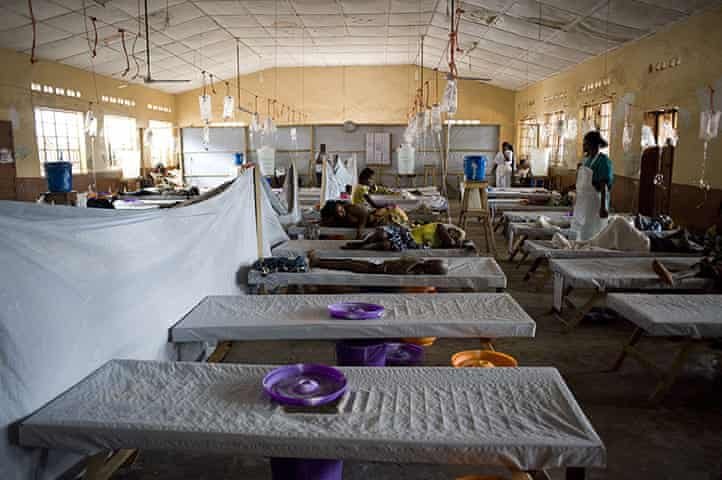
Cholera and Diarrhoea Illnesses in a Changing Climate
Some of the most urgent issues regarding the population health in Sierra Leone are waterborne diseases, especially cholera and diarrhoea diseases. These diseases have become a big burden with regard to morbidity and mortality, particularly in children below the age of five, pregnant women, and those economically sidelined. Waterborne diseases in Sierra Leone did not come about by one particular element, but because of a multifaceted construct between climate change, insufficient water and sanitation systems, socio-economic susceptibility, and a weak public health system.
Sierra Leone is one of the countries that have the highest water related diseases in the world. Fifty-eight percent of the population has no access to safe and reliable drinking water and only one in five has access to basic sanitation services. Climate variability, such as increased rainfall and frequent flooding and protracted dry seasons are also adding to these structural deficits, thereby reducing water quality and augmenting vulnerability to pathogens. In this regard, the waterborne diseases like the Cholera disease and the diarrhea disease are both a development crisis and a health crisis.
This essay discusses the disease burden caused by cholera and diarrhoea in Sierra Leone through epidemiology, environmental and climatic factors, socio-economic factors, and responses of the health system. The essay combines statistics and research results on the subject by offering an evidence-based and contextualized discussion of the interaction between climate change, water and sanitation conditions, and the outcomes of waterborne diseases with the systems in place to increase their adverse effects.
Water borne diseases: Cholera and Diarrhoea diseases
Waterborne diseases are contracted when a person ingests or comes into contact with water contaminated with disease causing micro-organisms. These are diseases which are transmitted by bacteria, viruses and protozoa including cholera, dysentery, typhoid fever, and other variants of diarrhoea disease. Among them, the cholera and diarrhea diseases have the most significant burden on the population health in Sierra Leone because of their high spread and direct relationship with the poor condition of water and sanitation.
The bacterium Vibrio cholerae causes cholera which is an acute watery diarrhoea accompanied by vomiting and high rate of dehydration. Cholera can be lethal within a few hours, especially when there is no timely treatment, especially to the vulnerable group. The illnesses of diarrhea in wider sense are the infection by such pathogens as Escherichia coli, Salmonella, Rotavirus and Shigella. These diseases are significant contributors of child death and malnutrition, and are closely associated with the presence of water pollution, suffering as a result of water scarcity, and poor hygiene behavior.
Waterborne diseases are also increased by the high level of dependence on unimproved water sources, lack of access to latrines, and lack of hygiene facilities in Sierra Leone. Such conditions provide a favorable environment to the spread of pathogens, in particular, in the seasons of active rains and flooding.
Epidemiological Situ of Waterborne Diseases in Sierra Leone.
Out patterns and Burden of Cholera
The outbreaks of cholera in Sierra Leone have happened repeatedly in several decades with the cases usually reaching their highest points during the rainy season between May and October. The result of flooding in this season is usually the water source contamination, sanitation systems destruction, and overcrowding in the informal settlements.
World Health Organization reported 20,736 cases including 280 deaths. This outbreak showed that the system was weak in water supply, sanitation facilities, and disease surveillance mechanisms. Population density, informal housing, and poor drainage were some of the factors that affected urban centers like Freetown especially because of the high population density.
The outbreaks of cholera are more recent and show evidence that this disease is still a menace. Recent outbreaks in Freetown recorded by Medecins Sans Frontieres (MSF) showed increased cases of cholera (over 1,500) and at least 17 deaths, which highlights the persistent susceptibility. Research of cholera prone communities depicts that even up to 76 percent of the sampled water exceeds the limits of safe microbes with contamination by E. coli and Salmonella, which indicates fecal contamination of drinking water sources.
Child Health and Diarrhoea Illnesses
Diarrhoea diseases are chronic in Sierra Leone and a major cause of morbidity as well as mortality, especially among children under the age of five. In a cross-sectional national study survey that was conducted in 2019, 12.3 percent of the surveyed households said they experienced diarrhea illness recently. The research also found out that, households which use poor water sources were almost twice as likely to experience diarrhea disease than the households that had access to improved water.
There are strong urban-rural inequalities. In urban areas, about 66.2 percent of households have their water sources as unimproved and only 73.0 percent of households in rural regions have their water sources as unimproved, as well as the sanitation coverage is very low in rural areas. The number of deaths caused by unsafe water, sanitation, and hygiene (WASH) practices is 81.3 deaths per 100,000 population, which is a high-density of health problems related to the diarrhoea diseases.
Waterborne Disease Environmental and Climatic Drivers
Climate Change and Rainfall Variability
The climate in Sierra Leone can be regarded as a tropical monsoon, although climate change is raising the number of variations in rainfall, which in turn increases the intensity of extreme weather conditions as well as interference with the seasonal pattern. The climate forecasts show increased and wrathful flooding, especially in the coastal and lowlands like Freetown and riverine communities.
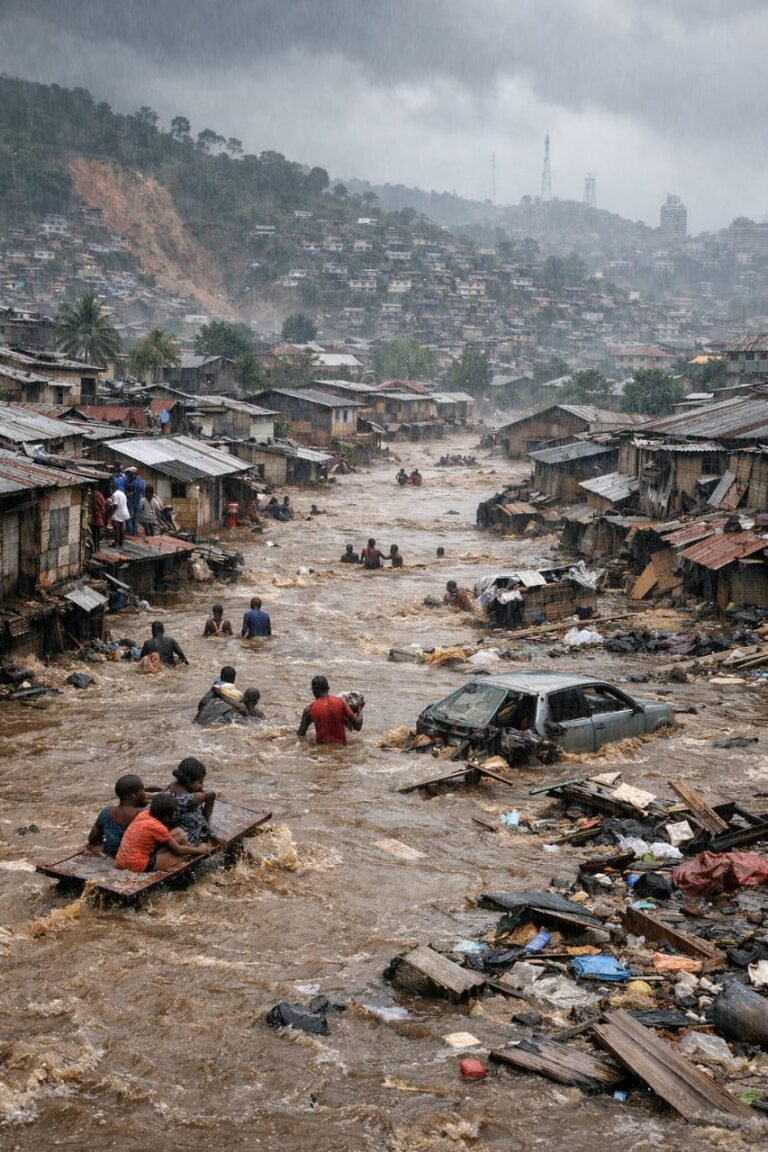
Flooding is a very important factor in the spread of waterborne diseases because it overloads drains, destroys latrines and sweeps away human and animal waste into water bodies. According to national climate vulnerability reports, floods greatly expose people to cholera, diarrhoea, and other diseases as people are compelled to use contaminated water due to the inaccessibility of clean water.
Informal settlements that lack proper drainage are the centers of diseases during the times of heavy rainfalls. Sewage mixed with standing water contains the best environment in which Vibrio cholerae and other disease-causing organisms can multiply, which may result in mass outbreaks.
Climate Stress on Water and Sanitary Infrastructure
Climate stress and poor infrastructure interact to increase the risks of diseases. Less than 16 percent of the population in Sierra Leone has access to basic sanitation and 28 percent of the population continue to use open defecation. In addition, 58 percent of them do not have access to basic water services and use unprotected wells, rivers, and surface water.
Even the enhanced water sources are not very reliable. According to UNICEF approximates 18 percent of the improved water sources are not functional, and that of all households, only a quarter have water sources within their premises. Such restrictions place households in long queues to access water, and more use of unsafe water is more likely.
This mainly affects children almost 46.5 percent of them use unsafe latrines, which do not have the necessary waste containment and lead to the polluted environment. These facilities are further weakened by flooding due to climate, thus exposing people to the risk of spreading pathogens.
Social-Economic and Demographic Susceptibility.
Poor and marginalized people are disproportionately affected by waterborne diseases. Poverty restricts the right to clean water, sanitation, and health services and overcrowding conditions expose them to infectious agents. In most cities’ slums, there is one toilet per house or even the use of open defecation which is an extreme alteration of the disease threat.
Communities in the rural areas have different challenges. Rural households have the lowest access to improved water sources at a rate of only 42.2 percent as opposed to 88.9 percent in urban households according Prevalence and risk factors of diarrheal diseases in Sierra Leone, 2019. Rural health centers are usually under-equipped and cause delay in seeking treatment and a higher chance of serious dehydration and death especially in young children.
Households are also restricted by economic means to buy water treatment supplies, i.e. chlorine or filters, or to obtain timely medical attention. The circumstances are compounded by malnutrition that makes the immune systems weak, and this increases the vulnerability to diarrhea diseases, and this leads to a vicious cycle of diarrhea diseases and poverty.
Capacity in the Health System, Public Health Responses and Surveillance and Outbreak Response.
The health sector of Sierra Leone is still struggling to overcome the great shocks that occurred in the recent years like the 2014-2016 Ebola crisis, which revealed significant vulnerabilities in terms of disease surveillance, workforce capabilities, and infrastructure. Although it has improved, there is still a problem of detecting and responding to outbreaks of water borne diseases at the earliest possible time.
There is a lack of regular monitoring of water quality particularly in rural areas and disease surveillance mechanisms do not have the capacity to detect warning signs before disease development goes out of control. The early detection and prompt response require strengthening laboratory capacity, community-based surveillance, and data integration.
Health Interventions in the community
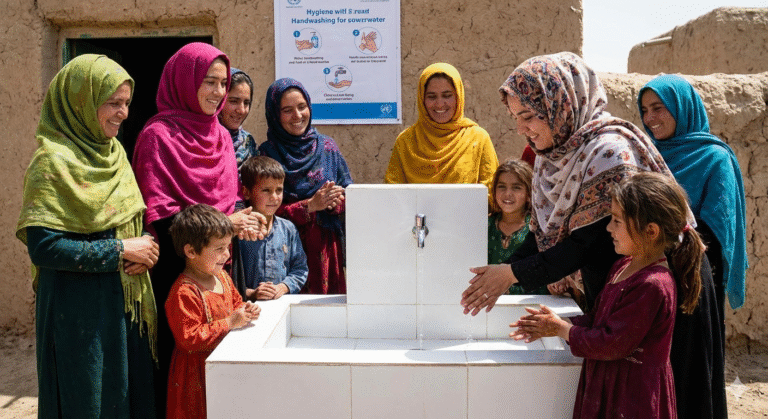
The interventions currently being used are cholera treatment centers, oral rehydration, vaccination programs and community-based hygiene education. The international community including MSF, UNICEF, and World Vision facilitate the work of government by supplying water treatment chemicals, promoting handwashing, and enhancing emergency WASH infrastructure.
These interventions are however, in most cases reactive, but not proactive. Unless there is long-term investment in water and sanitation infrastructure implementing gains in the response to the outbreak are hard to sustain.
Government reactions and resilient to climate planning
Understanding the nexus between health and climate change, Sierra Leone has started to incorporate climate resiliency in health and WASH planning. The national climate adaptation plans focus on enhancing water security and sanitation as major factors in lessening the exposure to the climate-sensitive diseases.
One of such initiatives is the World Bank-funded Water Security and WASH Access Improvement Program which is provided with a US investment of US$180 million over a decade. The program is meant to increase access to clean water and sanitation, build institutional capacity and enhance service delivery in schools, health facilities and underserved communities.
The effectiveness of such programs requires that they include climate risk evaluation, early warning systems in case of floods and community involvement. Specific actions in informal settlements and rural regions are of great importance.
A Future of Sustainable and Integrated Solutions
Water related diseases like cholera and diarrhoea diseases still present a heavy burden of health and economic cost to Sierra Leone. It is evident that low water quality, lack of sanitation, environmental disturbances caused by climate change, and restriction of the health system are highly interrelated causes of these diseases.
To overcome this difficulty, it is necessary to replace the emergency response with the long-term, preventive, and climate-resilient solutions. The infrastructure of water and sanitation, disease surveillance, community education, and access to equitable healthcare services are necessary. It is also important that climate adaptation is incorporated in the health planning to lessen the vulnerability to floods, droughts and environmental shocks.
In order to deal with persisting climate variability and development issues, the reinforcement of the nexus of water, sanitation, health, and climate resilience will be essential in Sierra Leone. By so doing, it will not only decrease the load of diseases related with cholera and diarrhea but will also improve the health of the population, increase their resilience and aid in the sustainable development in the conditions of a changing climate.



 Jonathan Tarnue Payne
 Precious Douglas Maulana
 Eslam Mohamed Elsheikh
 Lutfi Nurachma
 David R.K Brown
 Asef Jafari
Good times at 777becasino! A decent selection of games and a pretty smooth experience all around. Have a peek: 777becasino
Alright folks, check out gachoic1.con. I heard they got some good stuff going on over there. Might be worth a look, ya know?
Giao diện website và ứng dụng cũng chính là điểm gây ấn tượng đặc biệt với hội viên. mã nhận thưởng 888slot Nền tảng cho sử dụng màu sắc hài hòa, đơn giản nhưng khi kết hợp với nhau tạo cảm giác thu hút đặc biệt. Ngoài ra, hệ thống điều hướng, danh mục đều sắp xếp vô cùng khoa học nên dù bạn có là thành viên mới thì cũng sẽ dễ dàng tìm thấy thông tin mong muốn nhanh chóng. TONY01-12
Bạn có thể tùy chỉnh âm thanh, tốc độ quay và chế độ tự động trên mọi slot tại xn88 là gì – tạo nên trải nghiệm cá nhân hóa đúng theo sở thích và thói quen của riêng bạn. TONY01-12