

We usually see natural disasters as an unstoppable act of God, it become events where human power becomes useless standing against nature. But the tragedy of Derna, Libya challenges this narrative. The scar has cut the city in half, made a path of mud and rubble where neighborhoods once stood. This is not only the result of a storm. It is the visible consequence of a much deeper, man made crisis.
Derna is a stark case study of what happens when critical infrastructure is allowed to be runied by the shadow of political mismanagement. The disaster was not caused because of concrete fracture and climate change, but it was a failure of the institutions designed to protect them. As climate change accelerates, it turns the historical weather anomalies into frequent reality, Derna serves as a harsh warning to the world. The greatest threat to our safety is often not the storm itself, but the silence of the bureaucracy that came before it.
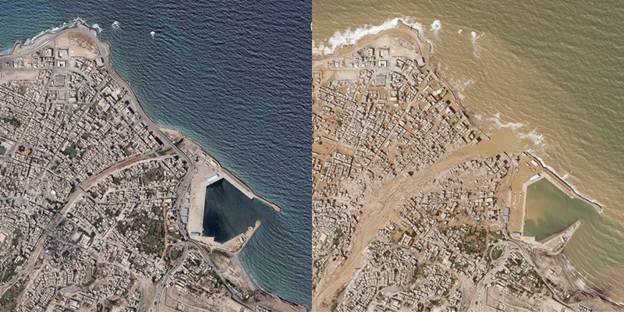
The Flood Failure
To get how big the failure was, we must first look at the event itself. On September 11, 2023, Storm Daniel which is a rare intense storm struck the Green Mountains or Jebel Akhdar of eastern Libya. The meteorological violence was unusual.
Reports are showng that the region got more than 400 millimeters of rain in just less than 24 hours. To put this into perspective this number is roughly 400 times the usual average monthly rainfall for September in this specific region (WMO, 2023). The dry riverbed of Wadi Derna, usually is a dry river landscape,but it filled instantly.
The direct mechanism of the disaster was the double collapse of the two dams protecting the city, which are the Abu Mansour Dam, located 14 kilometers upstream, and the Derna Dam, which is just one kilometer from the city limits. When the upper dam failed, it released a 30 million cubic meter wall of water. This water wall built momentum and collected rubble, then smashed into the lower dam and destroyed it instantly. The main wave ripping through the city center at 2:30 AM, while most of the residents were sleeping. The numbers died that night from official is over 4000 people, and still thousands remain missing (UN OCHA, 2023). These numbers represent families, history,and dreams. Derna flood is a tragedy that that has started long before the first drop of rain fell.
The Predictable Collapse
It’s rare to relly the failure of a dam on just engineering failures, but they are almost always governance failures attached to it. The dams in Wadi Derna were modern engineering projects, built in the 1970s by the Yugoslav company Hydrotehnika-Hydroenergetika to protect the city from flash floods (Hydrotehnika, 1977). They were designed to save lives. However, like much of the world’s infrastructure, they were allowed to age without the proper maintenance.
The problem was neither unclear nor unknown. It was documented and academic. In a 2022 studyabout the structural vulnerability of water dams in Wadi Derna, Eastern Libya published by hydrologist Abdelwanees Ashoor from Omar Al-Mukhtar University one year prior to the disaster, he specifically warned that the dams were structurally susceptible. His work incorporated how the wadi flowed and he found that the situation of the dams at the moment, is considered a threat of disaster to the city of Derna (Ashoor, 2022). He explicitly demanded an immediate repair and the building of a third dam to accommodate the load.
All of these clear signs failed to prevent the fact that, according to reports, there had been no maintenance on the dams since 2002 (Reuters, 2023). It wasn’t a surprise that it collapsed, but it was a surprise that people ignored the data.
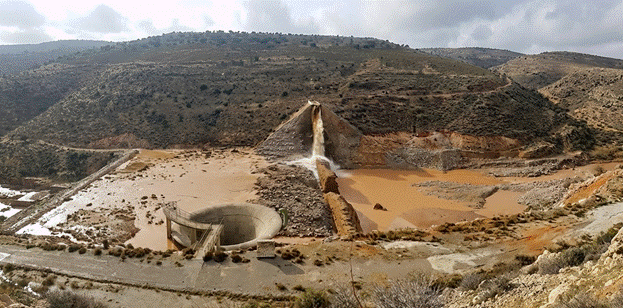
Failed Dams Same as Failed Governance
The collapse of the dams is just a mirrors the collapse of the Libyan state’s ability to function. The country’s political fragmentation, split between rival administrations in the East and West, created a vacuum of responsibility where critical infrastructure became a casualty of goverment failure. In Libya, the issue was not a lack of funds, as Libya is an oil-rich nation, but a lack of institutional coherence. Funding for dam repair was caught in a bureaucratic gap, unrecognized by central banks or diverted by corruption. In 2021, the Audit Bureau of Libya reported that more than $2 million had been allocated for the maintenance of the two dams in 2012 and 2013, but the contracts were never fulfilled (Audit Bureau, 2021).
This phenomenon is known as institutional delay, that makes the dangerous gap between identifying a risk and acting on it. In a functioning system, Ashoor’s warning would have triggered an emergency inspection. In a fragmented system, and it was ignored(Ashoor, 2022). On the night of the storm, this breakdown in the chain of command proved fatal. People even got different orders as some officials imposing a curfew that trapped residents in their homes, while others called for evacuation too late (AI, 2023).
The Climate Multiplier
We can no longer rely on historical weather patterns to predict the future and its risks. Scientific analysis by the World Weather Attribution group found that human induced climate change made the rainfall from Storm Daniel up to 50 times more likely and 50% more intense than it would have been in a pre industrial world (WWA, 2023).
The Mediterranean Sea is warming about 20% faster than the global average, which acting as a battery that stores thermal energy, would come with unpredictable changes (IPCC, 2023). When cold air meets this overheated sea, it fuels storms with the ferocity of tropical cyclones. Relying on infrastructure design standards from the 1970s to withstand the climate of the 2020s is a fatal calculation.The Derna dams were built for the 20th century, not the volatile reality of the 21st.
Chart showing the rise in Mediterranean sea surface temperatures starting from 1982 to 2023 (CEAM, 2023)

A Global Warning with 50 Year Threshold
It would be a mistake to view Libya as an isolated case. The threat of aging infrastructure with weather changes are hunting every continent. We are sitting on a global time bomb that is according to the United Nations University, as tens of thousands of large dams worldwide are reaching or exceeding the alert age the threshold of 50 years (UNU-INWEH, 2021). Most of the world’s large dams were built between 1930 and 1970, designed using hydrological era that is now not facing the same challenges.
- United States average age of the 90 thousand of dams is already over 57 years. The Oroville Dam crisis in 2017 demonstrated the fragility of even well funded infrastructure.
- Asia has thousands of large dams in India and China that were built in the mid 20th century, are showing signs of distress.
- Europe Aging flood defenses are struggling to stay with the new reality of flash floods.
Institutional Reform Is the Only Path Forward
Restoring the dams in Derna is not enough, but we should restore the institutions that manage them. The solution is Adaptive Water Governance, a model that builds resilience against both political instability and environmental shocks.
1. The Depoliticization of Safety
Critical infrastructure must be designated as a neutral zone, managed by independent technocratic bodies, and it would be better if it’s from the local. National Dam Safety Authorities must be shielded from political cycles, similar to how central banks are protected. Funding for maintenance must be fenced and legally separated (Trans. Int., 2023).
2. Integrated Early Warning Systems (EWS)
A dam should never fail in silence. Modern governance involves having access to real time meteorological data and hydrological models. These scenaria need to be fully automated, and make alert directly to rural population using mobile coverage, not passing the bureaucratic layer. The freeze order has to be automatic if the water is above some level.
3. The Climate Audit
Every country needs to stress test its 20th century infrastructure they have using 21st century climate models (IPCC AR6, 2022). If a dam is not capable of holding the Probable Maximum Flood (PMF) for the present climate age, it must be retrofitted or decommissioned at once.
The devastation in Derna is a testament to what happens when we dismiss a clear threats of climate change and institutionals that result in paralysis. Storm Daniel was a monster, but it was a monster welcomed in by government dysfunction. The way forward isn t simply a choice between the perfect and imperfect solutions, but it is a choice between a future in which governance is transparent and where science truly is followed and where the safety of a citizen is prioritized over the preservation of a political status quo. Trust and dams must build both with care.

 Jonathan Tarnue Payne
 Precious Douglas Maulana
  Eslam Mohamed Elsheikh
 Lutfi Nurachma
 David R.K Brown
 Asef Jafari
Been messing around on a5game lately. It’s got a few interesting things going on. Could be a good shout if you’re looking for something new a5game.
Yo, just wanted to say that using f168app has been a game-changer for me. The interface is slick, easy to navigate, and I’ve had some serious wins. Seriously recommend giving it a shot if you’re looking for a good time!
Yo! 23wincasino, anyone? I was a bit skeptical at first, but decided to give it a go. Pleased I did to be honest. Decent selection of games. Have a look at 23wincasino.