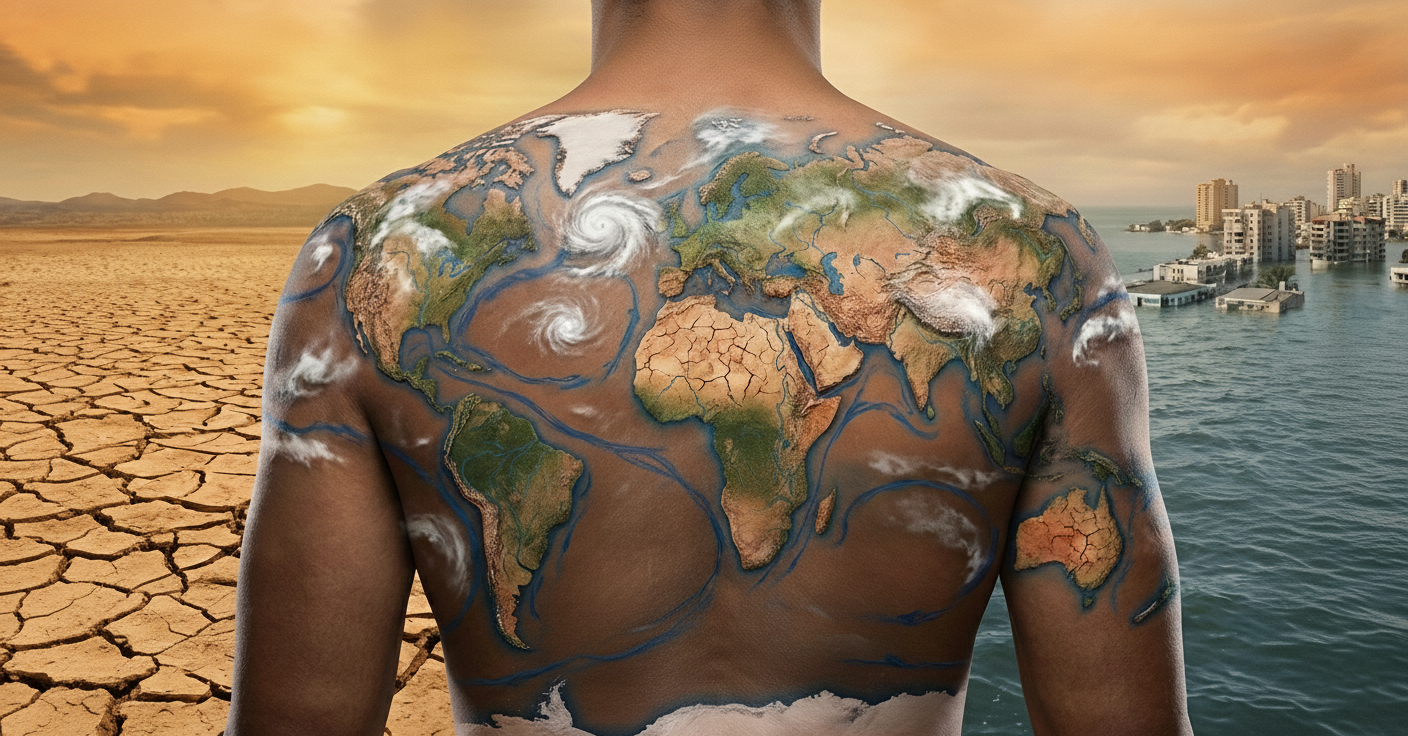

How would it feel if, literally, every environmental change was directly manifesting as a scar on some part of your body? What if every piece of contaminated water was flowing through your bloodstream? The world around us and how we feel it, affects us as much as we feel it. This instinct and reflex connote understanding the world and the surroundings as holistic.
This ecology understands the relationship as a systemic one. It understands the internal bond of the world and the body. We appreciate the world and our place in it through this systemic understanding. It is literally true, we feel our world through the environment. The world around us is a continuum of the world inside. We are currently experiencing a world wide health crisis. It lacks an external emergency, a loud noise, a striking event. It is the silent deterioration of our internal organs. It is the slow multiplication of harmful organisms. It is the gradual disintegration of our internal, holistic world. The external scars and internal wounds speak of the same story. The ask is simple, we have to read our health records and see the climate emergency they embody.
The Deadly Sun
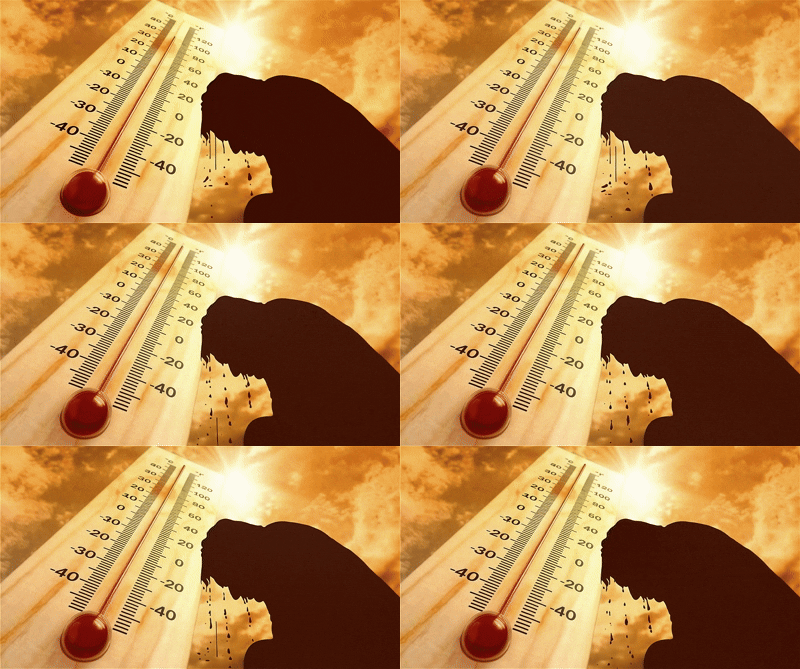
Egypt faced in August 2015 a record heat wave, with Cairo experiencing temperatures as high as 42 degrees Celsius and a higher feel temperature. The southern parts of the Egypt saw temperatures as high as 46 degrees (The Guardian, 2015) . The human body suffered greatly as a result. The heart has to work much harder in this hot weather. In an effort to help cool the body, it tries to deliver blood to the skin. However, sweat cannot properly evaporate in humid air. As a result, the body begins to heat up internally rather than cool.
This heatwave killed more than 61 people in just three days (Al Arabiya, 2015). Many of the victims were elderly, as they are more vulnerables. Some were patients in psychiatric wards where cooling was not available. Others were in crowded detention centers. The heat did not care who they were. It only cared that they were unprotected, as over 580 people were hospitalized for heat exhaustion during that short period of time (Al Arabiya, 2015). This event showed that our infrastructure is not fully ready for the new reality check from the sun.
The danger of heat is only increasing. In June 2024 the Hajj pilgrimage in Mecca was hit by some really intense heat. The temperature at the Grand Mosque soared to a blistering 51.8 degrees Celsius (WHO, 2024) . That’s dangerously close to the point where staying safe becomes a real challenge for anyone. More than 1,301 Hujaj lost their lives (The Guardian, 2024). Most of these people were walking long distances, as it needed. They did not have access to cooling stations. They died mostly of heatstroke while trying to fulfill their religious duties. This tragedy is a warning for every outdoor event in our region. We cannot ignore the fact that the sun is becoming more violent every year.
The Return of the Mosquito
Egypt face the return of diseases even after people thought it already fully gone. Egypt has a sort of long history with malaria, and it haunted the Nile Valley for thousands of years (WHO, 2024). For a long time, the country worked to end it, and people have believed the battle was over. However, in 2014, the disease all the sudden just appearance again. An outbreak of 313 cases reported in the Aswan Governorate in the south(WHO, 2024). Most cases were found in the village called Gharb Aswan.
The Nile Valley’s mosquito population thrives due to climate change, so this outbreak was seen as a warning. They also in high heat can digest the malaria parasite faster. This means they can infect more people in a shorter amount of time. The movement of people across borders also can helps the disease travel. Egypt had to fight hard to stop this outbreak. The government used massive spraying campaigns and rapid testing in the infected areas.
After the Egyptian intense efforts to get raid of malaria, the World Health Organization certified Egypt as malaria free in October 2024 (WHO, 2024) . This is a big achievement. It took nearly a century of work to reach this goal. But we must understand that this status is not permanent. The climate is making our borders as gaps to import more tropical diseases, especially as long as the planet continues to warm, the mosquito will search for new places to live. Our victory is real, but it requires constant vigilance. If we stop monitoring our water and our air, the disease will find a way back to Egypt.
The Poisoning of the Delta
The third disaster is happening slowly in our soil. The Nile Delta is considered the food source of Egypt. It provides the food that feeds millions of Egyptians. But the sea is rising. As the Mediterranean Sea rises, salt water pushes into the land. This is called soil salinity. You can see it on the ground. It looks like a white crust of salt on the fields. This salt is destroying the quality of the earth. But the real danger is invisible.
When soil becomes too salty, it changes how plants behave. High salinity makes heavy metals in the soil more mobile (bepls, 2012). Seeing metals like Cadmium and Lead. are poisons that stay trapped in the earth without risks. But the salt releases them. The roots of crops like rice and vegetables then suck up these metals. The poison moves from the dirt into the food we eat every day. This is a direct threat to our long term health.
Cadmium is a very dangerous substance, as it builds up in human body and stays there. It causes severe damage to the kidneys. It can also lead to bone diseases and various types of cancer (PubMed Central, 2024). Lead is even worse for the young. It attacks the brain and the nervous system. Exposure to lead can lower the IQ of children and cause behavioral problems. It also leads to heart disease in adults. Recent studies in the northern Nile Delta show that these metals are already present in the soil and the crops (PubMed Central, 2025). We are not just losing our land to the sea. We are losing the safety of our food. Having salt in the soil will turn some elements of our diet into a health risk.
I think we must stop treating these issues as separate problems. The heatwave, the mosquito, and the salty soil are all connected. They are all parts of the same climate crisis. We need to build better cooling systems for our cities to protect the elderly if needed. We must maintain our health surveillance to keep malaria away. We must find new ways to farm that protect our food from heavy metals. Our health is not a private matter. it is a public duty. The actions we take to protect our environment are the same actions we take to save our lives.

 Jonathan Tarnue Payne
 Precious Douglas Maulana
  Eslam Mohamed Elsheikh
 Lutfi Nurachma
 David R.K Brown
 Asef Jafari
Downloaded the game from ag999gamedownload, super easy and fast. No sketchy stuff, just a smooth download. Recommended! Get it from ag999gamedownload
Alright, so I stumbled upon 777kingcon and gave it a whirl. It’s got its moments, you know? Worth a look if you’re bored. Check it out yourself: 777kingcon
xn88 app có hệ thống cảnh báo “chơi quá thời gian” – sau 2 tiếng liên tục, bạn sẽ nhận thông báo nghỉ ngơi – vì sức khỏe luôn là ưu tiên hàng đầu. TONY02-11O