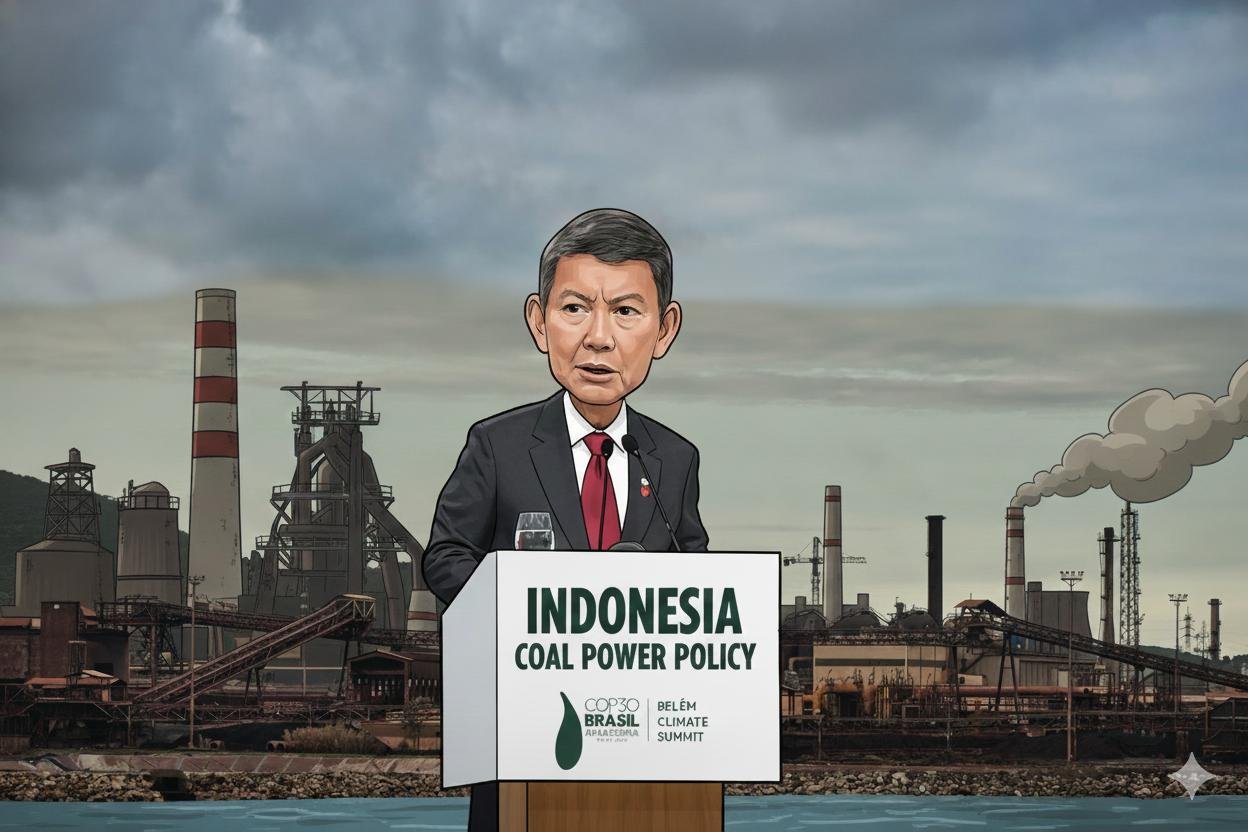

A decade after the Paris Agreement in 2015, the 30th Conference of the Parties or COP30 was held in Belém, Brazil. Nations and the global community gathered with one singular focus of turning pledges into actions, especially discussing the Global Goal on Adaptation (GGA) and climate finance. From the COP30 a lot of outcomes were produced with the most controversial one being the”Belém Roadmap.” Over 80 nations with high ambition coalition to establish a formal, voluntary global plan of the phase-out of fossil fuels. Indonesia being one of the biggest emitters, its participation was very anticipated. However, Indonesia was nowhere to be seen when the list of signatories for the Belém Roadmap was released. Indonesia denied the accusation that it was absent from the roadmap as an act of a denial in climate science, but rather a deliberate declaration of energy security and economic sovereignty. This highlights the global north’s plans for reducing carbon emissions and its actual development needs. In this article there are few arguments about Indonesia abstaining from the Belém Roadmap.
Indonesia’s diplomatic stance in Belém was based on the”Common but Differentiated Responsibilities and Respective Capabilities”(CBDR-RC). The Indonesia delegations made a clear position, the Belém Roadmap is ecologically necessary but economically impossible without a simultaneous, binding”finance phase-in”roadmap. The roadmap is not aligned with CBDR-RC because the developed countries expected Indonesia to shut down its coal plants; there should be capital from developed countries to bridge the resulting energy and revenue gaps. In reality, the huge amounts of climate money are mostly theoretical, leaving developing countries to choose between global climate leadership and domestic stability. Additionally, the slow progress of the Just Energy Transition Partnership (JETP) is a significant driver of Indonesia’s skepticism at COP30. Launched at the 2022 G20 Summit, with a promise of $20 billion in financing to help Indonesia accelerate its coal phase-out, three years later the reality of the deal has fallen short of the rhetoric.
Less than 15% of the promised funds are offered as grants; checks on the JETP plan show a tough financial setup. Most of its loans consist of commercial-rate loans. For a growing economy like Indonesia’s, replacing cheap, domestic coal with expensive coal and borrowed renewable energy could lead to huge national debt issues. This financial issue is reflected in Indonesia’s domestic policy. Another reason for Indonesia’s refusal to sign the Belém Roadmap comes from its domestic policy, which the 2022 presidential order (Perpres No. 112) attempted to prevent new coal plants and increase renewable energy, but it left a significant loophole for “captive power” plants dedicated to private factory setups.
The Dilemma
Another most significant hypothetical reason for Indonesia’s absence from the fossil fuel phase-out roadmap is its ambition to become an Electric Vehicle (EV) battery superpower. Indonesia’s position as a major producer of nickel is tied deeply to one of the reasons for Indonesia’s decision on the roadmap. Indonesia controls 50% to 67% of the world’s nickel supply by 2025 and it is part of Indonesia’s downstreaming strategy or Hilirisasi policy. Nickel is one of the major key resources for the shift to green energy. However, the mining and smelter of nickel companies require a massive amount of energy and Indonesia has built over 22 gigawatts of coal-powered plants to support this. Signing the roadmap could threaten the legal status of these operations. It creates a paradox; the world needs Indonesian nickel to meet net-zero targets, but Indonesia needs coal to produce it affordably and maintain its competitiveness. The Indonesian government is betting that the need for these green minerals will outweigh immediate demands for greener production practices by refusing to sign the roadmap. Indonesia’s economy deeply depends on coal for funding public needs. Indonesia produced 836 million tonnes of coal, and its revenue from the industries supporting taxes and royalties that pay for education, infrastructure, and social programs. In the era of global economic uncertainty and fluctuating commodity prices, coal acts as a steady financial buffer for Indonesia state budget (APBN).
In another argument, the most immediate threat from Indonesia’s decision to skip Belém Roadmap is the European Union’s Carbon Border Adjustment Mechanism (CBAM). This mechanism is a way for the EU to tax imports based on their carbon footprint, and it could loosen the price advantage of Indonesia’s coal-powered nickel in western markets. If Indonesia doesn’t support international climate initiatives, its exports may be labeled as”dirty,”and it could place Indonesia in secondary markets by losing its place in the high-value Western EV sector. This might reduce Indonesia’s cost and scale advantage. Furthermore, the distance with the global roadmaps may deter institutional”green”investors who are bound by strict Environmental, Social, and Governance (ESG) mandates, and it could narrow the opportunities for available capital for future infrastructure projects.
The Indonesian government sees a swift, outside-driven phase-out as a danger to its capacity to finance its own social development objectives. From Indonesia’s perspective, transitioning the coal without guaranteed and equitable finance to substitute for its lost revenue, would risk internal social and economic instability. Not being able to sign the Belém Roadmap, the Indonesian government gave a signal that Indonesia will prioritize national development and industrial sovereignty until the international community provides a financial framework.
A Geopolitical Reality Check
Indonesia’s stance on Belém Roadmap represents a high-stakes geopolitical gamble that could reshape Indonesia’s trade relationships for decades. According to the Institute for Energy Economics and Financial Analysis (IEEFA), Indonesia is currently prioritizing immediate domestic growth and industrial expansion over the accelerating timelines of global decarbonization. Although this may alleviate fiscal and industrial strains in 2025, underpinned by a significant revenue stream from delivering 836m tonnes of coal: but the persistent challenge will be how to adjust to a world where there is increasing resistance in international markets to heavy-on-carbon manufacturing. By tethering its success in “green minerals” to coal-based energy, Indonesia is confronting the risk of being locked out of higher value markets for a key export at a time when low-carbon supply networks are coming into their own. In the end, for Indonesia to fit into international climate plans, the global conversation has to shift from high-interest commercial loans to concessional grants and direct technology transfer. Here in Jakarta, the current financial architecture that fuels debt accumulation is considered as part of “climate colonialism”that stands in the way to make progress. This will likely continue to be the case until global banking systems evolve enough for climate change to be considered more of a collective moral, planetary responsibility rather than just complex loan opportunity; Indonesia and many other countries within the Global South will probably continue to prioritize economic self-sufficiency and industrial strength over following these roadmaps.





 Abdul-Razak Issifu Yidana
 Amadu Barrie
 Primrose Mutema
Yo, signing up for W88 can be a pain sometimes, but dangkyw88 makes it super easy. Smooth process, highly recommend giving it a shot if you’re looking to join them. Go sign up at dangkyw88!
Alright, Jili123PHcom… that’s quite a name! Registering now and crossing my fingers for some wins! Come and join if you’re feeling lucky: jili123phcom
Hey mate, looking for 7m.cn ma cao odds? This is the place. Been using it for years and never had an issue. Good luck with your bets! Get started at 7m.cn ma cao.