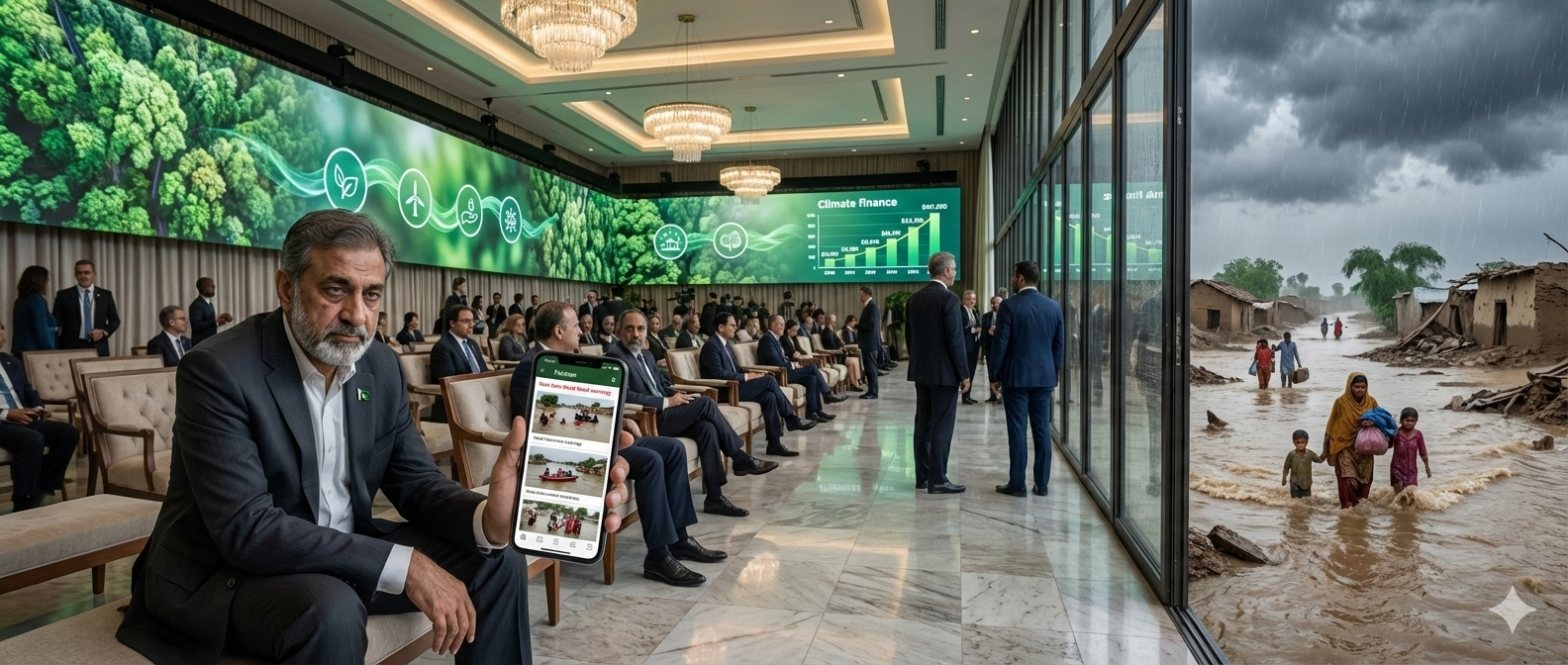

Belém’s COP30 which was held in Brazil this time, felt like standing in two different worlds at once: inside the pleasant air-conditioned arena where screens glowed with the promise of trillions in climate finance; outside, delegates from disaster-hit countries like Pakistan kept checking their phones for fresh updates from home about destruction and casualties. You never saw an explicit item on Pakistan’s 2025 monsoon disaster on the agenda. But it was everywhere in the subtext. Speeches on loss and damage. Corridor whispers on adaptation finance. And the listless exhaustion of negotiators who spent yet another long hot summer managing evacuations rather than making or implementing policy.
The Belém Package: Money on the table, ambiguity in the shadows
The 30th Conference of the Parties to the United Nations Framework Convention on Climate Change will be remembered for the “Belém Package”, the agreement that is meant to shift the process from promises to delivery. The nations agreed to redefine the trajectory of financing. Countries committed to mobilising at least $1.3 trillion a year by 2035 for climate action. They also made a headline commitment to triple adaptation finance. It was also agreed to operationalize regular replenishments of the Loss and Damage Fund. According to a UN report, climate action agenda fails to consider vulnerable nations. For those nations which are vulnerable to climate change, this recognition is long overdue. This report further outlines how adaptation, not just mitigation is key to their survival. The Pakistani flood 2022 and 2025 illustrates the underfunding of efforts to build resilience. But the deal had dark spots. The Belém statements referred to “planning” the transition away from fossil fuels, but stopped short of a clear, time‑bound commitment to phaseout production and consumption. Pakistani negotiators, who have stressed that their people are drowning and overheating, despite contributing less than 1% to climate chaos, often feela pull on familiar strings like strong language on finance but weak wording on the root causes.
Loss and damage: From symbol to system
The corridors representing loss and damage witnessed a contrasting tone at COP30 compared to COP27, as officials agreed, with the fund now a reality alongside an agreed structure and replenishment cycle. The negotiators have managed to stabilize the architecture around three pillars, namely the Warsaw International Mechanism, the Santiago Network, and the new Fund for Responding to Loss and Damage that is now part of the Belém decision. The words associate “urgent and enhanced action and support” on loss and damage with the wider ramp up of climate finance, making it more difficult for rich countries to pretend this is a niche or symbolic side issue.
This institutionalization is a win and a test for Pakistan. It has become a reference point in speeches and reports. Its floods are shorthand for climate injustice and cascading social impacts. Shifting from a warning example to actual receipt of predictable, grant-based finance for loss and damage will depend on the post Belém rules: who is counted as “most vulnerable”; the speed of disbursement after events, like the 2025 monsoon; and whether the procedures work with overstretched national systems, like NDMA and PDMAs or overwhelm them in paperwork.
Adaptation finance: A win that still feels too small
One of the headlines from Belém involved a pledge to at least triple adaptation finance for developing countries by 2035, building on the prior pledge to double it by 2025. For delegations from flood-prone countries, this was the language they had been asking for: a sign the world does finally accept that adaptation is not charity, but a pillar of global stability and justice. Pakistan’s representatives repeatedly linked this outcome to concrete gaps at home – under-resourced early warning systems, weak river embankments, non-existent urban drainage in informal settlements, and the mental-health toll on communities surviving flood after flood.
However, as analysts noted in the days after the summit, achieving tripling adaptation finance by 2035 is not as ambitious as it sounds. The target timeline is pushed out and the target is now looser than earlier “doubling” language. Furthermore, a lot of the money is now expected to come from re‑labelled or leveraged flows via multilateral development banks and private finance. Unfortunately, not from new grant‑based public funding that countries like Pakistan say they need to avoid deepening their debt crises. Looking from the view point of a village that got evacuated thrice since 2022, the promise for 2035 seems very far away.
Pakistan’s COP30: turning floods into leverage
COP30 had been labeled the COP of implementation, while the Pakistani strategy for the meeting can be termed that of the COP of survival and dignity. Thus, before COP30 in Belém, a series of policy briefs and roundtable consultations in Islamabad concluded in a clear strategy: Pushing the agenda of climate justice. In this context, pressing hard for grants rather than loans. And framing Pakistan’s National Adaptation Plan as well as its climate-resilient reconstruction agenda as directly connected to demands for new global finance commitments. In speeches and side events, Pakistani officials strongly relied on the Common But Differentiated Responsibilities principle, noting that Pakistan contributes around 0.9 percent of global emissions, although it is among the most climate-vulnerable countries.
At the same time, domestic reforms were part of the story Pakistan was telling: efforts to develop a Pakistan Climate Resilience Financing Framework, to expand renewables and to invest in river-basin restoration initiatives such as the “Living Indus” were presented as proof that the country was aiming not simply to ask for assistance but to change its own trajectory. In this context, the floods of 2025 were used as both an appeal for empathy as well as a technocratic argument; without scaled-up, predictable support, even well-designed adaptation and disaster-risk strategies will be overwhelmed by a non-stationary climate.
Process and politics: a COP between forest canopies and floodwaters
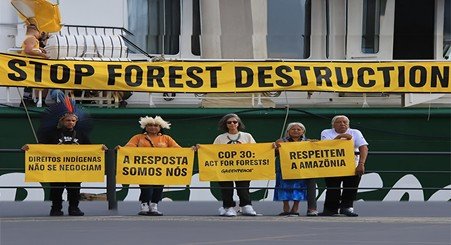
The process taking place in Belem mirrors the politics. taking place globally. The Brazilian government said forests, finance and implementation while promoting the “Global Mutirão” decision is a joint commitment to overcome North–South divides and place people and nature centre stage. Groups representing civil society from the Amazon, South Asia, and small island states provided a different energy inside the halls. They activated negotiators again to remind them that implementation without justice can easily become another form of greenwashing, especially if fossil-fuel expansion continues. Furthermore, if high-interest loans for their own adaptation are locked in for frontline communities.
Pakistan’s lesson from COP30 along with other climate-vulnerable states was mixed . They got several of their key demands on adaptation and loss and damage , and saw climate finance targets finally put down with numbers that match at least part of their asks. The failure to fix a hard fossil-fuel phase-out deadline and the reliance on complicated finance architectures behind the agreement mean that every future flood season every monsoon in Pakistan, every cyclone in the Bay of Bengal will emerge as a test whether Belém’s promises live beyond the negotiating rooms.
In the end, COP30 reads like a chapter where the plot advances but the central tension remains unresolved. The Belém Package gives countries like Pakistan new tools, frameworks and talking points to demand climate justice and resilience, especially after brutal seasons like the 2025 monsoon floods. But the real story will unfold not in plenary halls, but along riverbanks, in district disaster offices, and in the everyday decisions of families deciding whether to rebuild in the same flood‑prone places or to move on—waiting to see if the trillions promised under the Amazon canopy ever reach the soaked streets of Sukkur, Swat, or South Punjab.
“Countries that contributed least to the crisis must not be asked to finance their own survival with debt.”





 Jonathan Tarnue Payne
 Precious Douglas Maulana
 Eslam Mohamed Elsheikh
 Lutfi Nurachma
 David R.K Brown
 Asef Jafari
Alright, gk88slot, you got my attention. The variety of slots here is HUGE. Plus, the interface is pretty smooth. Thumbs up from me! Give it a try gk88slot
Spinph8 is where I’ve been spending my free time lately. Got some nice wins on the slots! The site layout is pretty slick too. Head to spinph8 if you want to give it a go.
188betlogin is a really solid platform for sports betting! Easy to navigate, loads of markets. Highly recommended for fellow punters. 188betlogin
M88casino, what’s up! A solid platform with all the familiar games. It’s like visiting my local casino without having to put on pants – bonus! Check it out: m88casino
Okay, 1xslots – there are SO MANY slots! If you’re a slot fan, this is your place. I got a little lost at first with all the options, but once I figured it out, it was fun. Check them out here: 1xslots
Go88club, huh? Never tried it before. Any of you guys had any luck there? Thinking of giving it a whirl. Share your experiences! Maybe go88club could be our next hangout spot!
CK999login is my go-to! Super simple login process and I’ve never had any issues. If you’re looking for a hassle-free experience, this is it. Give it a shot ck999login
Discovered ZK77game recently and been having a blast! It’s simple, easy to use, and has a good selection. It`s fun zk77game
Downloaded the qk777gameapk today and so far, so good! Installation was a breeze, and the games are kinda addictive. Give it a shot if you’re into mobile gaming! qk777gameapk
Vin68bet has been on my radar. I’ve put a few bets down and so far so good. Interface is clean and simple. Give it a whirl: vin68bet
Whinph is an interesting platform, giving it a spin myself currently. Noticed they have a few game options I haven’t seen elsewhere. Worth checking into: whinph
Heard some buzz about 123betplataforma, so I checked it out. Found a couple of things I liked. Definitely give it a once-over if you are searching for something new: 123betplataforma
I was hesitant to try a VIP program, but KUVIP.CLUP changed my mind. The benefits are unreal like increased bet limits and faster withdrawals. I encourage every player to try kuvip.clup it.
Yo, 555winpg, not bad! Registered quick and easy. Games are solid, nothing groundbreaking, but definitely entertaining. Give them a whirl! 555winpg
888jili7, huh? Tried them out last night. Won some, lost some, you know how it goes! Good variety of games though. Jump in and have some fun! 888jili7