

Strengthening National Health Resilience
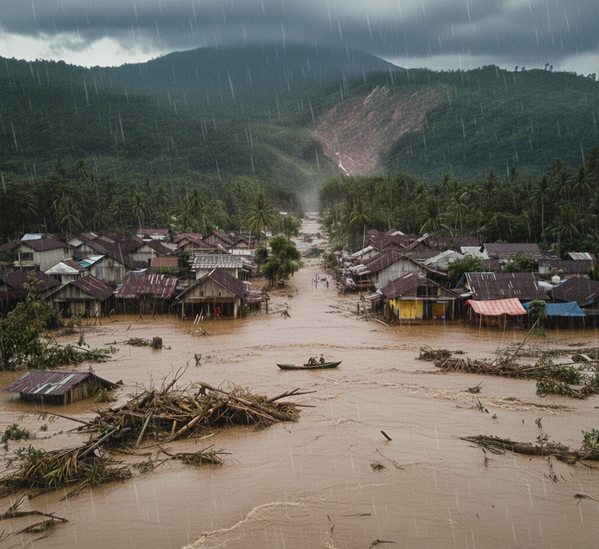
Climate change has become inseparable from public health, as it has significantly affected, both directly and indirectly. However, the awareness of climate change’s impact on health conditions and life expectancy is still low among the people. For instance, heatwaves lead to death and potentially increase the number of fatalities when the policymakers do not address the climate risks properly. The disaster that occurred in Sumatra has concrete impacts, as more than a thousand people died due to the floods, more than a hundred are missing, and the survivors suffer from health problems at the inappropriate evacuation shelters. The potential risk of disease transmission is immense, as the evacuation shelter, which is an overcrowded condition, has limited access to clean water and sanitation. It demonstrates a linkage between climate change and its impact on public health.
Early Detection as an Early Warning System: Desa/Kelurahan Sehat Iklim (DEKSI – Climate-Resilient Healthy Villages/Sub-Districts)
Geographically, Indonesia as an archipelago country, has a high level of exposure to climate change. Indonesia has many small islands, so that can be categorized as Small Island Developing State (SIDS), which is vulnerable to the rising sea level and extreme weather -heatwaves and heavy rainfall – are becoming more frequent, leading to many disasters. Access to food, clean water, and any daily life supports are affected by climate change. Furthermore, the impacts also trigger population movement, particularly when disasters or disease outbreaks happen. Thus, the urgency for early detection at the community level is essential to reduce public health risks related to climate change.
The Climate-Resilient Healthy Villages/Sub-districts Program (Desa/Kelurahan Sehat Iklim – DEKSI) is a program developed by the Government of Indonesia, particularly the Ministry of Health. The program is concerned about climate-sensitive diseases, such as dengue, malaria, Acute Respiratory Tract Infection (ARI/pneumonia), and diarrhea. Through a community-based approach, DEKSI aims to reduce the number of those diseases in the community. The community approach matters because the local level community is the most vulnerable to be affected by the climate-related health risks. DEKSI encourages communities to prepare for these risks and respond to them in practical ways. In this sense, DEKSI can be seen as part of Indonesia’s climate adaptation efforts in the health sector.
DEKSI is carried out based on four key principles, prioritization of locations, participatory approaches, community leadership, and the sharing of good practices. The first principle, prioritization of location, points out the identification process of the priority area. The process is valuable for the government, since it provides map locations that can be used by the government to carry out the intervention, which are more appropriate for the specific conditions and needs of each area. The participatory approaches, as the second principle emphasizes the involvement of all the stakeholders who come from all levels and sectors. The policymaking process – planning, implementation, and evaluation – involves the crucial role of local communities. The public awareness and contribution are strengthened by the active role of communities, which aligns with the third principle, that is, to put society as the leader. Since the local communities are frequently most exposed to the impacts of climate change, they have to recognize how the climate is reshaping their environment and livelihood, so that they can take appropriate adaptive measures. The last principle is sharing good practices, which perceives that climate-related health actions can be diffused across different sectors and levels, while taking local context and specific characteristics into consideration.
DEKSI programs at the grassroots level are generally manageable to implement due to the possibility of their integration into health and climate programs, which were already performed at the villages or sub-district levels. Health-related initiatives include Community-Based Total Sanitation (Sanitasi Total Berbasis Masyarakat – STBM with its five pillars), Alert Villages, Mosquito Larvae-Free Campaigns, and other similar programs. Meanwhile, climate-related and cross-sector programs include the Climate Village Program managed by the Ministry of Environment, Disaster-Resilient Villages under the National Disaster Management Agency, and Climate-Caring Villages initiated by the Ministry of Villages. Connecting DEKSI with these ongoing programs, communities are more likely to understand the purpose and goals of DEKSI. As this understanding improves, community participation and involvement are also expected to increase. This condition supports DEKSI’s main objective which is to reduce the risk of climate-sensitive diseases and strengthen adaptation to climate change.
Implementation of WHO Guidelines within the Ministry of Health’s DEKSI Program
In its report titled Compendium of WHO and other UN Guidance on Health and Environment, the World Health Organization (WHO) outlines 38 key points serving as guidance for climate change mitigation and adaptation. It consists of mitigation and adaptation aspects, which point out the public health issues in some areas. For instance, respond to the heat-related problems, and ensure drinking water safety, sanitation safety, and malnutrition. The relationship between the DEKSI program and the WHO guidance is demonstrated by the implementation of DEKSI at the grassroots level in Indonesia.
One of DEKSI’s ultimate goals is to scale down the number of climate-sensitive diseases, for instance, malaria, ARI, dengue fever, and diarrhea. Climate change causes extreme weather, such as heavy rainfall, and is getting worse due to poor drainage, so the standing water is created, which provides a suitable ecosystem for dengue-carrying mosquitoes to breed. The potential for wider transmission substantially increases when the diseases arise in the community areas. The initiative program has already been implemented at the village and sub-district level, named “One House, One Larvae Monitor” movement, in order to prevent the breeding of dengue-carrying mosquitoes. Another program that has been run by the community is Community-Based Total Sanitation (STBM) and household wastewater management. The program is valuable for reducing the transmission of diarrhea. The transmission of diarrhea is also a primary concern in the shelter of disaster evacuation. In some cases, the preventive programs are in step with WHO guidance, which takes extreme climate events into consideration for potential health risks. Even though some diseases are not mentioned in the WHO report, since they depend on the country or area’s characteristics.
An early detection system and integrated disease surveillance, which are mentioned in Point 10 of the WHO report, are implemented in the DEKSI Program. The role of the smallest and most accessible health unit in society – Puskesmas – is strengthened through DEKSI. Puskesmas (community health centers), as the pivotal stakeholder, have responsibility for providing at least four priority diseases that occur in two-year periods. The government can reduce the numbers based on the data and take targeted and effective measures. Furthermore, high-risk area identification, for example, in industrial areas, may capture the high vulnerability to ARI among the residents. The findings serve as a groundwork for industrial regulations or evaluation for the residential zoning policies. Reducing disease risk and loss can be done by taking preventive actions; thus, the early detection and early warning system is crucial to be done.
DEKSI also reflects the WHO guideline in terms of its cross-sectoral collaboration. It underscores the significant role of partnership and inter-agency cooperation. Point 8 of the WHO can be interpreted as the outcome of effective policies, and more strategic implementation can only be done through cross-sectoral collaboration and cooperation. DEKSI implementation becomes less challenging, since it is not a completely new program, but rather is adopted into existing initiatives that have already been run by other ministries or institutions at the grassroots level – village and sub-district levels. The involvement of various stakeholders is required in DEKSI, which is beneficial for strengthening community engagement and increasing public awareness regarding public health issues related to climate change.




 Jonathan Tarnue Payne
 Precious Douglas Maulana
 Eslam Mohamed Elsheikh
  Lutfi Nurachma
 David R.K Brown
 Asef Jafari
Fun88dangky, I think that i am ready for the awesome experience. Click here to find out: fun88dangky