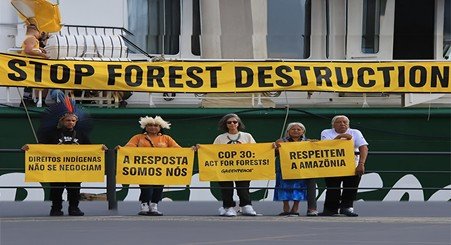

The recently concluded COP30 in Belém, Brazil once again brought the nations of the world together [AW1] with one major target; Reducing the global GHG emission. This time however, COP30 brought the global climate conversation to the very heart of one of the world’s largest terrestrial carbon sinks; the Amazon. This move exposed a deep gap between the symbolic value of location and the reality of the lives of people at the full fronts of the forest. Issues of justice were raised; hidden agendas were brought forth but the bigger questions remain: will justice be served? Are we in for yet another show of promising ambitions with little progress? This paper brings to light the major protest events at COP30; What happened, what protesters demanded, how authorities and the summit organizers responded, and what it might mean going forward. [AW2]
The main protest events (what actually happened)
Natives of the Amazon and local activists together saw COP30 as a golden opportunity to get [AW3] heard and so they took their place on centre stage in highly sustained and visible actions ranging from mass marches and a flotilla, to blockades and an incursion into the conference venue. Considering Brazil’s population and the number of people participating in these protests, one would think it doesn’t matter. The actuality [AW4] is that these voices do matter as they demanded actions to issues of national and global climate importance like land rights actions, an end to mining in regions of the Amazon, logging, oil incursions, and real enforcement, not just promises.
The mobilization and marches: led by mostly natives [AW5] of the Amazon, in conjunction with people in their thousands allied with civil-society organizations and marched through Belém to demand justice and protection of Indigenous territories within the reach of the Amazon.
For days, native groups were blocking the entry to the COP30 venue. Munduruku and other Amazonian peoples were preventing people from entering and leaving the venue until negotiators met their representatives. Those blockades were a deliberate tactic to force visibility and urgent engagement with presidential level officials.
Breaching the venue of COP30: in an episode of the protest, some groups of Indigenous protesters forced their way into the conference compound, a place labelled “the UN Blue Zone.” Protesters clashed with security, rant chants, and waved banners carrying slogans like “Our land is not for sale.” This indicates that the communities are excluded from the decision-making process regarding their own development.
Flotilla and river actions: because this COP was in the Amazon region, activists used rivers as well as streets. River flotillas and paddling actions brought attention to how extractive projects and pollution affect waterways and local livelihoods. The use of waterways was both symbolic and practical, amplifying Indigenous presence in a way that city-based summits rarely allow.
Creative and targeted actions: alongside Indigenous-led actions there were targeted, theatrical protests for example, activists dressing up (the “Pikachu” action aimed at Japan’s fossil financing) and other direct actions aimed at fossil fuel financiers and companies attending COP. These sought to broaden blame beyond national governments to global investors and banks.
What were protesters core messages?
Protesters advocated for an immediate end to invasions happening in and around the Amazon, a halt to illegal mining in the region, an end to logging, and agribusiness encroachments. These were the most persistent of the demands from the protesters. The main global point is that in the fight to achieve the Paris Agreement target, the Amazon can’t function as a carbon sink or biodiversity reservoir in the absent of [AW6] proper territorial security. Native leaders highlighted that a formal recognition or demarcation of Indigenous territories by signatures and enforcement on ground rather than words will be the first security step for the protection of the Amazon.
The termination of new fossil initiatives on Indigenous territories, as well as stopping state or private funding for oil or gas or mining that specifically endanger communities and ecosystems. They advocated funding mechanisms that directly reach Indigenous communities, and for meaningful seats at negotiation tables (i.e., not just tokenism).
How organizers and authorities reacted
Mixed space for protest but tight security[AW7] . Brazilian organizers allowed large civil-society participation and there were many sanctioned “people’s summit” events, which signalled openness. But the incursion and blockades triggered heavy security responses. Protesters were removed, some scuffles occurred, and authorities insisted on protecting the integrity of the Blue Zone. The contrast between staged inclusion and hard-edged security measures became a talking point.
Hosting the COP in the Amazon has given the government of Brazil an international platform and the protests have forced that very platform to confront domestic tensions namely, nail-biting promises to protect the Amazon against self-same pressures from agro-business and resource extraction. International media viewed it as an opportunity and a disgrace for the Brazilian government.
Immediate outcomes and why the protests mattered
Visibility and agenda pressure the protests pushed Indigenous land rights and anti-extraction demands into headlines and official texts. Elements of recognition for Indigenous rights and language on traditional knowledge did appear in draft texts [AW8] but protesters and rights groups quickly said language without enforcement is insufficient.
Political pressure on finance and fossil actors’ creative direct actions (e.g., targeting fossil finance) helped shift some of the conversation from nation-state targets to banks and export credit agencies that fund fossil projects overseas. That frames climate action as also needing financial-system pressure.
Fracture between symbolism and power; the sequence of protests loud, visible, sometimes confrontational exposed a core tension: it’s powerful to host COP in the Amazon, but unless local claims are met with tangible policy changes (land demarcation, policing of illegal mining, curbs on new extraction), the summit risks being remembered as symbolic rather than transformational.
A few things to watch next
Final, plain-spoken take
Bringing COP to the Amazon was the right idea, it forced the global climate conversation to happen where it matters most ecologically. But the protests showed that geography alone doesn’t confer justice. Indigenous people and local inhabitants turned up the volume because decades of incremental recognition haven’t matched the scale of threats they face. The actions in Belém were as much about survival and sovereignty as they were about emissions targets. If COP30 leaves one clear lesson, it’s this: real climate solutions for the Amazon require shifting political power and resources to the people who live there and not just meeting room rhetoric. Efforts in Belém were not only associated with emissions targets [AW10] but also against survival and sovereignty.

 Jonathan Tarnue Payne
 Precious Douglas Maulana
 Eslam Mohamed Elsheikh
 Lutfi Nurachma
  David R.K Brown
 Asef Jafari
Need to download the Jilipark download so I can play anytime, anywhere. Heard it’s a blast! Time for some fun! Time to jilipark download!
Just signed up at 555wincom.info! Loving the variety of games. Hoping to increase my bankroll! Join me: 555wincom
Been messing around on taib29 lately. Some decent games on there. Worth a look if you’re bored. Give taib29 a look see.
Heard some buzz about kubet1, wasn’t sure where to start. Found everything I needed right here. Quick and easy access. Give it a look: kubet1
Alright, mateys! Just checked out qq288login and it’s pretty decent. Easy to navigate, and the games load up quick. Worth a look if you’re after a new spot to have a flutter. Check it out here: qq288login
1winconnexion, you say? Well, I signed up last week and it’s been alright so far. The bonuses aren’t too shabby. Give it a look-see if you fancy a change. Here’s the link: 1winconnexion