

Indonesia is a topographically endowed nation that is very prone to the impacts of climate change. This can be explained as its weakness, considering that it is the biggest archipelago in the world and has the longest continuous coastline in the world, with five major islands and thousands of minor ones. Without sound mitigation and adaptation processes, climate change will inject a radical shock into the security of the nation (environmental, social, political, and economic). It was the first step to this issue that made signing the Paris Agreement an international commitment in 2016. The Indonesian parliament tamed and reinforced the act by creating Law No.16 Year 2016 on the Ratification of the Paris Agreement on the United Nations Framework Convention on Climate Change. The start of the systematic presence of the national commitment, then, is the point at which the mitigation and the strategy of adaptation are systematized and pursued in a systematic manner against the prevailing situations of climate change, as is expressed in the Law No.16 Year 2016.
The National Registry System (SRN) as a Pillar of Transparency
The biggest policy mechanism in Indonesia in order to support the ratification of the Paris Agreement was the formulation of the Nationally Determined Contribution (NDC) report, in which the entirety of Indonesia’s particular climate action commitments and targets are to be drawn. Indonesia submitted the first NDC in the year 2016 and further developed it in the Enhanced NDC (ENDC). In 2022, ENDC was published and stated a greater Indonesian climate accountability and new commitments. Some of the roles played by the ENDC report are that it forms a roadmap to all the national adaptation practices and mitigation practices, it forms the national security and interest of Indonesia in its climate policies, and is the most vital requirement of global accountability and transparency in its commitments to the international community as far as the regime of the Paris Agreement is concerned.
The national registry System (SRN), implemented by the Indonesian government, is the ingredient that determines the implementation of its accountability and transparency, which are the key requirements of the Paris Agreement. SRN is the institutional support of the transparency framework that partly performs the role of registration of mitigation and adaptation, provision of data and information to the public, data base management to support the policy analysis and formulation process, and carbon registry to support the implementation of the President Regulation No. 98 Year 2021, and the prevention of the occurrence of double counting of the mitigation achievement and protection of the carbon transfer. SRN is exposed to the management of the Ministry of Environment or Environmental Control Agency (Kementerian Lingkungan Hidup/Badan Pengendalian Lingkungan Hidup) with the required functions.
Theoretical Perspectives: The SRN as an Instrument of Regulatory Power
The state’s role as a key player in promoting environmental policy through mechanisms of coercion and regulation can be recognized by the establishment of the SRN and its integration into the climate framework. In line with the definition of public policy by Lowi, “….deliberate coercion statements at the point of setting forth the purpose, the means, the subject, and the objects of coercion”, the SRN can be classified as a crucial instrument of regulatory public policy. The state exercises its power and authority over the emission-producing sectors and business actors to make mandatory reports and comply with the rules. Consequently, the state not only enforces the regulatory coercion inherent in climate policy -to be specific, the obligation to report emission data and comply with reduction targets-, but also establishes and oversees the institutional infrastructure, for instance, the carbon trading platform, which enables the emitters to trade and purchase carbon emissions. To conclude, the SRN’s function for transparency and regulatory governance mechanism is derived from the state authority.
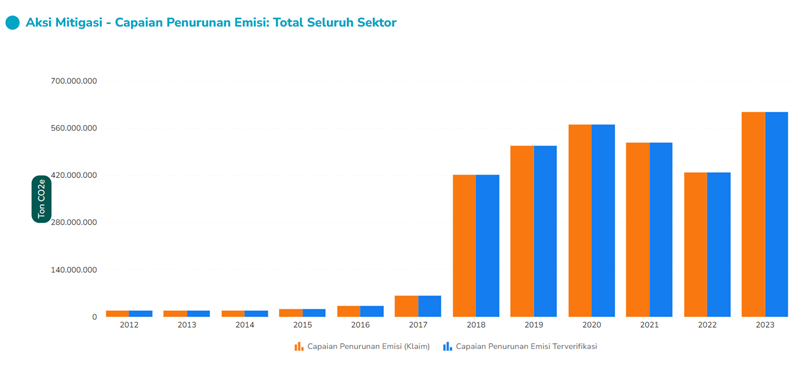
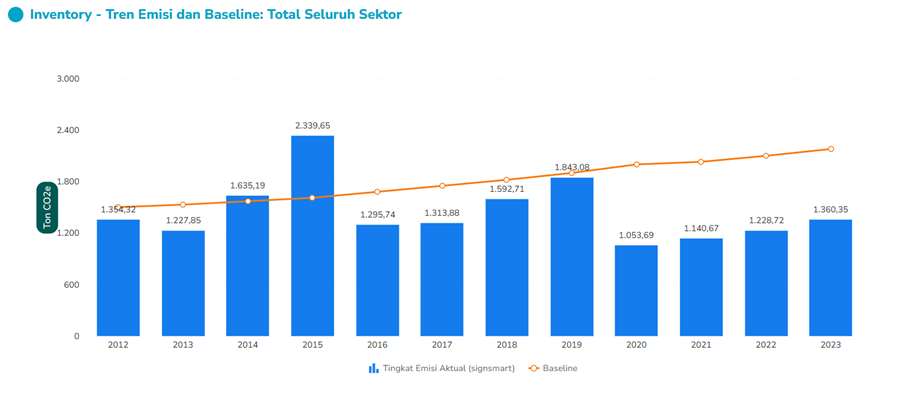
The country’s policy regarding ensuring transparency is working fine as the SRN is the platform. The graph presented in Figure 1 indicates the performance realized in the reduction of emissions that have been assumed by all the sectors in mitigating climate. These five important sectors are the Energy, the Industrial Process and Product Use (IPPU), Agriculture, Forestry, and Waste. Furthermore, the data indicates that from 2012 to 2023, Indonesia has been continuously making more efforts to reduce carbon emissions, especially after the signing of the Paris Agreement, and the enactment of Law No. 16 Year 2016 as the legal basis that would enforce the Paris Agreement. Moreover, Figure 2 indicates the trend and base level of the emissions in the period 2012-2023. The five sectors contributed to the emission level of about 1.360 million tons of CO2e of emissions and the mitigation measure resulted in the elimination of the mission of about 824 million tons of CO2e of emissions. In other words the overall emissions would be nearly 2.184 million tons CO2e without any mitigation measure taken to control the emissions. That is, we may suppose that the total emissions would be around 2.184 million tons CO2e in the event there is no mitigation measure to streamline the emissions.
All the stakeholders (Indonesian public, private sectors/business actors, and the international community) are not only able to access the information easily, but also able to monitor Indonesia’s effort and commitment to meet its NDC target through SRN. To sum up, the state plays a great role in pursuing clean energy, and enforce all the related stakeholders to contribute. Moreover, it runs effectively for maintaining and monitoring the progress of Indonesia’s commitment to mitigate and adapt to the adverse of climate change.
Conclusion
The National Registry System (SRN) functions as more than a technical database; it is a transformative instrument of state authority designed to mitigate the “radical shocks” that climate change poses to Indonesia’s environmental, social, and economic security. Drawing on Lowi’s theory of public policy, the SRN exemplifies regulatory coercion, where the state utilizes its power to mandate transparency and intervention within emission-producing industries. This coercive framework is essential because, without active mitigation measures, Indonesia’s projected emissions would reach approximately 2.184 million tons CO2e; however, through these state-led interventions, emissions were reduced to 824 million tons CO2e by 2023.
A critical analysis reveals that the SRN is the structural backbone of Indonesia’s global accountability. The system will allow centralization of data in the fields of Energy, IPPU, Agriculture, Forestry and Waste, thus avoiding the issues of the same work being counted twice, which is a crucial condition to the integrity of the Paris Agreement. Moreover, the fact that the first NDC gave way to the Enhanced NDC (ENDC) in 2022 reflects the increase in the national commitment, which no longer presupposes being a participant but rather a stricter roadmap to national security and national interest. Finally, the strategic value of the SRN is that, through the data democratization, the private sector and the international community will be able to monitor the climate. To sum up, the SRN is the ultimate engine through which the promises under legislative legislation in Indonesia namely Law No. 16 Year 2016 can be converted into impeccable environmental protection such that the topographical weaknesses of the country do not cause a systematic breakdown.






 Jonathan Tarnue Payne
 Precious Douglas Maulana
  Eslam Mohamed Elsheikh
 Lutfi Nurachma
  David R.K Brown
 Asef Jafari
You can certainly see your expertise in the article you write.
The arena hopes for more passionate writers like you who aren’t afraid to say how they
believe. All the time follow your heart.
Appreciate this post. Will try it out.
Do you have a spam problem on this blog; I also
am a blogger, and I was wondering your situation; many of us have created some nice procedures and we
are looking to exchange methods with other folks, why not shoot me an email if interested.
Admiring the time and effort you put into your website and detailed information you offer.
It’s great to come across a blog every once in a while that isn’t the same out
of date rehashed information. Excellent read! I’ve bookmarked your site and I’m
adding your RSS feeds to my Google account.
There is definately a great deal to find out about this issue.
I like all the points you made.
Everything is very open with a really clear explanation of the issues.
It was definitely informative. Your site is very helpful.
Thanks for sharing!
I like the helpful information you provide in your articles.
I will bookmark your weblog and check again here frequently.
I’m quite certain I will learn many new stuff right here!
Best of luck for the next!
Hey! I know this is kinda off topic however , I’d figured I’d ask.
Would you be interested in trading links or maybe guest writing a
blog article or vice-versa? My site goes over a lot of the same topics as yours and I believe we could greatly benefit from each other.
If you are interested feel free to send me an e-mail.
I look forward to hearing from you! Terrific blog by the way!
کراتین دایماتیز، یکی از خالصترین، اثباتشدهترین و معتبرترین مکملهای انرژیزا در دنیای بدنسازی حرفهای است.
Simply desire to say your article is as surprising. The clarity in your
post is simply nice and i can assume you’re an expert on this subject.
Well with your permission let me to grab your feed to keep
up to date with forthcoming post. Thanks a
million and please carry on the enjoyable work.
This article is truly a pleasant one it helps new internet viewers, who are wishing for blogging.
Nhóm 4: Tập trung vào Trải nghiệm người dùng & Giao diện (20 đoạn) TONY03-02
Kính mời quý khách gia nhập cộng đồng 188V để trải nghiệm sự khác biệt từ một thương hiệu giải trí tầm cỡ quốc tế với dịch vụ hoàn hảo. TONY03-11O