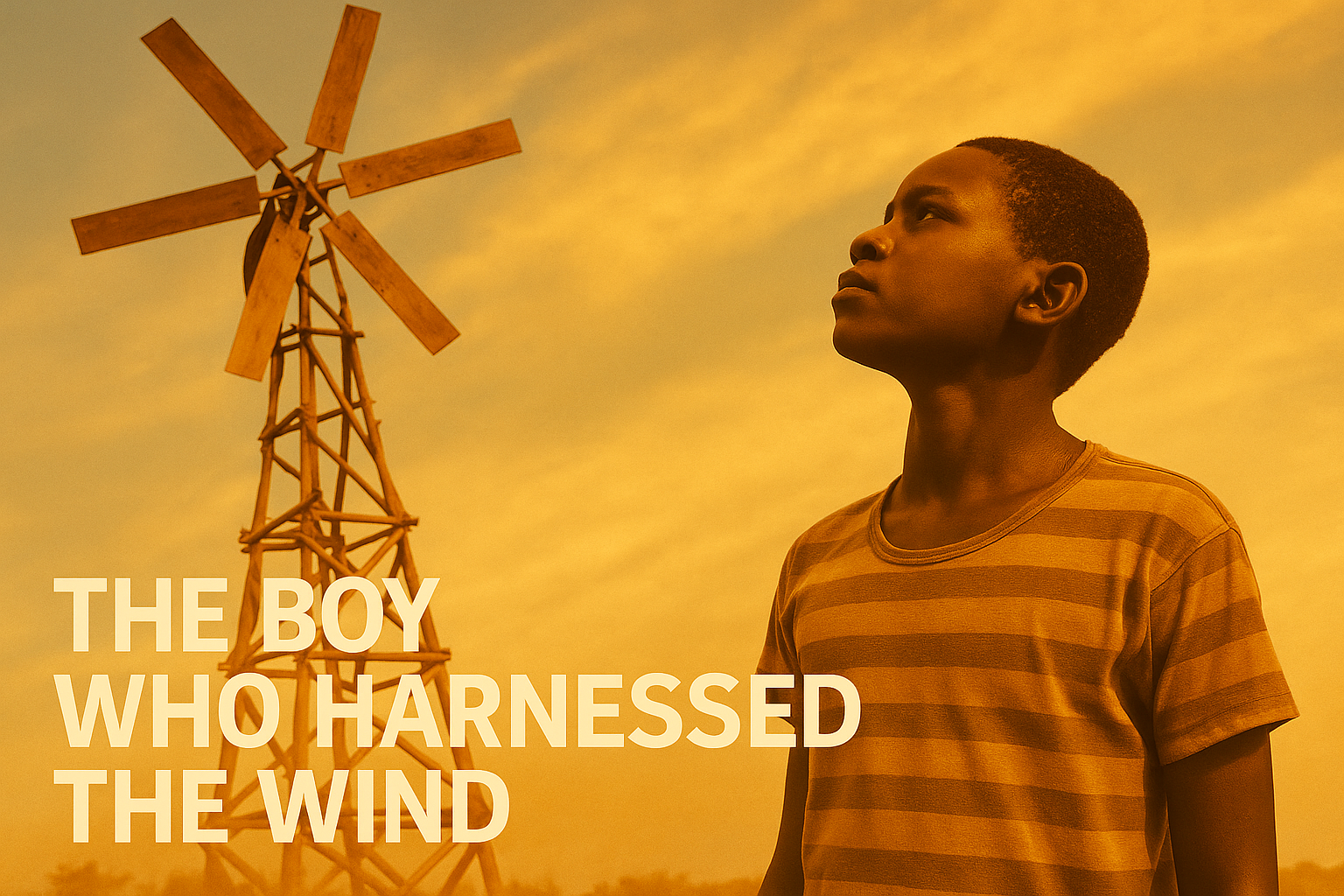

The arid fields of Wimbe, Malawi are under the blazing sun. The earth is torn apart by cracks and the crops are shriveled into withered husks. A family, helpless and standing next to a dying field is debating whether to make another planting or to submit to hunger. In this desperation, some young boy, William Kamkwamba, looks on as the wind blows through the trees and discovers what everyone else has stopped believing in, a solution. The world portrayed in The Boy Who Harnessed the Wind, a movie that is based on the striking real-life story of William, provides a clear visualization of the real effects of climate change in Global South. climate change is not explained through charts or scientific reports, it is felt in the stomach, the soil, and the seasons. The movie shows clearly that daily hardships, family conflicts, and neighborhood conflicts are all aggravated by shifting climate conditions.
Climate Change You Can Feel
The film treats climate change as an everyday struggle rather than as something distant to science. Scholars like Shwom notes that in order to make scientific concepts relevant, climate literacy has to be meaningful to people. The Kamkwamba family never uses the term “climate change,” yet their lives unravel because of it. Failed rainfall, falling harvests, and increasing desperation are phenomena that are not abstract notions, but occur and determine human survival. According to Janković and Schultz, extreme climate change affects communities even before scientific explanations are delivered to them. In the absence of climate information or early warnings of what they face, families turn to tradition, instinct and hope, making them more prone when shifting weather patterns present immediate crises. As the world works out global frameworks, the rural communities like Wimbe have little ability to explain or foresee climate change.
Why Stories Are Better Than Statistics
Before moving on to solutions, the movie prompts one to reflect on how societies make sense of climate uncertainty when technical explanations are no longer available. Tabak notes that stories act more as a potent communicator of climate realities than technical reports as it appeals to both emotion and interpretation. The movie offers a clear picture of the effects of climate change in the lives of the Kamkwamba family. It also highlights the fact that narratives can help people imagine opportunities that cannot be envisioned solely by data. The scene of William in the scrapyard, where he plays with wires and bicycle parts that are discarded shows that learning may begin with curiosity. This emotional connection makes the movie a powerful tool of climate literacy. Such stories remind us in the global world where we are overwhelmed with information about climate that we need to stimulate action with knowledge that initially appeals to the heart.
Climate literacy is not just about explaining the greenhouse gases but it is the ability to perceive, challenge and act in an innovative way regarding the issues related to the environment. William is the best example of such literacy. His windmill is not just an instrument, it represents how knowledgeable people can turn climate adversity to their advantage. It shows that the answers to climate problems do not necessarily come out of the laboratory or the government; often, they are created in the mind of the literate. His resourcefulness is also an opposition to the popular discourse about how the rural folks are not capable of addressing the climate problems. The movie shows that knowledge that is readily available and placed in a cultural context can spark radical changes.
When Systems Fail, Knowledge Becomes Power
The movie clarifies on system weaknesses that encourage climate vulnerability. Leaders ignore early warning pointers; agricultural inputs are not managed well; educational facilities are closed; and communities are getting minimal to little substantive support. The stress experienced by the environment quickly escalates into society, and institutional forces are not able to communicate, prepare and intervene. The society needs the availability of timely and easy to access information and responsive systems that allow them to adapt. Access to such access is lacking in Wimbe; as a result, self-educated climate literacy of William is the only substantive line of defense of the community. In this respect, climate literacy must therefore extend to policymakers, local leaders, and institutions responsible for protecting vulnerable populations.
A Story with World Relevance
Although the story is set in Malawi, there is universal resonance in it. Water shortages, drought, crop failures, and seasonal changes are common climatic change manifestations in the Global South and the world at large. Pastoralists in Eastern Africa, rural communities in Latin America and agriculturalists in South Asia face similar problems. The movie highlights the urgency of making climate literacy practical, reachable and well-established in the experience of life. It has to recognize domestic knowledge, encourage young people and develop creative adaptation policies. Most crucially, it must also communicate the idea that communities are not passive consumers of climate change but also proactive investors and issue solvers.
More Than a Film- A Climate Lesson
The Boy Who Harnessed the Wind serves as a reflective prism within which the issue of climate change is construed not just as an environmental disaster but as an anthropological story of survival, grief, acceptance and hope and so it transcends the domain of environmental issues. It is more than the victory as the first drops of water drop off the windmill powered tap. It is a representation of what happens when literacy meets bravery. It is a message to all the communities that are facing the issue of uncertainty in climate conditions that hope can be systematically nurtured. Although the windmill might have turned water, the determination of William made the community look into the new possibilities, and this is what the real power of climate literacy is.
William’s journey shows that climate literacy is not only about understanding the science, it’s about recognizing the power of knowledge to transform despair into possibility. His windmill was more than innovation, it was proof that informed minds, even in the most fragile conditions, can rewrite their future. In a world where climate change threatens the most vulnerable, his story reminds us that true climate literacy empowers communities to think, adapt, and act. And if a boy in Wimbe could harness the wind with nothing but curiosity and courage, imagine what each of us could do with the climate knowledge we carry today.



 Jonathan Tarnue Payne
 Precious Douglas Maulana
 Eslam Mohamed Elsheikh
 Lutfi Nurachma
 David R.K Brown
 Asef Jafari
Simply wish to say your article is as astonishing. The clearness in your post is simply cool and i could assume you are an expert on this subject. Fine with your permission allow me to grab your feed to keep up to date with forthcoming post. Thanks a million and please carry on the rewarding work.
Thank you
Alright, trying pkslots out tonight. Hoping for some good luck. Slots time at pkslots!
Just downloaded the 188bet app via cachvao188bet.net and it’s a game changer! So much easier to place bets on the go. Get yours: tải app 188bet
88online4 is on deck! I love how accessible the interface has being developed. Gonna make myself a cup of coffee and start winning! Come on, let’s explore 88online4 together!
Hey all, if you’re looking for something new, I took a look at Wim55. The interface is clean, and it didn’t give me any headaches, which is a bonus! Here’s the link: wim55
Just getting started with online betting? Startbet’s not a bad shout. Everything’s laid out nicely, so it’s easy to figure out even if you’re a complete noob. Check it: startbet