

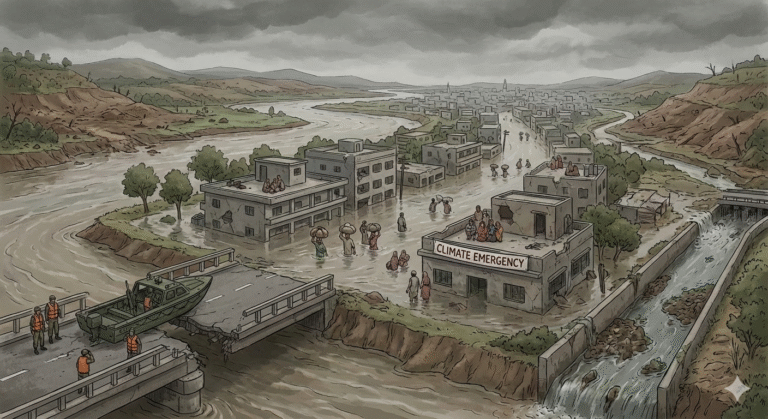
When walking around coastal areas in Liberia, regions like Buchanan, Robertsport, and West Point, you will observe the impact of coastal erosion on people and their livelihoods. (S. David, 2023). Homes are gradually sinking in the Atlantic; soils used for agricultural purposes are devastated by unprecedented rainfall, and the ground is eroding daily. Flooding poses similar threats. Communities in the greater part of Monrovia are severely affected by heavy rain that sometimes leaves many homeless and displaced. At this point in Liberia, Climate change is no longer considered a future problem, but a present disaster. However, to many, the term “Climate Change” seems remote, as though it is a secondary issue or doesn’t exist. The impacts are apparent: Liberia is indeed affected by climate change and is one of the most vulnerable countries to climate impacts (Sasnett & Sepmeyer, 2025). Moreover, there is a lack of sufficient awareness of climate education (Mission team Page I, 2015). Against this backdrop, there is a need for a robust climate education to enhance resilience on all levels.
Climate Change Impacts on Liberia
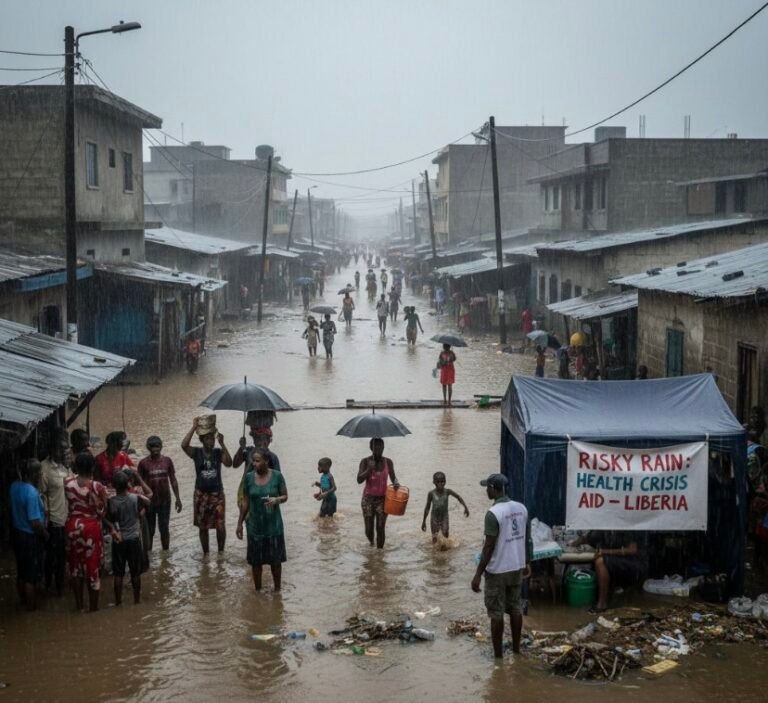
The irregular weather patterns over the years have staged a huge setback to major development in Liberia (Sarnoh, 2024). Farmers are subject to unprecedented rainfall, whereas communities around the coastal areas are endangered by increasing sea levels during the rainy seasons (S. David, 2023). Liberia is currently experiencing a major climate crisis that continues to undermine activities across the agriculture sector, which is considered the breadbasket of Liberia’s economy and a major source of employment and income (Sarnoh, 2024). Extreme rainfall sometimes causes flooding, leaving many homeless and displaced. The effects of climate change continue to hinder development and contribute to economic instability, making life difficult for the common people (Dove & World Bank Group, 2021).

How Liberia relates to the term “climate change”
Climate change is usually viewed as a low priority due to major economic instabilities. There is still a struggle to fully integrate climate education across the sub-visions of Liberia. However, there are a few actors responsible: Liberia is considered one of the poorest countries in the world (Ventura, 2025). Socio-economic instability is a major hindrance; concerns relating to low employment, poverty reduction, high illiteracy, and crime rates tend to be a major priority for the government. In this kind of economic crisis, the terms “global warming” or “climate change” might be regarded as of secondary relevance. Where communities feel deprived of basic needs, the concerns about carbon emissions feel less important. The burning issue at hand is putting food on the table, not prioritizing some scientific myth, some may say. There is a high vulnerability to environmental instability due to extreme poverty(“Clim. Risk Ctry. Profile,” 2021). People are more focused on their immediate needs rather than on environmental concerns.
How Does Climate Education Empower Our Communities?
- Strengthen Policy Participation
There is an urgent need for robust climate awareness across the sub-division of Liberia, from the urban cities to rural settlements. Adequate climate knowledge should be considered paramount. Through this means, citizens are more informed about international and local climate policies and can hold the government accountable for ignored or poor policies.
In May 2023, Frontpage Africa published an article claiming that there were major concerns in Sinoe County, Tartweh and Drapoein Communities regarding a forest concession. Local communities question government agency, The Forestry Development Authority (FDA), and SinoForest, stating that it illegally expanded its forest concession without considering the rights of the people. The disputed area is up to 39,000 hectares without the agreement of the local community (Duoe, 2023). Community dwellers showed frustration over failed projects, intimidation, and lack of inclusiveness, and opposed the concession. This art by community dwellers demonstrates how citizens can relate to poor climate policies that tend to undermine development within their communities when they are well informed on climate issues. In Liberia, locals should be fully represented in climate policy formulation and implementation because they are the direct victims of poor government decisions, like illegal mining or logging, which are common in Rural Liberia (Paying the People: Liberia’s Novel Plan to Save Its Forests, n.d.). Communities are left vulnerable and suffer at their expense.
- Established Disaster Readiness
Liberia has several challenges related to climate change impacts. floods, inconsistent rain patterns, heavy storms, erosion along the coastal areas, and rising sea levels are major climate instances (“Clim. Risk Ctry. Profile,” 2021). Liberia is considered one of the most vulnerable countries to the effects of climate change in West Africa(Mohammed, 2024). Clara Town, Doe Community, and New Kru Town are communities in greater Monrovia that are prone to climate impacts, mostly flooding, that sometimes result in thousands of people being displaced, rendered homeless, and deprived of essential infrastructure. These climate threats pose a serious need for a robust climate education that enables citizens build resilience. Most time, the severity of these circumstances is due to inadequate information to address climate issues from the onset. These particular climate problems offered a good rationale to have climate education as a means of preparation. Societies that possess sound knowledge of the risks of climate change have developed resilience against the unpredictable.
Factors Affecting Climate-Education
Liberia has gradual move towards building on climate knowledge as compared to the last few years (Security, n.d.). This shows a slow but gradual transition towards mitigating the climate effects that communities experience every year. Although there is a step towards improvement, there is still much more to be done. The question of whether the country will fully incorporate climate education in society is a giant task. Climate education is still facing significant hindrance due to several factors(“Clim. Risk Ctry. Profile,” 2021). In Liberia, climate-related problems are regarded as minor in comparison to large-scale economic problems; climate programs are mostly regarded as a secondary priority. There is also a lack of proper funding that goes to research and outreach programs on climate. Besides, key climate initiatives are not implemented, and the populations appear to be exposed to climate effects. There are other issues, such as inadequate infrastructure, underdeveloped technology, weak government policies implementation, cultural beliefs, and traditional practices that still hinder climate education in Liberia.
The Path Ahead: Climate Change as a National Priority
Climate Education is a serious concern that needs to be discussed on every street and corner if we are to build strong resilience and sustainable development. We must ensure that Liberia prioritizes climate education in its national agenda. The consequences of climate change are apparent; the more we delay our actions, the more vulnerable our society becomes. Considering the high level of challenges, there is a need for the government of Liberia to adopt policies that incorporate climate education in school curricula, as well as local awareness in rural communities, and also increase its efforts towards building both international and local cooperations with environmental organizations to ensure that a national climate education framework is developed.


 Jonathan Tarnue Payne
 Precious Douglas Maulana
 Eslam Mohamed Elsheikh
 Lutfi Nurachma
 David R.K Brown
 Asef Jafari
Hi i am kavin, its my first occasion to commenting anyplace, when i read this post i thought i
could also create comment due to this sensible article.
Thanks for sharing such a good thought, paragraph is good, thats why i have read it completely
Thanks for every other fantastic post. The place else could anyone get that kind of info in such an ideal manner of writing? I’ve a presentation subsequent week, and I am on the look for such information.
I haven’t checked in here for some time because I thought it was getting boring, but the last several posts are good quality so I guess I’ll add you back to my daily bloglist. You deserve it my friend 🙂
I am impressed with this web site, rattling I am a big fan .
Hey guys, I found this site sv388thomosv388 pretty useful. Check it out if you’re into that sort of thing!
Checking out jili30 for the first time. Looks like they have some cool promotions and bonuses. Worth a look! See the deals at jili30
Just signed up at jljl33login. The registration process was easy enough, and the site looks clean. Will update later after I’ve had a proper go. jljl33login
Heard 88clb8gq com is the place to be for baccarat. Giving it a try on baccarat88clb.com. Wish me luck! Here’s the link for those who want to join: 88clb8gq com
Casibom843 on casibom843.net seems to be the place to be! Let’s spin those reels! casibom843 Come check it out guys.
Alright, so I stumbled upon go99globe. Looks kinda promising. Gotta dig deeper and see what’s up. Maybe some good games in there? Worth a look at least: go99globe
Yo guys, just checked out l444win and it’s pretty slick. The games are smooth and the site is easy to navigate. Definitely worth a look! Check it out here l444win.
Alright, time to see what all the fuss is about with 24kbetlogin. Hopefully, it’s not just hype. I’m looking for some good odds and a reliable platform. Check it out lads 24kbetlogin!
Just logged into 38jililogin. The games look pretty slick. Gonna explore around and see what’s worth playing. Have a look for yourselves 38jililogin!