
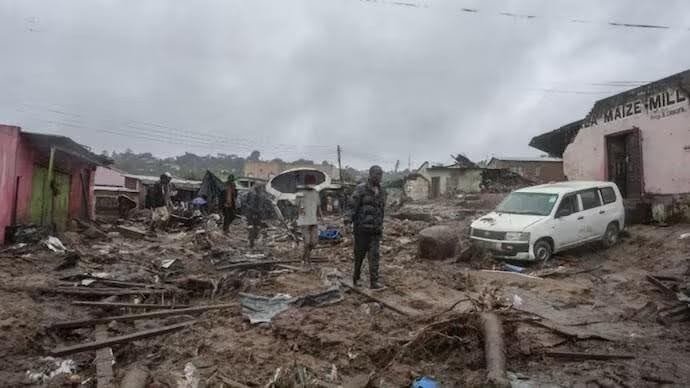
When Cyclone Freddy struck southern Malawi in March 2023, the rain was impossible to ignore. It battered communities for days, sent torrents of water and mud down hillsides, and cut off roads, homes, farms, and health services. By the end of the month, more than 600 people had died and hundreds of thousands had been displaced. Malawi was already fighting a severe cholera outbreak; Freddy added damaged clinics, disrupted water supplies, and crowded evacuation sites to an emergency that was already stretching the country’s capacity.
It was an extraordinary storm. But the storm alone cannot explain the scale of the disaster.
In the days that followed, headlines reached for familiar descriptions: a monster cyclone, an unprecedented natural calamity, a climate-fuelled catastrophe. Those phrases captured the force of the weather. They also risked making the disaster seem inevitable, as if the rain arrived, tragedy followed, and there were no human decisions to examine.
But, there were.
The story the storm can hide
Climate change matters. It changes the conditions in which extreme weather occurs, and communities need protection from the risks a warming climate brings. Yet a single disaste does not, by itself, explain how much climate change contributed to that specific event. That question requires careful scientific analysis.
There is another danger in making every disaster a climate story: the weather can take up so much space that the social conditions shaping the damage disappear.
Researchers Vladimir Janković and David Schultz call one version of this framing “atmosfear.” They argue that linking climate change to frightening weather can make an enormous, complicated problem easier to picture, but can also oversimplify the science and policy. Their point is not that climate change is unimportant. It is that reducing emissions and reducing the harm from a particular storm are different tasks. A lower-emissions future does not, on its own, make a vulnerable hillside safe or give a family a place to evacuate (Janković and Schultz, Weather, Climate, and Society).
Freddy’s impacts show why that distinction matters. In Blantyre, the rain triggered landslides on steep slopes where deforestation and hillside development had increased danger. Researchers studying Malawi’s disaster governance found that landslides caused most of the city’s fatalities. They also found that warnings in Blantyre focused on flooding and did not adequately anticipate the landslide threat (Bauer, Titz, and Manda, Jàmbá: Journal of Disaster Risk Studies).
The rainfall was the trigger. The exposure of homes and people, the condition of slopes, the reach of warnings, and the capacity to respond helped determine what happened next.
Risk is built before the rain
People do not choose dangerous places in a vacuum. In Malawi’s cities, rapid population growth has outpaced the supply of housing and infrastructure. A study of urban risk in Malawi describes how informal settlement growth, limited municipal resources, weak enforcement, and the historical neglect of urban disaster planning have allowed risks to accumulate. Its central lesson is simple: cities are not automatically safe, and broad measures of resilience can hide the dangers facing particular neighbourhoods and households (Bauer, Titz, and Manda).
The same study warns against treating residents as a single, passive “community.” People living near rivers or on steep slopes may have few affordable alternatives. Even relocation can feel dangerous if it means losing a home, a livelihood, or access to work and services. In fieldwork in Lilongwe, some residents feared that information about their homes could be used to justify moving them. That research does not tell us what every Freddy-affected household experienced, but it makes one thing clear: telling people to leave is not a complete plan if there is nowhere safe and secure for them to go.
This changes the question. Instead of asking why people stayed in harm’s way, we should ask what choices they had, and what public systems could have made safer choices possible.
A warning is only useful if people can act
Malawi had forecasts and warnings before Freddy. Yet receiving a warning and being able to act on it are not the same thing.
A study by the Malawi Red Cross Society and Danish Red Cross found that many respondents heard and believed early warnings but did not take early action. The study did not establish why every household stayed, but it identified possible barriers, including limited resources and a lack of safe evacuation destinations opened early enough (Malawi Red Cross Society and Danish Red Cross).
That finding undercuts the comforting idea that information alone saves lives. A trader asked to evacuate may worry about leaving stock behind. A family may hesitate if the nearest shelter feels unsafe or lacks basic services. Someone who has lived through previous storms may interpret a warning through that experience, not through the technical language used to describe the forecast.
Research on Malawi’s early-warning systems has also identified gaps between national and community-level systems, limited local capacity, and problems with communication and response (Chinguwo and Deus, Jàmbá: Journal of Disaster Risk Studies). Warnings need to reach people in time, make the local danger clear, and come with a practical way to respond. Transport, safe shelters, and plans for people who need help evacuating are part of the warning system, not optional extras.
The work that happens between storms
Freddy also exposed the weakness of preparing only for emergencies. A study of the cyclone’s response found that disaster institutions and aid organisations faced rapidly changing conditions, while some formal procedures did not account well for local circumstances and place-specific vulnerabilities. The researchers argue that disaster planning needs to consider more than floodwaters: landslides, sediment, damaged roads, disrupted services, and the effects on people’s daily lives all belong in the picture (Manda and Thindwa, International Journal of Disaster Risk Reduction).
That means doing the less dramatic work before the next cyclone: improving drainage and waste management, protecting vulnerable slopes, enforcing land-use rules fairly, investing in local disaster-management teams, and strengthening clinics and water systems. It also means planning relocation with affected residents and providing secure alternatives when moving is necessary.
The health consequences make the stakes especially clear. Freddy disrupted health services and water access as Malawi was already dealing with cholera. A review of the cyclone’s impacts describes harm to health, shelter, education, nutrition, sanitation, agriculture, transport, and livelihoods—not separate problems, but connected pressures that made recovery harder (Braka et al., BMJ Public Health).
After the headline fades
Cyclone Freddy was both an extreme weather event and a disaster shaped by human conditions. Saying so does not excuse the storm or deny the risks of climate change. It keeps the full story in view.
Emissions cuts matter because they shape the risks future generations will face. But they cannot replace the local work of reducing exposure and making protection possible now. Families need safer places to live. Municipalities need the authority and resources to manage risk. Warnings need to lead to transport, shelter, and support-not just instructions.
The rain made Freddy a threat. Long-standing inequalities and gaps in public systems helped determine who faced the greatest danger and how hard it would be to recover. If Malawi is to be safer when the next storm comes, the answer cannot stop at forecasting the weather. It has to include changing the conditions that turn dangerous weather into disaster.


 Mwaiwawo Banda
 Mujibullahi Shahud
 Seftario Virgo
 Jawal Sualisu
 Hanifah Setyaningrum
 Fadhli Ilahi
+ There are no comments
Add yours