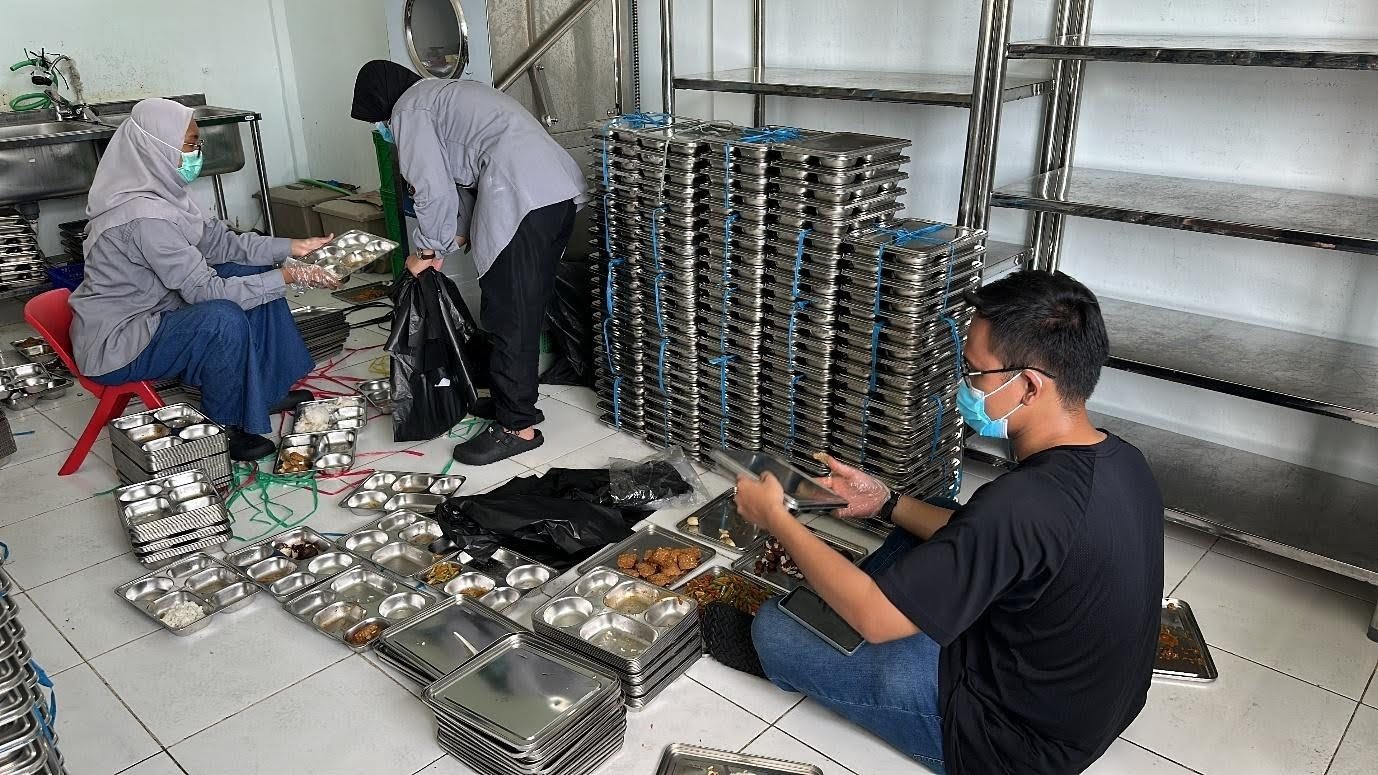

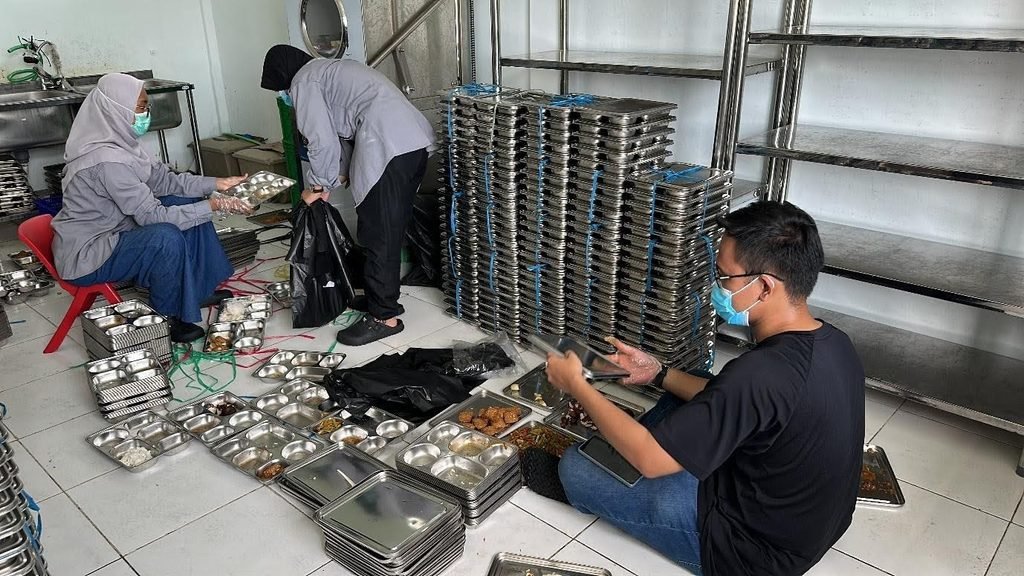
Source: Research team documentation.
Every day, food is prepared in kitchens and delivered to schools through Indonesia’s Free Nutritious Meals program, known as Makan Bergizi Gratis (MBG). When a meal tray reaches a student, we may think the program has done its job. But what if part of that meal is left uneaten? The food has been delivered, yet some of its nutrition has not reached the child. For a program that aims to improve nutrition, this difference matters.
I support the goal of helping more children access nutritious meals. At the same time, I believe we should look beyond the number of meals delivered. We need to ask whether the food is safe, whether children eat it, why some food is left behind, and where the leftovers go. Food waste should not be treated only as a kitchen problem. It can also tell us how well a public policy responds to the people it serves.
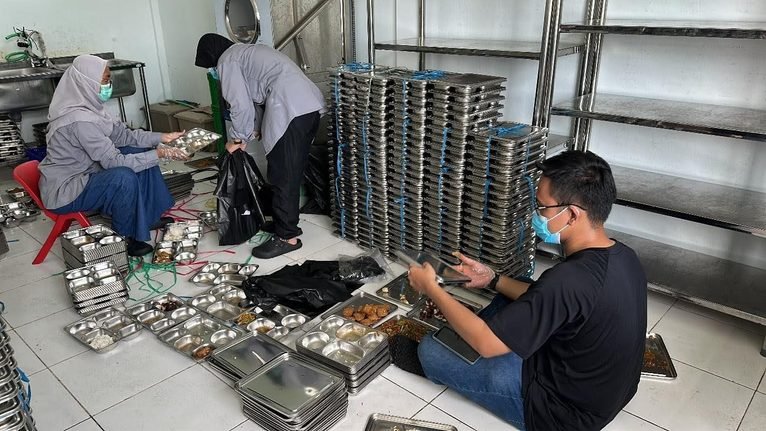
I began to see this issue more clearly when I joined a research team studying food waste in MBG. The study was initiated by Indonesia’s Ministry of National Development Planning (Bappenas) and GIZ in collaboration with Waste4Change. We collected information from kitchens and schools in Bogor and Cilacap. Working on this study also helped me connect field research with ideas from my Policy Communication and Climate Diplomacy course.
What our research found, and what it cannot tell us
Our team measured leftovers from 699 meal trays, surveyed 599 students, and interviewed 39 stakeholders. We also measured waste at two meal-production kitchens, or Satuan Pelayanan Pemenuhan Gizi (SPPG). The fieldwork covered two locations, not all of Indonesia. This difference is important when reading the national estimates in the report.
Using the field results and assumptions about program expansion, the study projected around 778,000 tonnes of MBG food waste in 2025 and about 1.95 million tonnes a year from 2026 to 2029. That scenario assumed coverage would reach 82.9 million beneficiaries in the last quarter of 2025 and stay at that level. These are projections, not actual nationwide measurements of food waste in those years. If coverage, menus, eating habits, or waste management change, the results will also change.
The study found two different kinds of food waste. At the kitchens we observed, much of the waste came from preparing ingredients, including peels and parts that are normally not eaten. On meal trays returned from schools, however, a significant amount was food that could have been eaten. In several school groups, edible food made up more than half of the leftovers. This difference is important. Managing fruit peels is not the same as preventing rice, vegetables, or other nutritious food from being left on a tray.
The survey also showed why it is too simple to blame students. Most respondents were generally satisfied with their meals, but some reported problems. About 33% of respondents in Bogor and 36% in Cilacap said the taste needed improvement. Other issues included menu variety, portion size, food quality, and allergies. Some kitchens also faced challenges with food storage, ingredient standards, and staff training. Interviews described cases of meals meant for different school levels being mixed up during delivery. In such cases, a child may receive a portion that does not match their needs.
These findings suggest that food waste is not just about individual behaviour. It can also be a sign that information is not moving well between kitchens, schools, and the people receiving the meals.
From research evidence to better policy
A reading from our course helped me understand the role of research. In A Level Playing Field, or the Hope for Science as a Common Ground, Jeroen Oomen (2019) argues that science can help provide shared ground for public debate, while also warning against treating expert knowledge as the only voice that matters. For me, this offers a useful way to understand what our MBG research can and cannot do.
Measurements give us something concrete to discuss. They can show which types of food are left behind and where waste begins. But data do not make policy decisions by themselves. Policymakers must also listen to students, teachers, kitchen workers, nutrition experts, suppliers, and local waste managers. A number can show that food is wasted. It may not explain why a student did not eat it unless we also ask that student about their experience.
Oomen’s discussion also reminds us to communicate uncertainty. A national projection based on fieldwork in Bogor and Cilacap is useful for planning, but it should not be presented as if every school in Indonesia has already been measured. The report also estimated around Rp221 trillion in the value of discarded food over 2025-2029 under its modelled scenario. This is an estimate of food value, not a record of money already lost by the government or an amount that could simply be recovered. If policymakers use this figure, they should explain the assumptions behind it.
The climate connection is important too. Food needs land, water, energy, transport, and labour before it reaches a tray. When it is wasted, much of that effort brings no benefit. Organic waste can also release methane when it breaks down in poorly managed disposal sites. According to the United Nations Environment Programme (2024), food loss and waste together are linked to about 8-10% of global greenhouse gas emissions. This global estimate is not an MBG-specific figure. It helps explain why reducing food waste is part of climate action, not only waste collection.
Our MBG report estimated about 1.18 million tonnes of carbon dioxide equivalent over the five-year scenario from the modelled management of leftovers from beneficiaries. That figure does not cover the full climate footprint of producing and delivering every MBG meal, and it does not include kitchen food waste in that impact calculation. The boundaries of the estimate matter as much as the number itself.
Good communication also needs cooperation
Food waste cannot be solved by one institution. In another course reading, Moinuddin and colleagues (2021) examine how climate action and the Sustainable Development Goals can be connected at the local level in West Java. They explain why cooperation is needed across government agencies, between national and local levels, and with other stakeholders. This is useful for understanding MBG, even though their study is not about school meals.
MBG brings together many actors. National agencies develop policies and standards. SPPG kitchens buy and prepare food. Schools receive meals and know their students’ needs. Local governments and waste partners may manage the leftovers. If one group has important information but cannot share it with the others, the program can lose opportunities to improve.
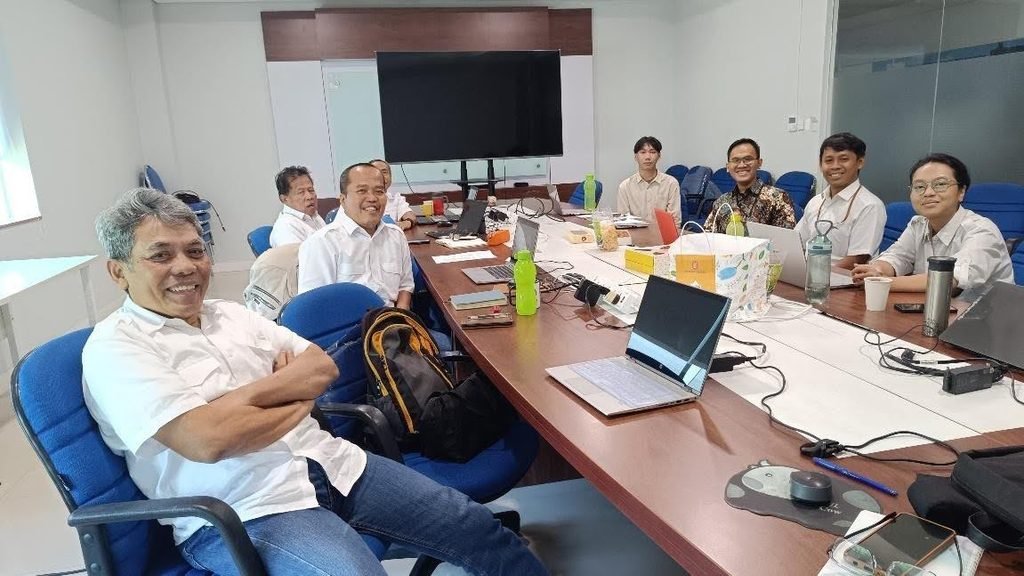
Source: Research team documentation.
Our study found different practices in Bogor and Cilacap. In Bogor, some organic waste was managed through a municipal facility using black soldier fly larvae. In Cilacap, some schools and local poultry farmers also played a role in handling food scraps. These examples show that local solutions may differ. They also show why national guidance needs to leave room for local capacity, while keeping clear food-safety and environmental standards.
There is also a trade-off that deserves more attention. A kitchen may focus on delivering meals on time, while a school may need different portions for younger children. A national agency may want uniform standards, while local suppliers and waste facilities have different resources. Better coordination does not mean that all interests will be the same. It means creating a way to discuss these differences before they become larger problems.
How MBG could improve
I see four practical priorities. The first is to build a simple feedback system between students, schools, and kitchens. Schools should be able to report meals that are often left behind, portions that do not fit, and allergies that need attention. Nutrition standards must remain important, but the food also needs to be safe and acceptable to the children who receive it. Listening to students is not the same as letting them choose only their favourite meals. It is a way to improve delivery without losing the nutrition goal.
The second priority is regular food-waste measurement. Schools and kitchens should record the amount and type of waste and separate edible leftovers from unavoidable scraps. Information should be shared in a useful format, not kept in separate records that are never reviewed. These data could guide menu planning, purchasing, and improvements in distribution. To be meaningful, the results should be discussed with the people who can act on them.
Third, prevention should come before treatment. Better storage, quality checks, careful purchasing, and suitable portions can help reduce waste before it is created. Composting or black soldier fly treatment may be useful for unavoidable organic scraps where facilities and safety conditions allow. But treating waste after it is produced should not become an excuse to ignore why edible food was wasted in the first place.
Finally, the government should communicate MBG success more broadly. The public should know not only how many meals are delivered, but also whether meals meet students’ needs and how food waste is being reduced. Clear indicators and honest explanations can help build trust. They can also make climate issues easier to understand because food waste is something families and students see in everyday life.
Indonesia already has a national direction for reducing food loss and waste and moving towards a circular economy. MBG provides an opportunity to make those goals practical. School meals can teach nutrition, responsible consumption, and environmental care at the same time. But this will only happen if research findings become part of planning and if people working at different levels can communicate with each other.
I do not see food waste as a reason to reject MBG. I see it as a reason to make the program better. The lesson I take from our research, and from the readings on communication and policy, is that good evidence needs a clear public story and cooperation among the people who must act on it. A meal is not fully successful simply because the tray reaches a classroom. We should also care about what students actually eat, why food is left behind, and how this information can help improve the MBG program.
References
Bappenas, GIZ, & Waste4Change. (2025). Studi integrasi konsep ekonomi sirkular untuk pengelolaan sisa pangan pada Program Makan Bergizi Gratis (MBG). Kementerian PPN/Bappenas.
Moinuddin, M., Zhou, X., Anna, Z., & Satriatna, B. (2021). Integration of climate actions and SDGs at the sub-national scale: Results from stakeholder consultation in West Java. Institute for Global Environmental Strategies.
Oomen, J. (2019). A level playing field, or the hope for science as a common ground. RCC Perspectives: Transformations in Environment and Society, 2019(4), 23-30.
United Nations Environment Programme. (2024). Food Waste Index Report 2024.

 Jozi Ikhlas Attarik
 Muhammad Ariiq Nurfidani
 Nasib Sahim
 Grienda Qomara
 Ellena Pangestu Kavarera

 Arahman Akbar
+ There are no comments
Add yours