
Photo source: https://www.mkg-goebel.de/en/witznitz-energy-park/
Introduction
To overcome climate change, we need adaptation and mitigation. In this article, I will discuss the Witznitz Solar Park project developed in Germany as a mitigation project. I argue that the development of Witznitz Solar Park was driven by a market-based mechanism that emphasizes private financing, with limited state intervention confined to a regulatory role.
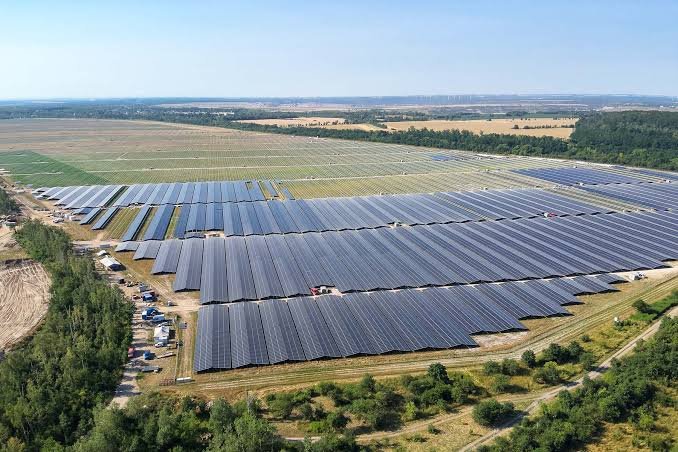
Witznitz Solar Park is a large-scale solar power project built near Leipzig, Germany, on a 500-hectare former lignite mining site. Construction began in 2022, and the project commenced operations in July 2024. Witznitz Solar Park has an installed capacity of 650 MWp and consists of more than 1.1 million solar panels. The project is financed by the Signal Iduna insurance group through Hansainvest Real Assets. The electricity generated is marketed through Shell Energy Europe.
Market-Based Approach
The Witznitz Solar Park project has successfully mobilized private finance to fund its development. Signal Iduna invested approximately €485 million through a combination of equity and debt financing provided by insurance companies within its group. In terms of ownership, HANSAINVEST holds approximately 93 percent of the project, while MOVE ON Energy owns the remaining 7 percent. Signal Iduna, HANSAINVEST, and MOVE ON Energy are all private companies.
Several investors have financed the project with the expectation of generating returns over an investment horizon of approximately 30 years. The ownership and financing structure of this project demonstrates that the clean energy transition can effectively mobilize private capital. Unlike state-based projects driven by green industrial policy, the Witznitz Solar Park project is driven by private companies, whose investment decisions are based on feasibility studies and commercial calculations, with the expectation of generating profits in the future.
Electricity sales from this project are conducted through commercial contracts under Power Purchase Agreements (PPAs). Shell Energy Europe signed a 15-year electricity purchase agreement for approximately 600 MW of capacity. Of this capacity, Shell Energy Europe allocated 323 MW to Microsoft under a separate agreement. The contract took effect on January 1, 2025. This PPA demonstrates that electricity prices are determined through market mechanisms, with exposure to electricity price volatility. The average electricity price in the German market in 2024 reached €54.64, representing a 31 percent decline compared to the previous year.
The Witznitz Solar Park project also illustrates the limited role of the German state, which primarily acts as a regulator. The German government is responsible for issuing permits, regulating land use, establishing environmental standards, and overseeing transmission networks. The government does not provide subsidies, nor does it directly determine electricity prices or establish national priorities for specific sectors. The entities involved in the project are private companies. The project also involves technological cooperation with Shanghai-based Jinko Solar. German utility company 50Hertz partnered with MOVE ON Energy to manage inverter maintenance and the integration of renewable energy into the electricity grid.
For private investors such as Signal Iduna, the Witznitz Solar Park project offers opportunities to generate long-term returns through a 15-year Power Purchase Agreement (PPA) with Shell Energy Europe. This PPA provides certainty regarding the commercial viability of the renewable energy project. On the other hand, private investors have influence over which clean energy projects receive financing. With corporate buyers that have strong financial capacity, long-term contracts tend to be more attractive to investors.
In addition, the private sector bears the long-term investment risks associated with this project. This means that investors face uncertainty regarding electricity prices and revenues after the project is developed. They do not receive any government-guaranteed offtake agreements from the German government. Companies must therefore consider these risks when making investment decisions. As a result, profitability is determined by operational efficiency and market forces of supply and demand, requiring investors and project operators to compete with other market participants.
Effectiveness of Witznitz Solar Project
In terms of effectiveness, the project has successfully developed and operated a large-scale solar power plant through a phased development process. The project began supplying electricity in December 2023, with a connected capacity of 605 MWp as of March 2024. With more than 1.1 million solar panel modules, the project is estimated to generate 640,000 MWh of electricity annually. This is equivalent to the electricity needs of approximately 255,000 two-person households. This demonstrates that a privately financed project can successfully deliver operational renewable energy infrastructure and provide users with an alternative to fossil fuel-based energy.
The project also has a stable grid connection, as the solar power plant is directly connected to the 380 kV extra-high-voltage transmission network. With approximately 3,500 inverters, the plant can provide up to 150 MVAr of reactive power to maintain voltage stability, including at night when the solar panels are not generating electricity. From a commercial perspective, the project has also successfully secured an offtaker through a 15-year Power Purchase Agreement (PPA) with Shell Energy. This agreement also includes arrangements for supplying renewable energy to Microsoft.
Most importantly, in terms of environmental impact, the project has the potential to avoid approximately 250,000 tons of CO2 emissions annually. The project also serves as an example of the structural transformation of a former mining area into a site for renewable energy technology, particularly solar panels, making it one of the largest solar power installations in Europe.
Conclusion
In conclusion, the Witznitz Solar Park project demonstrates a market-based approach to clean energy development that has successfully mobilized private financing. The project has also been relatively effective in providing solar-based clean electricity to both corporate users and household consumers.



 Jozi Ikhlas Attarik
 Muhammad Ariiq Nurfidani
 Nasib Sahim
 Ellena Pangestu Kavarera

 Arahman Akbar
گینر کوین لورون یک مکمل افزایشدهنده وزن
و حجم فوقپیشرفته است که ترکیبی ایدهآل از کربوهیدراتهای پیچیده، پروتئینهای زودهضم و دیرهضم، و اسیدهای آمینه ضروری را در خود جای داده است.