
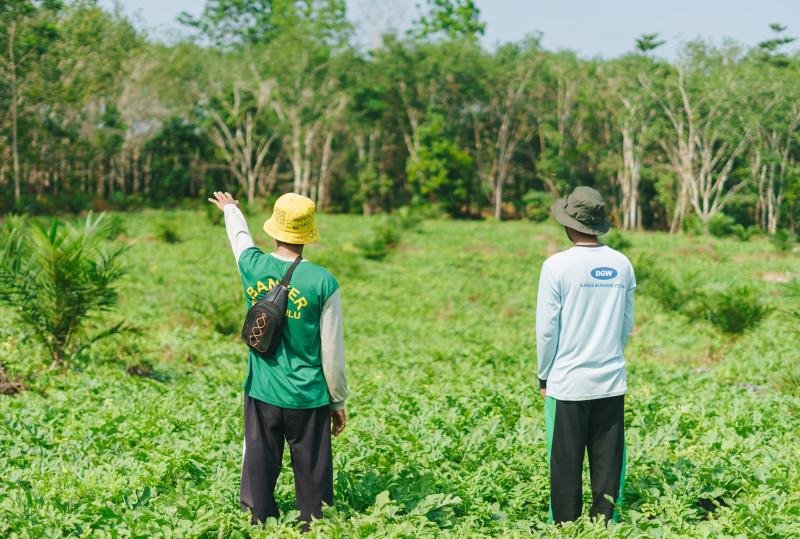
Indonesia is one of the countries with the largest forest areas in the world with a total area of 92 million hectares based on data from the Food and Agriculture Organization (FAO). However, Indonesia has a major problem with deforestation and climate change, Global Nature Watch (2026) records that from 2001–2022 Indonesia lost 33 Mha of tree cover, equivalent to a 21% decrease in tree cover 2000 area or equal to 24 gigatons of carbon dioxide equivalent, where the main cause of Indonesia’s forest loss is due to the conversion of forests into agricultural land such as mixed dryland farming, plantations, and mining. On the one hand, the use of forest land into commercial agricultural areas can provide economic improvement for the country through the export of commodities such as palm oil. The position of palm oil in the Indonesian economy is very vital Where Indonesia plays a role as the largest producer and exporter of Crude Palm Oil (CPO) in the world with a share of around 60% of the global market (Dwi R.N. 2024). According to BPS data (2025), Indonesia’s palm oil production amounted to 45.44 million tons with a land area of 16.01 million hectares, of which 53.57% was dominated by large corporations while smallholder plantations reached 42.94% and state plantations 3.49%. On the other hand, forest conversion brings negative impacts such as the decline of flora and fauna biodiversity, both endemic and non-endemic, damage to ecosystems and food chains, increased carbon emissions, soil erosion, and decreased water quality and availability. This means that Indonesia is facing a dilemma, Palm oil in particular is often considered as the main driver of deforestation in Indonesia. However, on the other hand there are millions of people whose lives depend on this commodity, and there are many derivative products from this crop ranging from cosmetics, soap, cooking oil, food raw ingredients, to biofuel. The problem is not oil palm as a crop but the expansion of oil palm planting on forest land for the needs of economic development. Then a question arises, how can we stop the rate of deforestation while considering the socio-economic aspects of society?
Optimizing available land through a sustainable agriculture approach can be an alternative to facing the pressure of agricultural expansion while improving rural livelihoods in Indonesia. Climate-Smart Agriculture (CSA) is an agricultural approach that aims to increase land productivity in a sustainable manner, strengthen adaptability to climate change, and reduce the impact of agricultural activities (Arconesia, 2022). This approach encourages more efficient land use through diversification and integration of various commodities in one farming system, so that increasing production does not always have to be done through new land clearing. In Indonesia, the principles of CSA are reflected in various local agricultural practices such as intercropping, agroforestry, rice mine, and plant-livestock integration. These practices combine several commodities in one land so that they can increase productivity and economic value of land compared to the monoculture system. According to Arconesia (2022), CSA prioritizes a mutually beneficial relationship between components that allows for more optimal use of land resources. From the perspective of farmers’ welfare, CSA not only increases production but also strengthens income stability. Commodity diversification allows farmers to gain profits through the overyielding effect, which is an increase in crop productivity from two or more commodities in one field and then produces an insurance effect.
This CSA practice can be applied to existing oil palm plantations, according to Slingerland et al. (2024) explaining that oil palm plantations have a planting distance of about 9 X 9 meters. At the age of 1-4 years, the canopy cover of oil palm is still around 20%, so the space between the rows of oil palm still allows for other crops to be planted. This condition provides an opportunity to optimize land use in periods when oil palm plants have not produced optimally, so that it can provide additional income outside of oil palm production. There are several types of crops that can be planted among the oil palm rows such as horticulture (bananas, papayas, melons, and watermelons), food (corn, gogo rice, peanuts, mung beans, and soybeans) and feed (Koro pepada) Where the selection of crops needs to consider market demand, input needs, labor, farmer knowledge, soil conditions, location, and availability of seeds. Integration with livestock is the same, koro sword plants can support livestock activities such as cows or goats, the harvest can be used as feed, the manure produced from livestock can be used as organic fertilizer to support soil fertility and plant growth, including to oil palm itself (Slingerland et al, 2024). Thus, one plantation area not only produces oil palm, but also food crops, horticulture and animal feed. This shows that increasing land use efficiency can be done through diversifying products on available land, this can prevent the expansion of plantation areas.
However, the author realizes that the potential for increased productivity can also encourage land expansion, not automatically result in forest conservation. Without strong land management and protection of forest areas, increasing profits from the agricultural sector actually creates incentives for agricultural land expansion. Therefore, government policy support is very important, the government can create an environment that allows farmers to implement intercropping practices, agroforestry, crop-livestock integration through technical support, access to green financing, strengthening assistance, and market access and ensuring that productivity increases go hand in hand with the protection of forest areas.
References
Food and Agriculture Organization. (n.d.). Broadening forestry education to tackle the climate crisis. FAO. Retrieved November 10, 2026, from https://www.fao.org/newsroom/story/Broadening-forestry-education-to-tackle-the-climate-crisis/en
Global Nature Watch. (n.d.). Indonesia country dashboard. Retrieved November 10, 2026, from https://globalnaturewatch.org/dashboards/country/IDN/?dashboardPrompts=eyJzaG93U&map=eyJjYW5Cb3VuZCI6dHJ1ZX0%3D
Slingerland, M., Tarigan, S., Sumantri, I., Nahrowi, Sudradjat, Hariyadi, Suwarno, A., Purnomo, J., Woittiez, L., de Vos, R., & Yanda, J. S. O. (2024). Oil palm plantation intercropping strategies to improve land use efficiency, local community participation, and smallholder livelihoods: Lessons from Bengkulu and South Kalimantan (SustainPalm Policy Brief). Wageningen University & Research. https://doi.org/10.18174/704232
Arconesia. (n.d.). Mainstreaming climate-smart agriculture (CSA) di Indonesia. Retrieved November 10, 2026, from https://arconesia.com/blog/mainstreaming-climate-smart-agriculture-csa-di-indonesia.html
Ministry of Finance of the Republic of Indonesia. (2024). Oil palm: A pillar of Indonesia’s economy. Retrieved from https://opini.kemenkeu.go.id/pages/read/kelapa-sawit-pilar-ekonomi-indonesia
Central Statistics Agency. (2025). Indonesia’s annual plantation crop statistics 2024: Oil palm, coffee, cocoa, rubber, tea, and leading plantation commodities. Central Statistics Agency.

 Jozi Ikhlas Attarik
 Muhammad Ariiq Nurfidani
 Nasib Sahim
 Grienda Qomara

 Ellena Pangestu Kavarera

 Arahman Akbar
+ There are no comments
Add yours