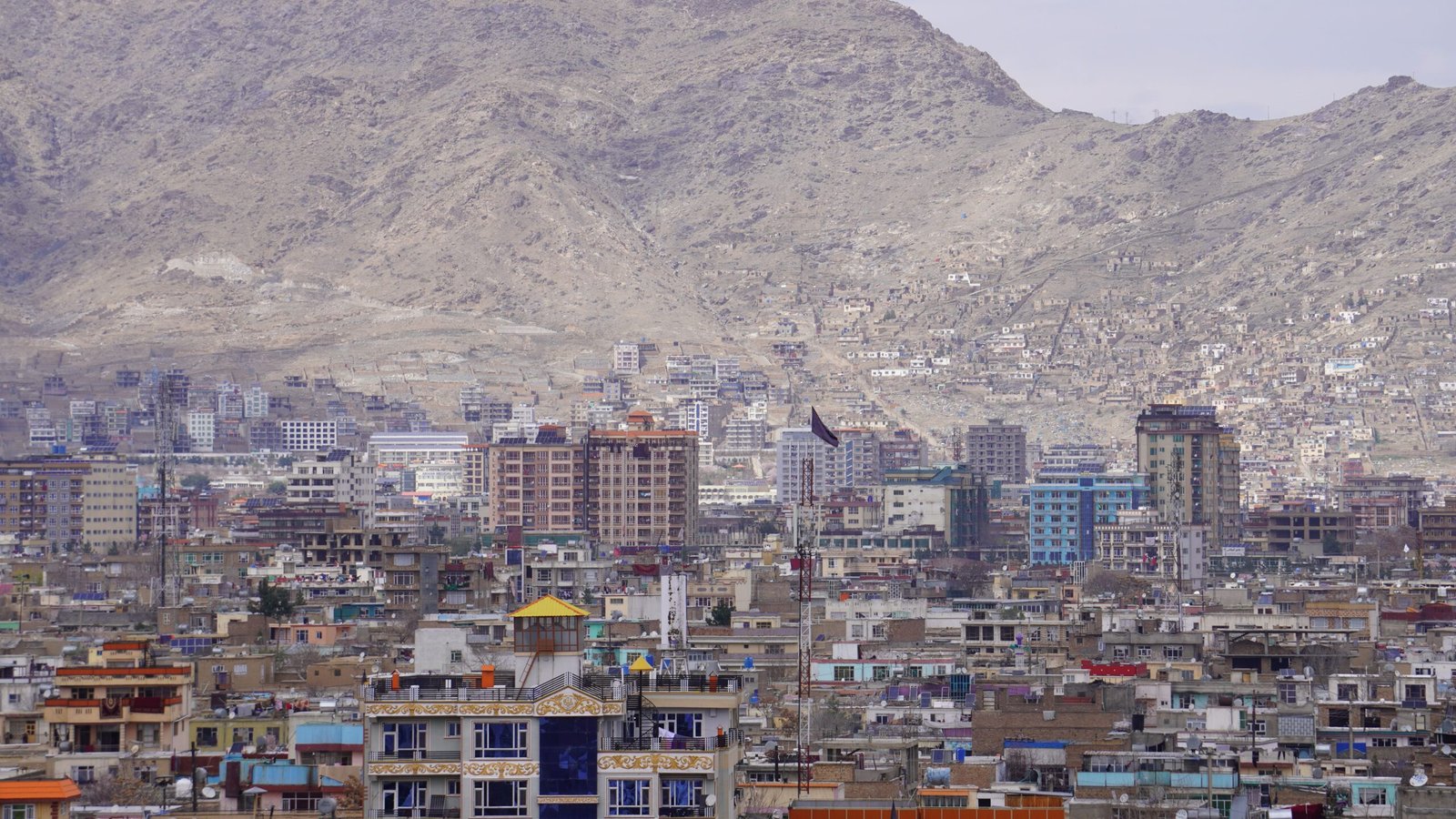

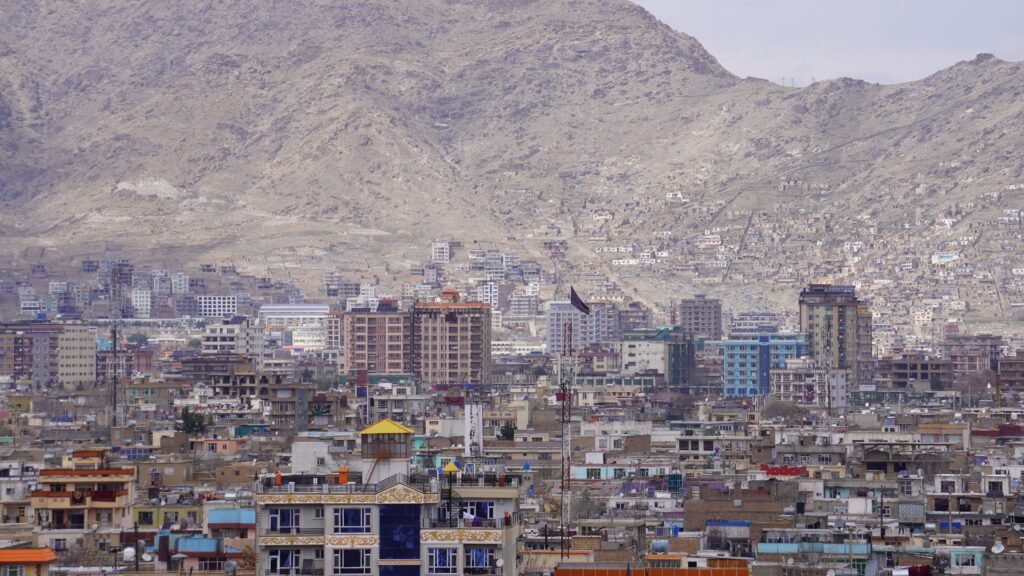
In May 2025, the aid group Mercy Corps published a report warning that Kabul could become the first modern capital to run out of water. If current trends continued, the city’s aquifers would be dry by 2030, and as many as three million people could be displaced (Al Jazeera, 2025). Within weeks the line had travelled. CNN ran it, Al Jazeera ran it, Radio Free Europe ran it, and most versions put climate change near the top of the list of causes (CNN, 2025; Najibullah, 2025).
There is no reason to play down the danger. The water table under Kabul is falling, and nobody serious disputes that. What interests me here is a narrower question, and it is the kind of question this course keeps asking. Once a crisis becomes a story, what does the story do?
My argument is that the “climate crisis” frame has helped Kabul’s water problem get noticed, but it has also blurred what the science actually says. The peer-reviewed hydrology of the Kabul Basin points mainly to extraction outrunning recharge in a city that grew far faster than any water system could follow. Climate is part of the picture. However, it acts as an amplifier, not the main engine. When the public story reverses that order, it moves responsibility away from the things policy can change and towards a force nobody in Kabul controls.
Start with what the scientists found. A U.S. Geological Survey team analysed monthly water levels from about 70 monitoring wells between 2004 and 2012 (Mack et al., 2013). Their result is quite telling. In the rural parts of the basin, groundwater levels rose slightly once normal precipitation returned after the drought of the early 2000s. Inside the city, levels kept falling, and the fall sped up: from 0 to 0.7 metres a year on average in 2004 to 2008, to 1.5 metres a year in 2008 to 2012, with more than 4 metres a year in parts of the northwest (Mack et al., 2013, pp. 457, 463). The same climate fell on both areas. Only the city kept sinking. As a result, the authors put the urban decline down to increasing water use in an area with limited recharge, not to the weather.
The mechanism matters here, and it is the part hydrology can explain best. Rain falling directly on Kabul barely refills the aquifer. Mack et al. (2013, p. 459) estimate net recharge from direct precipitation at close to zero in a normal year. Most recharge comes instead from rivers leaking into the ground and from water spread over irrigated land. So climate reaches Kabul’s groundwater mainly through the rivers, through how much snow falls in the mountains and when it melts. Land use reaches it through what happens on the surface: whether the ground is open fields or concrete.
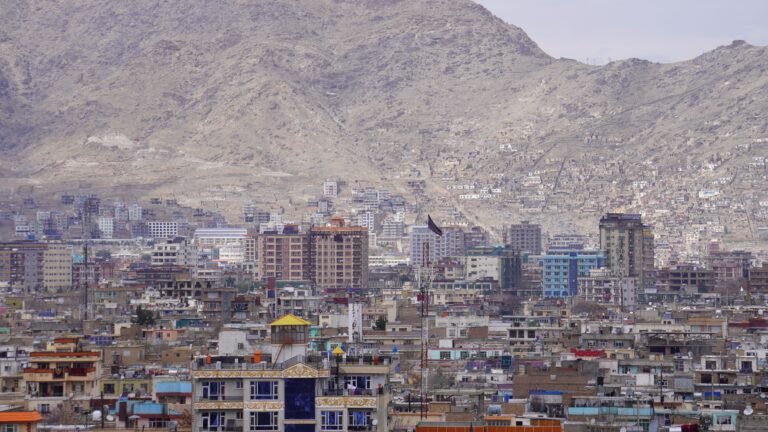
A newer study adds the land-use side. Using Landsat images from 2000 to 2022, Ahmadi et al. (2024) found that Kabul’s built-up area expanded by about 70 percent over those two decades, while groundwater levels dropped by between 13 and 35 metres. The districts with the most intensive urban growth showed the sharpest declines. In other words, the city was sealing over the very fields and bare ground that used to let water soak in, while also pumping more of it out. Ahmadi and colleagues do mention climate change, though carefully. They say it “may have contributed” to lower precipitation feeding the aquifer, and they list it alongside population growth and urban expansion as factors that “require further investigation”.
The third study comes from Kabul University’s Department of Hydrometeorology. Reshteen et al. (2024) bring together data from the Ministry of Energy and Water and show that groundwater levels have fallen by roughly 25 to 30 metres in the past decade, against an annual natural recharge of only about 51 million cubic metres (pp. 146–147). They also report a 12 percent fall in precipitation between 2012 and 2023 and a 19 percent fall in snowfall between 2014 and 2020 (p. 140). So the climate signal is real. Yet the same paper contains a sentence that, for me, says more than any headline: many districts in Kabul face severe shortages “even when the river is full” (p. 148). About 394 million cubic metres flow into the city area from the Paghman, Maidan and Logar rivers each year, and most of it leaves again unmanaged (p. 145). That is a governance failure, not a rainfall one.
Taken together, the three studies agree on the order of causes. Demand from a population that grew from about 720,000 in 1978 to around 4 million by 2012 (Mack et al., 2013, p. 461), and more than 6 million by 2025 (Najibullah, 2025), comes first. Lost recharge from urban sprawl comes next. Climate stress sits on top of both and makes the gap wider.
The public story arranges the same facts differently.
There are understandable reasons for this. “First capital to run dry” is a strong headline, and a date like 2030 gives a story urgency that a slope of 1.5 metres a year never will. Janković and Schultz (2017), whom we read in Week 5, argue that linking local disasters to climate change can grab attention while flattening the human decisions that turned a hazard into a disaster. Kabul fits that pattern well. A climate frame also travels better to the readers who fund aid. For donors who will not work through Afghanistan’s de facto authorities, “climate adaptation” sounds like neutral ground in a way that “municipal water regulation” does not. I should be careful, because this last point is my interpretation of the incentives, not something the reports state.
The trouble is that the 2030 date suggests a precision the evidence cannot support. The estimates disagree with each other quite openly. Mercy Corps put the annual gap between extraction and recharge at about 44 million cubic metres (KabulNow, 2025). Other experts quoted by AFP put it at about 76 million (Walden, 2025). A source cited by Ahmadi et al. (2024, p. 2) claims extraction runs six times faster than recharge. These are not small differences in rounding. They reflect how thin the data are. Climate recordkeeping in Afghanistan stopped around 1980 (Mack et al., 2013, p. 459). Ahmadi et al. (2024, p. 9) had 527 groundwater measurements for 2005 but only 97 for 2022. Even in 2013, the USGS team warned that security problems made monitoring difficult (Mack et al., 2013, p. 465). A countdown built on that record is a projection, not a measurement, and it should be communicated as one.
This matters for a reason beyond accuracy. Oomen (2019) describes the hope that science can act as common ground, a level playing field that different actors accept. A deadline that later turns out wrong does the opposite. If 2030 arrives and Kabul still has some water, as is quite possible given local differences in the aquifer, the next warning will be easier to ignore.
What does the climate frame hide? Mostly, it hides the actors. Mercy Corps itself counted more than 100,000 unregulated wells in the city (Dawn, 2025). One soft drink company, Alokozay, reportedly uses about a million cubic metres of groundwater a year (Najibullah, 2025). More than half of Kabul’s people live in informal settlements and buy water from private sellers at higher prices (Reshteen et al., 2024, p. 148). As early as 2013, the USGS noted that there was simply “no management of groundwater resources” in the basin (Mack et al., 2013, p. 459). None of these facts is about rainfall. All of them are about who pumps, who pays, who builds where, and who is supposed to regulate.
There is also a political convenience in the climate story. If drought is the cause, then nobody in Kabul is responsible. Authorities can point to the sky, much as officials in other water disputes have pointed to drought when asked where the water went. Large commercial users avoid scrutiny. Even residents may take the message as fatalism: if the city is doomed by 2030, why bother with metering or recharge schemes?
The strongest objection to my argument is practical. Alarm gets money, and Kabul needs money badly. In early 2025, the UN reported that partners had received only $8.4 million of the $264 million needed for water and sanitation programmes in Afghanistan (Daryo, 2025). Compared with that gap, a dramatic headline might be the only tool aid agencies have, and a careful sentence about recharge rates would raise nothing. I take this seriously. Still, the choice is not between alarm and silence. The same report can carry urgency and an honest account of causes. Indeed, Mercy Corps ends its own report by discussing how aid actors could work with the private sector (Mercy Corps, 2025), which is a governance answer, not a climate one. The framing in the media went further than the policy logic of the report itself.
So what would better communication look like? First, it would describe the problem as a balance: how much water goes into the aquifer, how much comes out, and who takes it. Second, it would give ranges instead of a single year, and say plainly how much monitoring is missing. Third, it would name the levers. Reshteen et al. (2024, pp. 145, 148) point to capturing river flows and recharging the aquifer on purpose, while Ahmadi et al. (2024) call for a legal framework to regulate extraction and a central monitoring database. These are boring measures. They are also the ones that work.
Climate change will make Kabul’s water problem harder in the years ahead, and that deserves to be said clearly. But a city that loses most of the river water passing through it, and lets more than 100,000 wells pump without rules, is not mainly a victim of the weather. The most useful message about Kabul’s water is less dramatic than “the city will run dry by 2030.” It is that the aquifer is being emptied faster than it fills, mostly by people and decisions that can still be changed.
References
Ahmadi, H., Popalzai, A., Bekbotayeva, A., Omarova, G., Assubayeva, S., Arshamov, Y., & Pekkan, E. (2024). Assessing the impacts of landuse-landcover (LULC) dynamics on groundwater depletion in Kabul, Afghanistan’s capital (2000–2022): A geospatial technology-driven investigation. Geosciences, 14(5), 132. https://doi.org/10.3390/geosciences14050132
Al Jazeera. (2025, July 5). ‘End is near’: Will Kabul become first big city without water by 2030? https://aljazeera.com/features/2025/7/5/end-is-near-will-kabul-become-first-big-city-without-water-by-2030
CNN. (2025, July 19). For the first time in modern history, a capital city is on the verge of running dry. https://ktvz.com/news/national-world/cnn-world/2025/07/19/for-the-first-time-in-modern-history-a-capital-city-is-on-the-verge-of-running-dry/
Daryo. (2025, August 26). Afghanistan faces worsening water shortages as Kabul’s aquifers decline. https://daryo.uz/en/2025/08/26/afghanistan-faces-worsening-water-shortages-as-kabuls-aquifers-decline/
Dawn. (2025, May 16). ‘Serious problem’: Kabul losing race against water shortages. https://www.dawn.com/news/1911380
Janković, V., & Schultz, D. M. (2017). Atmosfear: Communicating the effects of climate change on extreme weather. Weather, Climate, and Society, 9(1), 27–37.
KabulNow. (2025, June). Report warns Kabul could run out of water within 5 years. https://kabulnow.com/2025/06/report-warns-kabul-could-run-out-of-water-within-5-years/
Mack, T. J., Chornack, M. P., & Taher, M. R. (2013). Groundwater-level trends and implications for sustainable water use in the Kabul Basin, Afghanistan. Environment Systems and Decisions, 33(3), 457–467. https://doi.org/10.1007/s10669-013-9455-4
Mercy Corps. (2025). Kabul’s water crisis: An inflection point for action. https://www.mercycorps.org/research-resources/kabuls-water-crisis
Najibullah, F. (2025, July 6). Kabul on course to be world’s first capital to run out of water. Radio Free Europe/Radio Liberty. https://www.rferl.org/a/kabul-water-crisis-running-out-of-water-afghanistan-2025/33461892.html
Oomen, J. (2019). A level playing field, or the hope for science as a common ground. RCC Perspectives, (4), 23–30.
Reshteen, S., Rahmatzai, A., & Safi, A. G. (2024). Urban water crisis in Kabul City: Key challenges and solutions. Journal of Natural Science Review, 2(3), 138–150. https://doi.org/10.62810/jnsr.v2i3.51
Walden, S. (2025, May 16). ‘Serious problem’: Afghan capital losing race against water. AFP via RNZ. https://www.rnz.co.nz/news/world/561274/serious-problem-afghan-capital-losing-race-against-water

 Arahman Akbar
 Nasib Sahim
 Mwaiwawo Banda
 Jawal Sualisu
 Hanifah Setyaningrum
 Fadhli Fauzan Ilahi
+ There are no comments
Add yours