
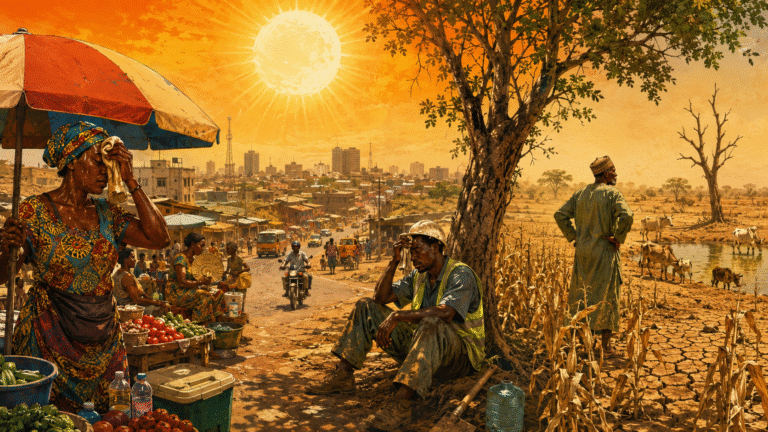
We tend to be surrounded by numbers and statistics on carbon trajectories, rising sea level, and the current innovations in renewable energy sources. Nevertheless, the more I read about climate change, especially in the African setting, particularly in Nigeria, the more I am persuaded of a serious reality: climate change might be the main concern, but rather the weak institutions of governance that must handle all forms of climate actions. The failure of good governance disrupts climate diplomacy and undermines the entire climate adaptation actions.
The Myth of the Environmental Signal.
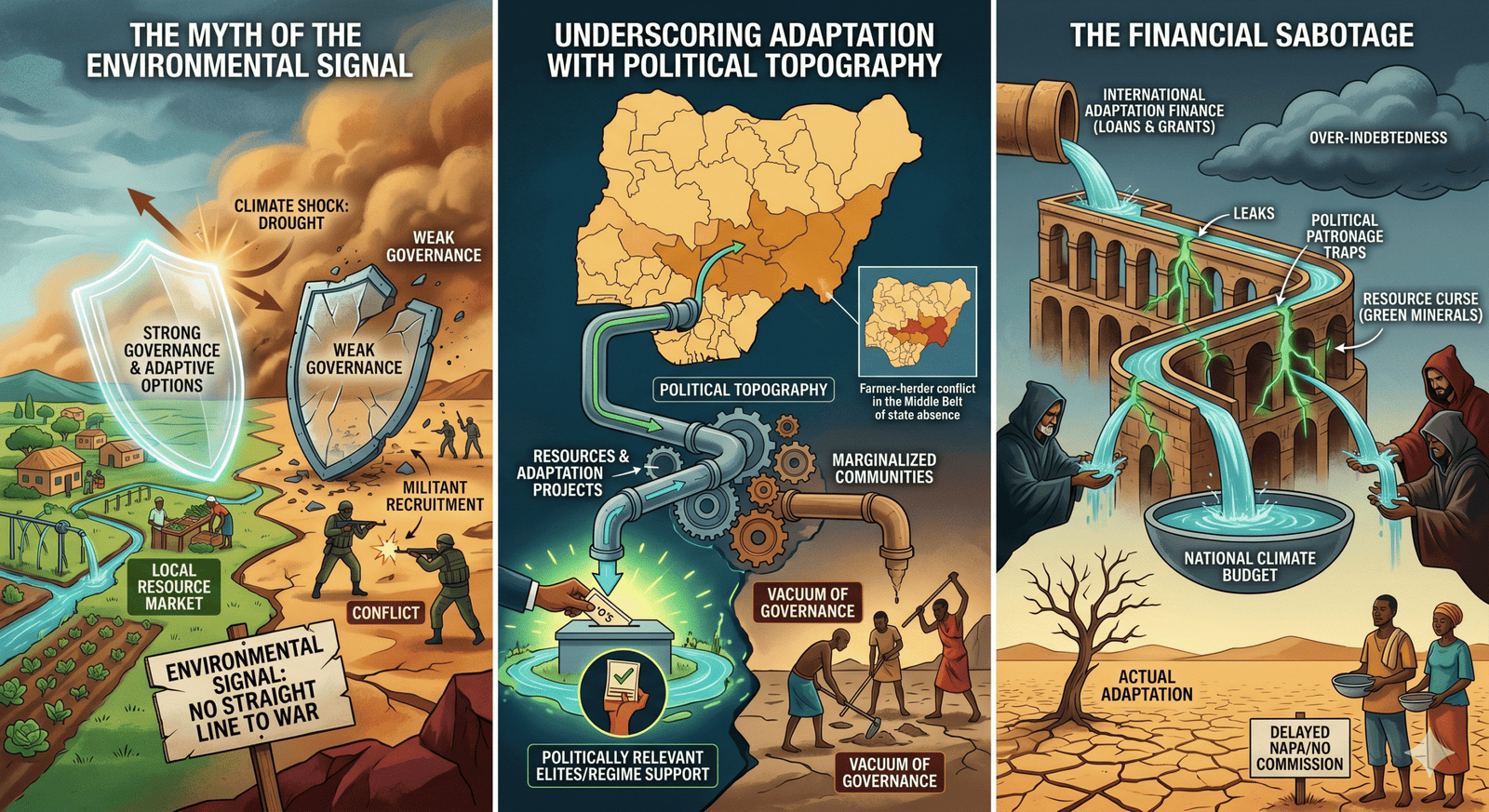
A common, widely spread narrative in the media is the concept that climate change, in the form of drought, floods, and heatwaves, is bound to cause war and social collapse. However, as research demonstrated, there is no direct link between environmental stress and conflict (Brown et al., 2007). The question of whether a shift in climate will trigger mayhem depends on the capability of a government to govern its people well and to provide them with real alternatives on how to cope and adapt (Raleigh, 2010).
The contribution of Africa to the total carbon emissions in the world is approximately 3-4 per cent, but the continent is disproportionately exposed to climate (Welsh, 2021). More than half of the countries in Sub-Saharan Africa have to deal with a double burden of extreme climate vulnerability and political fragility (Naidoo & Gulati, 2022). The major disruptor is this weakness. Weak institutions in the states are unable to cope with resource competition or offer the public goods, like irrigation, flood barriers or social safety nets, that citizens require to cope (Raleigh, 2010). This means that climate change itself does not merely cause conflict; rather, it is a threat multiplier that reveals underlying issues of political marginalisation and economic disparity (Tarif, 2022).
How Weak Governance Disrupts Climate Negotiations.
The task of negotiating international collaboration to reduce global warming and assist nations to adjust to its impacts is called climate diplomacy. In the case of African countries, such diplomacy is anchored on the principle of common but differentiated responsibilities (CBDR) – the idea that the Global North, which is the root cause of the problem, should contribute funds and technology to assist the Global South, which will help states to adapt (Brown et al., 2007). Nonetheless, poor governance within African states undermines their bargaining power on the global stage to a great extent.
The African Union (AU) and African Group of Negotiators have achieved tremendous progress in the international engagement, but the responsibility of the member states and lack of financial strength have become the major issue (Aminga & Krampe, 2020). International donors will naturally reduce the size of the large-scale, long-term funds they are prepared to devote to the system when they see that there is no concrete policy implementation, and that adaptation money is at risk of being squandered by political figures who are occupying powers (Aminga & Krampe, 2020).
Furthermore, African agencies tend to be undermined by their dependency. The fact that most climate programs run by the AU are mostly donor-led as opposed to the member states has often made the climate agenda of the continent be viewed as one imposed on the continent instead of an internally-driven priority (Aminga & Krampe, 2020). Devoid of inner responsibility and a truly coherent stand, the demands of increased awareness of the needs of Africa will likely not result in any significant change (Naidoo & Gulati, 2023). This is evident in the artificial division that international finance brings about; when donors will create a boundary between what they see as development and what they see as adaptation, which in a Nigerian village, where clean water is a development failure and a climate risk does not make sense (Sayne, 2011).
Weakening Adaptation: The Politics of Failure of Adaptation
On the ground, what Raleigh (2010) calls the political topography of power, the notion that in most African states, resources and development projects are allocated by people with political utility, rather than according to who needs what help, is undermining adaptation efforts.
A good example is Nigeria. In the north, the country is experiencing desertification, and in the south, it is experiencing an increase in sea levels (Sayne, 2011). However, intricate and poorly implemented land-use system and absence of effective federal control tend to thwart adaptive responses (Sayne, 2011). A vacuum is formed when the government merely offers relief to groups that offer support to the ruling regime, without paying attention to those deemed politically insignificant (Raleigh, 2010). In such a vacuum, violence is a means through which communities cope with the diminishing resources themselves (Raleigh, 2010).
And this is what is being enacted in the farmer-herder tussles of the Middle Belt of Nigeria. Although the pastureland is being degraded in the north by climatic factors, the rise to organised violence is indicative of the failure of governance (Sayne, 2011). The failure of the state to control land ownership, ensure security, and implement grazing contracts has enabled the local conflicts over resources to be capitalized on by influential elites and militias (Tarif, 2022). The failure of a state to deliver basic services makes militant groups intervene when the state fails to deliver basic services to people, and they leverage the very real suffering that climate change causes to attract new members and increase their influence (Naidoo & Gulati, 2022).
The Financial Sabotage: Loans, Leaks, and lack of Vision.
Adaptation is also compromised by weak governance due to poor management of finances. A large part of the present climate finance takes the form of loans, which only further burdens the already existing debt that many African countries are already carrying (Naidoo & Gulati, 2023). However, even with grants, institutional capacity also implies that funds frequently do not reach the most vulnerable communities (Aminga & Krampe, 2020).
In Nigeria, Nigeria has experienced delays on several occasions in the implementation of the National Adaptation Program of Action (NAPA) and attempts to set up a Nigerian Climate Change Commission have been met with significant challenges in the legislature (Sayne, 2011). Lack of a central oversight body means that adaptation efforts are being fragmented and do not have a connection to any greater strategy (Sayne, 2011). A looming threat is also the risk of a resource curse (Naidoo & Gulati, 2023). Provided that the transition towards green minerals (e.g. lithium and cobalt) is managed with the same lack of transparency that has characterized oil industry, it will not only continue to entrench inequalities, but also finance a fair and inclusive energy transition (Naidoo & Gulati, 2023).
A Call to No Regrets Governance.
Policy makers need to advocate for a paradigm shift in the way will approach adaptation. It cannot be merely planting trees or constructing sea walls, it needs to be also about reinforcing the social fabric and the rule of law.
To start with, we require co-ordinated, evidence-based actions that transcend national or ethnic interests (Tarif, 2022). This involves the establishment of early warning systems not only sensitive to conflict, but also to climate risk – systems capable of identifying danger before it escalates into a crisis (Tarif, 2022).
Second, all adaptation projects should be evaluated in terms of the impact on the balance of power among various groups in the society (Raleigh, 2010). We should ensure that adaptation is not a new type of political patronage that favours the strong and leaves the most vulnerable communities out (Raleigh, 2010).
To sum up, the climate crisis in Africa is fundamentally a governance crisis. Weak institutions stand in the way of global collaboration to finance adaptation and, at the same time, undermine local efforts to implement such adaptation. However, no amount of foreign aid will suffice to create a climate-resilient future without first tackling the political weaknesses that have been constructed into our systems (Naidoo & Gulati, 2022). We must govern ourselves as solid and sturdy as the citizens whom it is destined to serve.
Keywords: Weak Governance, Climate Adaptation, Threat Multiplier, Political Topography, Financial Sabotage


 Reston Dennis Juah
 Noor Ul Ain
 Hassan Barrie
 Hoby Nasandratra Andriamiandrisoa
888SLOT nổi bật với ba trụ cột chính: đa dạng trò chơi, bảo mật cao cấp và dịch vụ khách hàng xuất sắc. Mỗi yếu tố này được thiết kế tỉ mỉ nhằm tạo ra môi trường giải trí trực tuyến đẳng cấp, khác biệt hoàn toàn so với các nền tảng thông thường trên thị trường. TONY05-09
xn88. com áp dụng chính sách “chơi thật – thưởng thật”, không câu kéo, không điều khoản ẩn. Minh bạch là tiêu chí hàng đầu của chúng tôi. TONY05-15