
Executive Summary
Climate change is a significant global concern, impacting economic growth and development. The 2015 Paris Agreement and Sustainable Development Goals have set pathways to combat climate change, urging nations to adopt global green transition pathways (The Ministry of Environment, Science, 2023).
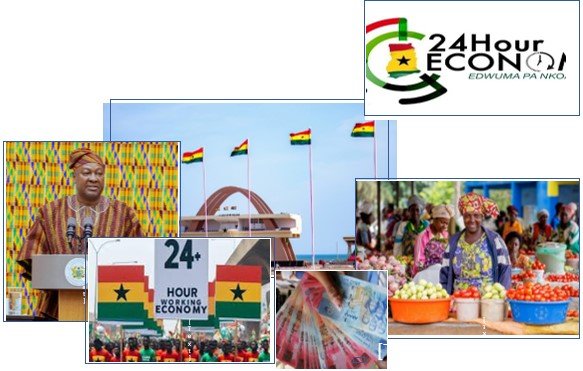
In December 2024, Ghana’s new president, John Dramani Mahama, vowed to improve living standards and build a “24-hour economy” to boost employment and unlock industry potential (News, 2025). This ambitious policy initiative aims to catalyse green industrial growth through renewable energy integration, circular economy practices, and inclusive policies (Abdul-Salam, 2024; News, 2025).
However, Ghana’s current policy landscape has strengths and gaps in coherence, focus, and implementation. This policy brief assesses Ghana’s green industrial strategy, highlighting core policy instruments and targeted sectors, and offers recommendations to enhance effectiveness and international support engagement.
Problem and Context – Coherent Green Industrial Strategy
Ghana has already laid the groundwork for green leadership. With the launch of the Energy Transition and Investment Plan (ETIP), the ongoing implementation of the National Green Jobs Strategy, 250MWp Bui Solar-Hydro Hybrid Plant, Kantanka Electric Vehicles, and the rollout of operational recycling and composting facilities, the country has laid important foundations for sustainable industrial growth (Energy, 2022). According to Figure 1, these initiatives are set to include a diverse perspective of a green economy (Ali et al., 2021). Again, to set a net-zero target by 2060 and aim to facilitate a just transition to an environmentally sustainable economy (The Ministry of Environment, Science, 2023).
Despite Ghana’s enormous potential for developing relevant policies, plans, and strategies, as well as signing global agreements to include diverse options for green economy (Figure 1), little progress has been made in terms of green economy transformation, which is the most important stage of any transformation agenda. Ghana’s quest for green industrialisation is reaching a turning point. Ghana’s green industrial growth presents a generational economic opportunity as well as a climatic imperative (Ali et al., 2021). This is due to the fact that the nation’s industrial sector accounts for the second-largest share of GDP (Abdul-Salam, 2024). But Ghana’s current policy environment is still disjointed, with several sectoral projects lacking a cohesive plan (Energy, 2022).
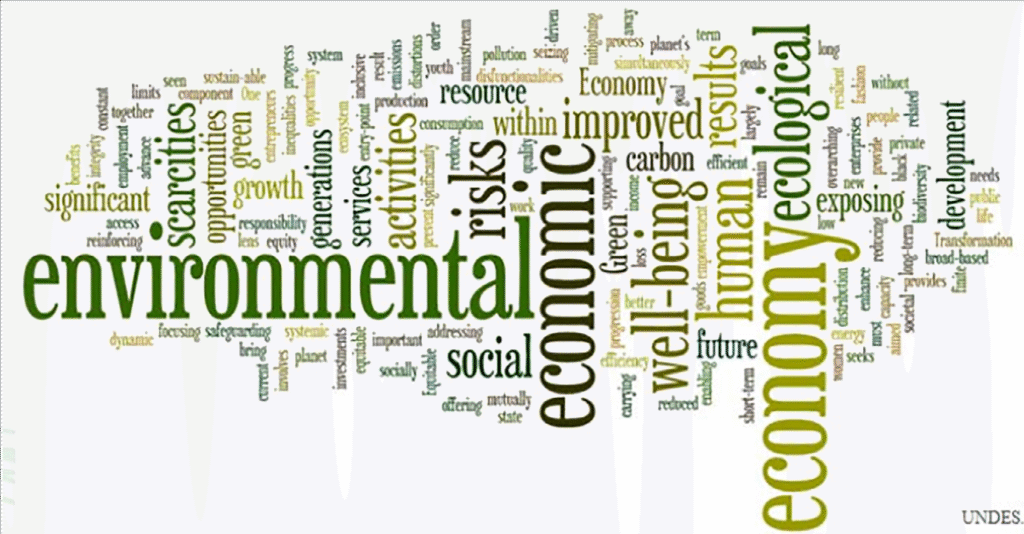
Figure 1: Diverse perspectives on green economy
Source: UNDESA
Ghana’s Green and the “24-Hour Economy” Policy Frameworks
Ghana’s ‘24-hour economy’ initiative offers a competitive edge in the global green transition market, maximizing energy use, boosting productivity, and demonstrating readiness for green manufacturing, commerce, and innovation (Dapilah, 2025). With advantageous trade access through the African Continental Free Trade Area (AfCFTA) and strategic location on the Gulf of Guinea, Ghana can become a low-carbon manufacturing hub in Africa’s green revolution (Dapilah, 2025)
The Ghana Green Jobs Program aims to create more decent green jobs in Ghana for vulnerable, women, and youth (Relations, 2019). It consists of interconnected elements that work in harmony to achieve its overarching objective of creating more decent jobs. The program’s components must be implemented in accordance with complementarity, cooperation, coordination, and collaboration concepts (Relations, 2019). Figure 2 illustrates how the elements relate to and work in harmony to achieve the program’s or strategy’s overarching objective (Relations, 2019).
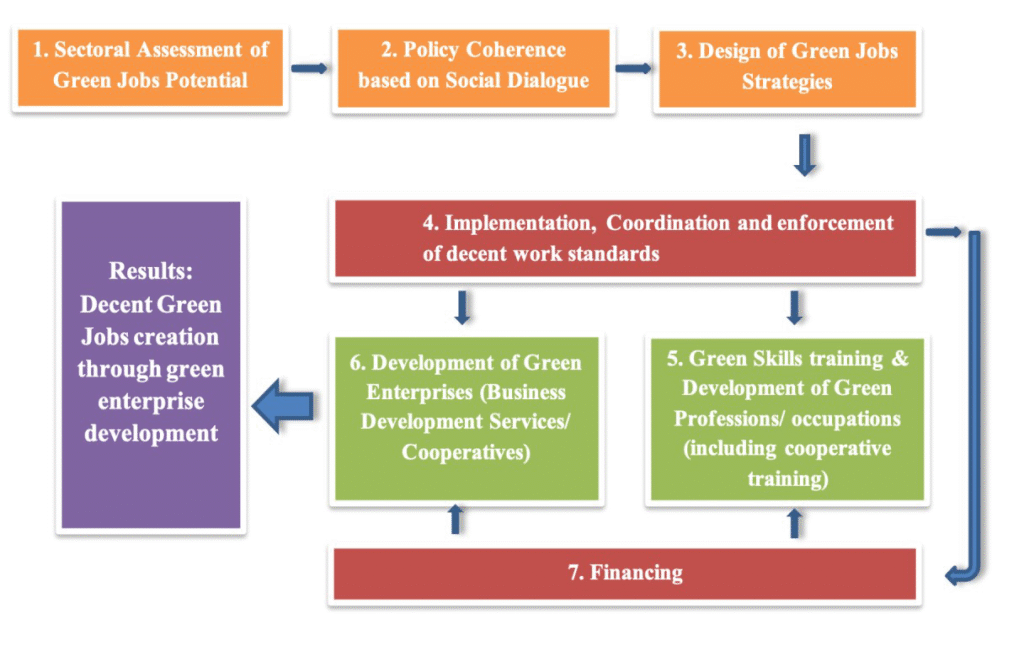
Figure 2: Ghana’s Green Policy Conceptual Framework, Source: Relations (2019)
The 24-Hour Economy Policy Implementation Strategy
Ghana needs a clear policy vision and a structured operational framework to capture a portion of the $9 trillion global green transformation market each year. The twenty-four-hour economy must turn into a systematic operating system and has milestones, resources commitments and institutional responsibility (Abdul-Salam, 2024; News, 2025).
Across short-term, medium, and long-term timeframes, this policy strategic roadmap offers a realistic path for Ghana to become a leader in the green industry (Dapilah, 2025). The implementation structure includes an Inter-Sectoral Coordination Working Group and a Governance and Strategic Management Committee, with government agencies using current regulatory frameworks and policies to enhance institutional structures and ensure successful execution (Figure 3). In order to enhance institutional structures and guarantee the successful execution of the activities, government agencies would make use of the current regulatory frameworks and policies. Certain Ministries, Departments, and Agencies (MDAs) and Metropolitan, Municipal, and District Assemblies (MMDAs) would be in charge of carrying out the specified component or components (Relations, 2019).
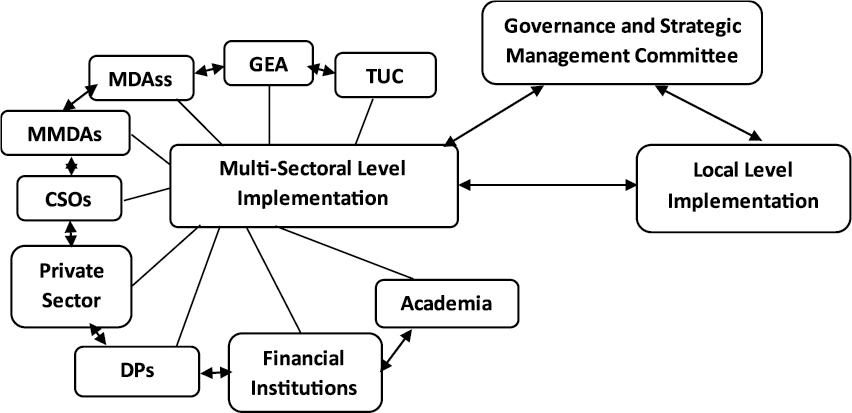
Figure 3: Ghana’s Green Industrial Policy Implementation Structure
Source: Relations, (2019).
Ghana’s Policy Mix and Targeted Industrial and Economic Sectors
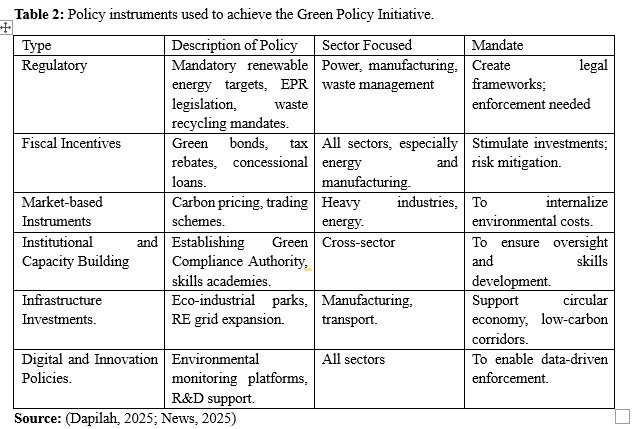
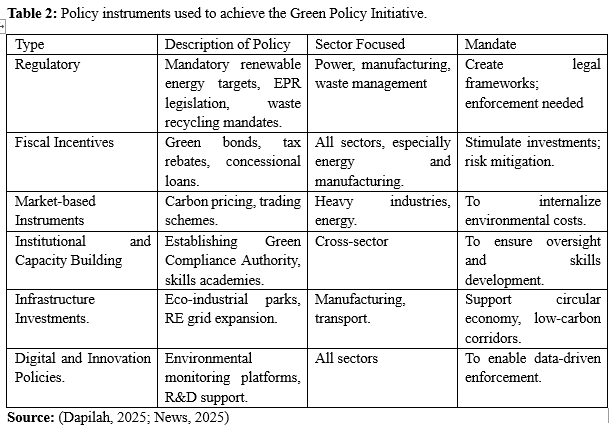
Ghana’s green policy strategy incorporates financial, institutional, regulatory, and capacity-building tools. Activities of sectoral actors, their responsibilities, and the processes played have help Ghana achieve a step towards the transition to a green economy. Figure 4 shows the various funding components of Ghana’s low carbon growth initiatives, highlighting the most prioritized areas since the mid-1990s (Ali et al., 2021). These activities and initiatives receive funding from international organizations such as IMF, Climate Green Deal and REDD+ (Ali et al., 2021). Again, Table 2 gives a summary of the policy instruments.
Targeted Sectors and solutions towards Green Transition
The following sectors are prioritized within Ghana’s green industrialization efforts:
- Energy and Power: Energy and Power: Increasing renewable generation; solar, wind, and bioenergy production, mini-grids, off-grid solutions.
- Manufacturing and Heavy Industries: Low-carbon processes, circular manufacturing zones.
- Agriculture: Green supply chains, organic production, waste-to-resource.
- Waste Management: Waste Management: EPR, Recycling, zero-waste systems.
- Transport and Logistics: Green logistics corridors, electric mobility hubs.
- Construction and Materials: Use of local resources (limestone, clay), green building materials, energy-efficient processes.
- Oil and Gas: Cleaner technologies, gas-to-power, emission reduction.
- Green SMEs: Support for innovation, business development, and market access.
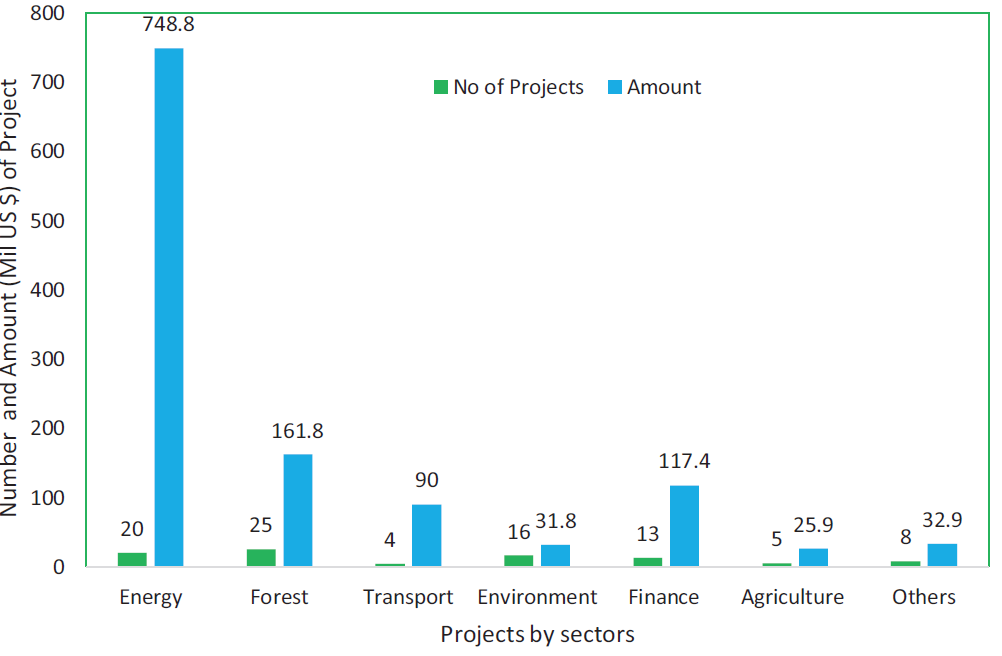
Figure 4: Ghana’s composition of low carbon growth initiatives and funding (in million US$).
Source: Ali et al., (2021)
Opportunities of Ghana’s 24-Hour Economy
- Green Job Creation and Human Capital Development: Ghana can unlock millions of jobs by expanding renewable energy infrastructure, eco-industrial parks, and green skills training programs.
- Renewable Energy Integration and Resilience: The solar, wind, and hydro resources available in the country can be exploited to address increasing energy needs and decrease the use of fossil fuels.
- Green Investment and Trade Competitiveness: Meeting the global climate standards and compliance regimes such as the EU Carbon Border Adjustment Mechanism (CBAM) will draw in climate-sensitive investors and maintain access to exports.
- Circular Economy Leadership: Mainstreaming zero-waste production, Extended Producer Responsibility (EPR), and sustainable supply chains places Ghana at the forefront of circular innovation.
- Green Policy Challenges to Address
- Greenwashing and Weak Regulation: The absence of strict enforcement of the requirements might undermine the belief in misleading environmental statements and discourage serious investments.
- Increasing Emissions and Resource Depletion: Unregulated industrial growth may compromise Ghana climate commitments and deplete natural resources.
- Unequal Access: Informal workers, women and rural populations are at risk of being left out of green growth unless there are conscious inclusion systems practiced.
- Public Gaps in Public Awareness: Inadequate communication and engagement may foster distrust and undermine the public buy-in.
- Policy Imperatives for Ghana’s Green Industrial Future
- Required Renewable Energy Transition: Require high targets (50% by 2050) with fiscal incentives, concessional loans and green bonds to increase adoption.
- Legislate Circular Economy Regulation: Require mandatory recycling benchmarks, EPR compliance, and incentives for zero-waste industrial models.
- Establish a Green Compliance Authority: Have an independent body to oversee third-party audits, verification, and enforcement of sustainability claims.
- Ensure a Just Transition: Have inclusive policies; reskilling, gender-sensitive finance and participatory governance to get equitable access and social cohesion.
CONCLUSIONS
Ghana is at a turning point in its history. A once-in-a-generation chance to change the nation’s industrial trajectory is presented by the global green transition, which is estimated to be worth $9.2 trillion a year and $275 trillion by 2050 (Dapilah, 2025). By increasing productivity, facilitating the use of renewable energy, integrating circular economy principles, and encouraging inclusive green growth, Ghana’s 24-hour economy project has the potential to be the driving force behind this opportunity provided it is well executed.
It is now obvious that Ghana needs to go from vision to disciplined execution. The future requires bold leadership, institutional innovation and an unflinching commitment to be sustainable, equitable and competitive in the global market.
Keywords: Ghana 24-hour economy, green industrial development, renewable energy, circular economy, green jobs, Ghana climate policy, low-carbon growth, net-zero Ghana 2060.

 Reston Dennis Juah
 Noor Ul Ain
 Hassan Barrie
 Hoby Nasandratra Andriamiandrisoa
Bạn có thể thoải mái lựa chọn vật phẩm và vũ khí đa dạng để tiêu diệt con mồi hiện ra trên màn hình. nhà cái xn88 Chưa dừng lại ở đó, với hơn 50+ boss khủng sẽ giúp ngư thủ mang về phần thưởng cực lớn với giá trị Jackpot hàng tỷ đồng. TONY05-15