

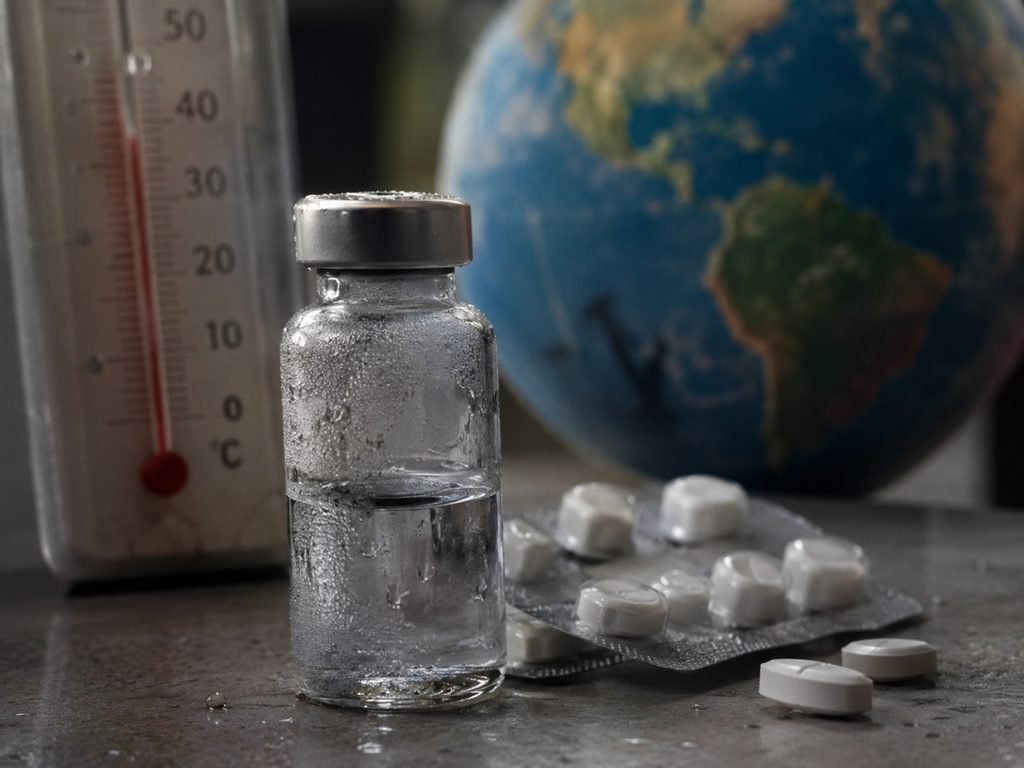
Today, climate change and antimicrobial resistance (AMR) represent two global challenges that increasingly complicate the agenda for public health and environmental sustainability. Climate change not only leads to rising temperatures, shifts in rainfall patterns, floods, and droughts, but it can also affect the balance of ecosystems and the dynamics of microorganisms. Meanwhile, antimicrobial resistance (AMR) results when microorganisms including bacteria, fungi, parasites and viruses evolve to the extent that they eventually become resistant to the antimicrobial drugs such as antibiotics, which are used to treat such conditions (Tang et al., 2023). This case makes infections more difficult to treat, increases the risk of complications, prolongs the duration of care, and can even lead to death. According to a report published by the World Health Organization (WHO) in 2025, approximately 1 in 6 laboratory confirmed bacterial infections are resistant to antibiotics. Furthermore, resistance has increased in more than 40% of the pathogen antibiotic combinations monitored between 2018 to 2023 (WHO, 2025).
How does climate change affect Antimicrobial Resistance?
The rising temperatures are a factor of climate change that has been widely studied for its impact on antimicrobial resistance. Research by Fernández Salgueiro et al. (2024) indicates that environmental temperatures can influence bacterial growth and adaptation, accelerating the replication rate and genetic mutation of these microorganisms through the mechanism of horizontal gene transfer.
These findings are supported by research from Macfadden et al. (2018), which found that a 10°C increase in temperature is associated with a rise in bacterial resistance specifically by 4.2% for Escherichia coli, 2.2% for Klebsiella pneumoniae, and 2.7% for Staphylococcus aureus in the United States. Meanwhile, another study by Bock et al. (2022) discovered that a 10°C rise in air temperature in Switzerland is linked to a 14 to 22% increase in cases of bacteria that produce extended spectrum beta lactamase (ESBL).
Furthermore, Aslam and Aljasir (2025) expand upon this issue by explaining that climate change can exacerbate antimicrobial resistance (AMR) by increasing the global incidence of infectious diseases. When temperatures and environmental conditions support the spread of pathogenic microorganisms, the need for the use of antibiotics may also rise. An increased use of antibiotics without optimal oversight can intensify selection pressure on bacteria and accelerate the emergence of resistance. The link between climate change and AMR manifests not only through direct effects on microorganisms but also through shifts in disease patterns and changes in how the public uses medication.
In addition to rising temperatures, changes in rainfall patterns and extreme weather events also have implications for the increase in antimicrobial resistance (AMR) through the spread of resistant bacteria. Research by Yeshiwas et al. (2025) explains that flooding can contaminate water sources via runoff and the disruption of sanitation systems. High-intensity rainfall and floods can transport contaminants from domestic waste, healthcare facilities, livestock operations, and agricultural areas into rivers and other water sources. In this context, climate change can amplify the risk of human and animal exposure to contaminated water sources.
The environment as a bridge between climate change and AMR
When viewed up close, the issue of antimicrobial resistance is not confined solely to healthcare facilities such as hospitals or clinics. Environments including rivers, lakes, soil, as well as agricultural and livestock farming areas can also serve as reservoirs and pathways for the spread of resistant bacteria.
The use of antibiotics in humans and animals can result in residues that enter the environment through feces, urine, household waste, medical waste, or agricultural and livestock waste. If waste is not managed adequately, these antibiotic residues can exert selective pressure on bacteria present in the environment. Bacteria capable of surviving exposure to antibiotics may then proliferate and disseminate their resistance genes to other bacteria.
Furthermore, research by Yu et al. (2023), which examined the Yellow River (Huang He) ecosystem in China, found that approximately 37% of antibiotic resistance genes and 42% of genetic elements could be predicted based on temperature factors. The study also identified an increase in the abundance of certain resistance genes as temperatures rose. These findings demonstrate that temperature changes can influence the dynamics of resistance genes within aquatic ecosystems.
In the livestock sectors, the uncontrolled use of antibiotics is also a cause for concern. Resistant bacteria can be transmitted through direct contact with animals, food products, or environmental contamination. Consequently, the relationship between climate change and antimicrobial resistance (AMR) involves various interconnected pathways.
Why is the One Health approach important?
Over the years, the complex interplay between climate change and the control of antimicrobial resistance (AMR) has exposed the limitations of sectoral approaches in addressing global health threats. The use of antibiotics in humans and animals, environmental pollution, and shifting ecosystem conditions are all components of an interconnected system, a concept known as One Health. The approach of One Health serves as a vital framework for integrating the health of humans, animals, plants, and the environment.
Research by Yeshiwas et al. (2025) identifies 58 studies, categorized into five areas such as the link between climate change and AMR, the impact of the agricultural sector, the dynamics of aquatic ecosystems, mitigation models, and the One Health approach. This review underscores the urgent need for integrated surveillance, effective waste management, the sustainable use of antibiotics, and collaboration among relevant stakeholders from both the public and private sectors to control AMR.
Aligning with these findings, Aslam and Aljasir (2025) highlight the roles of the WHO, FAO, UNEP, and WOAH in strengthening the implementation of One Health. Through the One Health Joint Plan of Action 2022–2026, these four organizations promote the control of AMR and the integration of environmental considerations into the One Health framework.
In Indonesia, this commitment has been reinforced through the National Strategy for Antimicrobial Resistance (AMR) Control in the Health Sector (2025–2029). The Ministry of Health emphasizes strengthening surveillance, enhancing laboratory capacity, promoting the rational use of antibiotics, fostering public education, and adopting a cross-sectoral approach. In September 2026, the WHO Representative in Indonesia further affirmed that the national AMR strategy employs a One Health approach, engaging the human health, animal, fisheries, food, agricultural, and environmental sectors.
However, the next challenge lies in integrating the issue of climate change into AMR control policies. Ideally, AMR surveillance should not only document resistance patterns within healthcare facilities but also begin to account for environmental factors such as temperature, rainfall, flooding, water quality, and the presence of antibiotic residues.
What concrete efforts have government institutions taken to control AMR?
One of the initiatives to control antimicrobial resistance (AMR) in Indonesia is the Wise Medicine Disposal Campaign (Ayo Buang Sampah Obat), launched by the Indonesian Food and Drug Authority (Indonesia FDA) in 2019 a program that continues to this day. This initiative encourages the public to return expired, damaged, or unused medications particularly antibiotics to pharmaceutical service facilities equipped to collect such waste. This effort aims not only to prevent the misuse of medicines but also to mitigate the risk of environmental contamination resulting from the improper disposal of pharmaceutical products.
At the regional level, AMR control efforts are also carried out by the Indonesia FDA Regional Office in Samarinda, in collaboration with various relevant sectors such as local health and agriculture departments covering animal health through joint inspections. These activities are designed to strengthen the oversight of antibiotic use and distribution, in line with the One Health framework. This synergy highlights the vital role of local governments and regulatory authorities in managing AMR. Such collaboration aligns with the One Health approach, which treats human, animal, and environmental health as an interconnected whole in the effort to control AMR.
AMR control strategies and policy implications in the climate change’s era
Strengthening the linkages between climate change, antimicrobial resistance (AMR) control, and the One Health approach requires more integrated policies. First, the government needs to develop AMR surveillance that extends beyond healthcare facilities to encompass rivers, soil, water, waste, and livestock environments. Resistance data can be correlated with information on temperature, rainfall, and flood events to identify shifting risk patterns.
Second, the management of pharmaceutical waste, particularly antibiotics, must be bolstered through regulations for collection facilities and the implementation of adequate waste treatment systems. Third, the use of antibiotics in both humans and animals must be monitored to reduce the selective pressure that drives the development of AMR.
Finally and crucially there is a need for climate change adaptation policies that account for the risks of antimicrobial resistance, especially in areas vulnerable to natural disasters, poor sanitation, and water source contamination. In Indonesia, integrating the national AMR control strategy with climate change mitigation and adaptation policies within the context of public health presents an opportunity to enhance cross-sectoral coordination.




 Jozi Ikhlas Attarik
 Muhammad Ariiq Nurfidani
 Nasib Sahim

 Grienda Qomara
 Ellena Pangestu Kavarera

+ There are no comments
Add yours