
Sierra Leone has a tropical climate, with a rainy season of May to November and a dry season of December to April. Rainfall has been beneficial for agriculture and forests and water resources in the past, but heavy rainfall can lead to flooding and landslides, especially in areas with deforestation and settlements encroaching on these risk zones.
Climate change is an emerging issue of concern in Sierra Leone over the last few decades. Global warming can lead to increased temperatures, and variations in precipitation and extremes can make it more difficult to plan for agriculture, water supply and urban development. Coastal erosion and flooding, along with rising sea-level are also threats to coastal communities in Sierra Leone. Communities with few resources and infrastructure to anticipate environmental risks are particularly vulnerable to these risks (Intergovernmental Panel on Climate Change [IPCC], 2022).
Climate change is a challenge that is not the only environmental challenge that the country is facing. Forests are under pressure, as are hillsides and urban infrastructure, due to deforestation, rapid urbanization and poor drainage and urban development. The capital Freetown has seen population growth and a resulting need for housing, some of which is being located in high-priced, environmentally fragile regions. Such conditions can exacerbate the impact of heavy rain, even if it cannot be definitively linked to climate change.
It’s not just about a tragedy of nature that occurred in Sierra Leone in 2017. The disaster was caused by heavy rainfall, but it’s devastating impact on lives was influenced by human vulnerability, environmental degradation and rapid urbanization and inadequacies in disaster-risk management. The mudslide thus illustrates the link between disaster risk and the vulnerability of communities, settlements and institutions to hazards: a hazard that meets vulnerable people, settlements and institutions becomes a disaster. In Sierra Leone, the combination of nature and vulnerability intensified the impact of heavy rains into a one of the most devastating disasters in the country in recent memory.
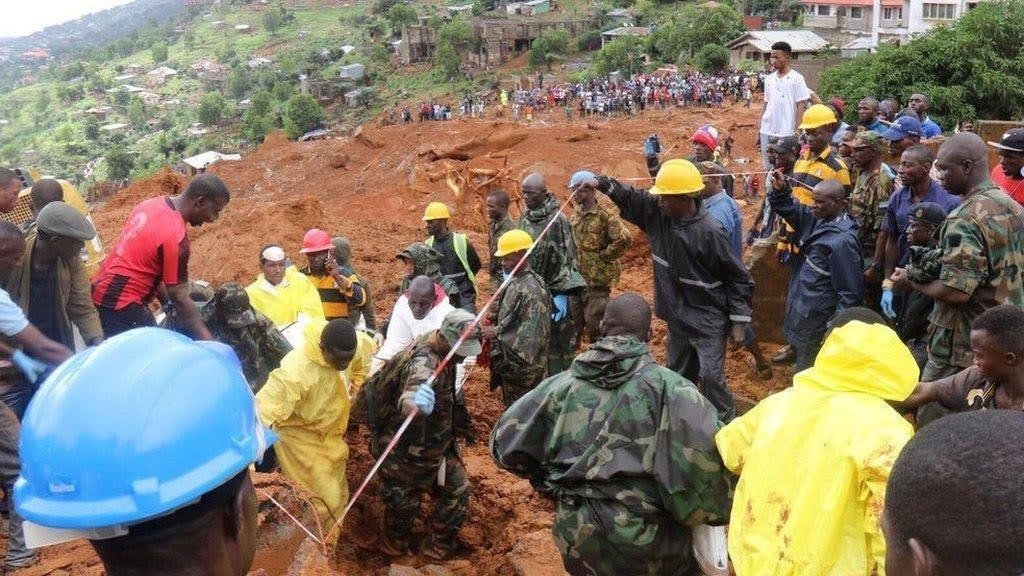
Following the arrival of heavy rainfall for several days, a large landslide was recorded around Mount Sugar Loaf in Regent area of Freetown on 14th August 2017. This was accompanied by the displacement of vast amounts of soil, rock, trees and debris running down the hillside and into populated zones. The resulting mud and flood water washed away homes and structures and covered whole communities. The World Bank and Global Facility for Disaster Reduction and Recovery (GFDRR) reported that about 6,000 people were affected by the landslide and associated floods while approximately 1,141 people were reported dead or missing (World Bank/GFDRR, 2017). Thousands of people were also displaced by the disaster and hundreds of houses were destroyed.
These numbers are significant but not sufficient in themselves to convey the human impact of the human disaster. The number of 1,141 were parents, children, relatives, neighbours and friends who vanished in minutes. For many survivors, their homes, belongings and livelihoods were all taken away. The economic losses were high too. World Bank / GFDRR estimated the disaster resulted in an estimated US$31.65 million in damage and losses regarding housing, infrastructure, health, education and social protection (World Bank/GFDRR, 2017). The mudslide, then, was simultaneously an environmental disaster, a social and economic crisis.
Heavy rain was the immediate cause, but rainfall is not the only one that can explain the magnitude of the tragedy. The physical geography of Freetown is significant both in itself and in terms of its significance to the history of the city. The city sits between the Atlantic Ocean and the Sierra Leone peninsula with available land for urban development relatively limited. Over time the city’s population have grown and these areas were increasingly settled on the tops of hills or in areas of environmental value. NASA’s disaster analysis reveals how years of development in and around the city of Freetown helped to increase the risk of landslides (NASA Earth Observatory, 2017). That is, not only were people inhabiting a hazardous environment, but the city was growing into a portion of its environment where the impacts of extreme rain could be devastating.
That’s where the idea of vulnerability can come in handy. Vulnerability is the state of being susceptible to harm in the event of hazard(s) occurring. It incorporates elements of occupation, house strength, access to infrastructure and services, economic resources and the capacity of the government to warn and protect. The same amount of precipitation in two communities can have different impacts due to distinct vulnerabilities. In a community with a well-designed drainage, forests that have been protected, land-use planning that is effective, as well as early-warning systems that are working, there could be minimal damage in the event of heavy rain. A community situated on a steep, poorly drained, and poorly constructed housing development could end up having disastrous consequences.
The case in Sierra Leone illustrates this correlation very vividly. The reasons for the threat include environmental damage and the patterns of human settlements. Deforestation may decrease the amount of vegetation that contributes to soil stabilization, whereas construction and roads may destabilize slopes and affect the flow of water. According to report, during the period from 1986 to 2015 about 15% of the dense forest in the region affected by the disaster was transformed into a built-up area (Macarthy, J. 2017). It means that not all the territories subjected to deforestation lead to landslides; however, it illustrates how environmental factors contribute to the weakening of natural barriers and, at the same time, increase human vulnerability.
There is another component that should be mentioned, urban poverty. One may find it easy to blame people for choosing unsafe places for building their houses, however, this approach is rather simplistic. People choose such places due to the fact that other territories are more expensive or even inaccessible.
In the report, the Intergovernmental Panel on Climate Change (IPCC) recognizes rapid urbanization, infrastructure gaps, and habitation in hazardous zones as some of the factors contributing to the increased risk of climate impacts in African cities (IPCC, 2022). In this context, the fact that communities live in vulnerable locations should not only be regarded as a problem of personal irresponsibility.
However, one needs to take climate change into account too; nevertheless, one should not overstate the available evidence. First of all, it would be scientifically wrong to argue that climate change caused the 2017 mudslide directly. As the IPCC mentions, there is no enough evidence of changes in landslides’ occurrence in West Africa for the long term, so it is impossible to attribute individual cases of such events to climate change (IPCC, 2021). Nonetheless, climate change plays a role since the variability of the precipitation regime may combine with existing vulnerabilities. Climate change does not have to create all the disasters itself to make preparedness and resilience more important.
It would be wrong for climate policy to concentrate only on the reduction of greenhouse gas emissions, since countries like Sierra Leone do not emit enough greenhouse gases into the atmosphere despite being very vulnerable to climate and environmental disasters. Hence, adaptation, which is defined as any measures that help minimize adverse effects from climate and environmental hazards, will have to play an essential role in national policy. Freetown’s adaptation measures may include land-use planning, forest/watershed conservation, improved drainage, better early-warning systems and avoidance of settlement in areas with extremely high risk.
This disaster also brings up a significant issue of governance. The government cannot control the weather and prevent rainfall, but it can regulate the extent to which it affects the population. Thus, regulations regarding land use, construction and environmental policies are not only administrative issues, but issues of life and death. As the 2017 disaster has shown, the separation of environmental and urban planning from disaster-risk management can have tragic consequences. This fact was highlighted in the World Bank’s report after the disaster (World Bank/GFDRR, 2017).
The reaction to the mudslide demonstrated the necessity of the cooperation between the state and international agencies. The Sierra Leonean authorities, the international organizations and the humanitarian organizations provided the assistance to people affected by the disaster in terms of emergency assistance, health care, shelters and other types of aid. According to report, the situation was marked by the significant public-health challenges and the organization assisted the state response in terms of emergency coordination and prevention of diseases (Musoke et al., 2020) Nevertheless, emergency response cannot be a replacement for prevention. The best disaster response is the response which allows minimizing the number of people in need of rescue.
This can be seen as the main lesson from the disaster in Sierra Leone. Disaster management has to start prior to the disaster itself. Early warning system is important, but the warning system can be efficient only in case the warning is believed, received in time and the place for going can be found. Building codes are good, but they do not matter until they are enforced
Environmental laws can help protect forests and hillside areas but only if institutions have the necessary capabilities and political will to enforce them. Information on climate matters is helpful too but it must be conveyed to the people in a way that they can grasp and act on. Climate literacy becomes as essential as climate policies. Communities must understand that the environment in which they live affect their safety at any moment. Understanding about rainfall, drainage, deforestation, slope instability and human settlements can help them see dangers that can strike before a disaster happens. At the same time, it would be unfair to leave all the responsibilities on the shoulders of vulnerable communities. Climate literacy must come along with government investment, affordable housing, good planning and capable institutions. Poor households cannot deal with dangers which have been caused, at least in part, by the failures of urban development and governance.
Sierra Leone mudslide calls into question the simplistic notion of “natural disasters.” Rainfall in this case was natural, however, its scale was affected not only by nature but also by human decisions. It is thus clear that this disaster was caused by the interaction of environmental factors and social vulnerability. As the IPCC (2022) explains more generally, climate risks are created through the interplay of hazards, exposure, and vulnerability and not the presence of climate hazards only
The mudslide of 2017 should thus also be seen as a tale of loss as well as an indication of things to come. Sierra Leone cannot control the rain, but it can reduce the elements that convert rainfall into a source of danger for its people. It can invest in better urban planning, preserve environmentally sensitive regions, set up improved warning mechanisms, increase public consciousness, and offer safer alternatives of housing to vulnerable communities. The underlying message here is that preventing disasters is not just an environmental challenge, but a developmental one as well. The impact of nature can be unpredictable when it interacts with vulnerability, but vulnerability itself can be changed, and that changes the impact.
References
Intergovernmental Panel on Climate Change (IPCC). (2021). Climate change 2021: The physical science basis. Cambridge University Press. https://www.ipcc.ch/report/ar6/wg1/
Intergovernmental Panel on Climate Change (IPCC). (2022). Climate change 2022: Impacts, adaptation and vulnerability. Cambridge University Press. https://www.ipcc.ch/report/ar6/wg2/
NASA Earth Observatory. (2017). A growing city and a deadly landslide. NASA. https://science.nasa.gov/earth/earth-observatory/a-growing-city-and-a-deadly-landslide-91356/
Macarthy, J. (2017, September). Sierra Leone mudslide was a man-made tragedy that could have been prevented. The Conversation. https://theconversation.com/sierra-leone-mudslide-was-a-man-made-tragedy-that-could-have-been-prevented-82783
World Bank/Global Facility for Disaster Reduction and Recovery (GFDRR). (2017). Sierra Leone rapid damage and loss assessment: August 2017 landslides and floods. World Bank. https://www.gfdrr.org/en/sierra-leone-rapid-damage-and-loss-assessment-august-2017-landslides-and-floods
Musoke, R., Chimbaru, A., Jambai, A., Njuguna, C., Kayita, J., Bunn, J., Latt, A., Yao, M., Yoti, Z., Yahaya, A., Githuku, J., Nabukenya, I., Maina, J., Ifeanyi, S., & Fall, I. S. (2020). A public health response to a mudslide in Freetown, Sierra Leone, 2017: Lessons learnt. Disaster Medicine and Public Health Preparedness, 14(2), 256–264. https://doi.org/10.1017/dmp.2019.53

 Jozi Ikhlas Attarik
 Muhammad Ariiq Nurfidani
 Nasib Sahim
 Grienda Qomara
 Ellena Pangestu Kavarera
 Arahman Akbar
+ There are no comments
Add yours