
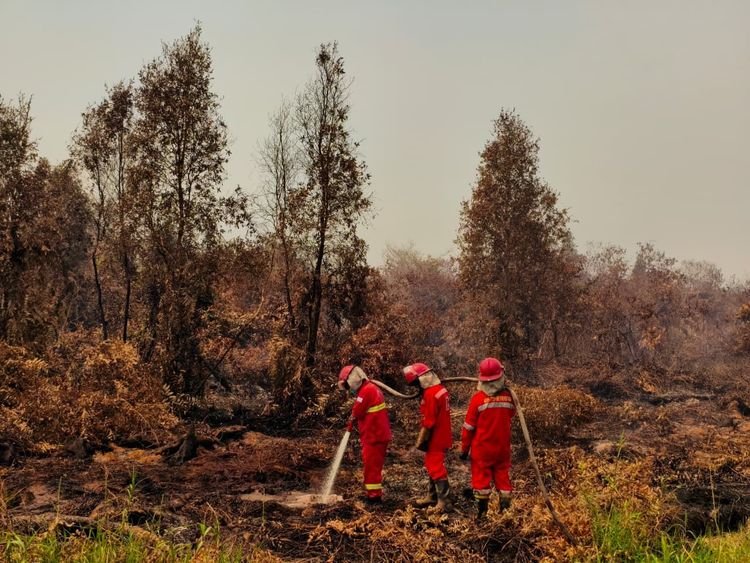
The issue of forest and land fires is not merely a seasonal natural phenomenon; rather, it is an extensive ecological crisis that has repeatedly plagued Indonesia for decades. History shows that major fire episodes have consistently paralyzed socio-economic life and contributed significantly to global carbon emissions. The historic disaster of 1982–1983, for instance, destroyed approximately 3.2 million hectares of land due to a combination of extreme drought and land-clearing activities (Tempo, 2023). This cycle has continued to repeat on a massive scale: from the severe fires of 1997-1998, which consumed 9 to 10 million hectares in Sumatra and Kalimantan; the 2006 national disaster, which wiped out 3 million hectares; the 2015 multinational haze crisis, which burned 2.6 million hectares across 29 provinces; to the events of 2019, which scorched 850,000 hectares. Furthermore, in 2026, the cumulative number of hotspots reached 17,108 (Kompascom, 2026; Tempo, 2023). This long track record underscores the fact that Indonesia has yet to break free from the cycle of large-scale forest and land fire crises.
Years of experience in dealing with forest and land fires should have fostered a mature, adaptive, and structured national mitigation capacity. Yet, this empirical experience has not translated into systematic preventive action at the ground level. The government tends to treat these fires as recurring emergency response events heavily dependent on macro-climatic dynamics such as El Niño rather than addressing them as a long-term strategic priority. This lack of a firm structural commitment is clearly reflected in institutional instability, exemplified by the termination of the Badan Restorasi Gambut (BRG) on December 31, 2024. This is particularly concerning, given that the BRG established via “Peraturan Presiden Nomor 1 Tahun 2016” held a vital mandate to restore peat ecosystems, which serve as a primary bulwark against fires. The implications of this diminished focus are dire on the ground: recent data indicate that 65.01 percent of the areas affected by fires are peatlands (Manda, 2026). The vulnerability of peatlands is not merely a product of weather anomalies; it is exacerbated by land-use conversion for large-scale monoculture plantations. The construction of drainage canals in peat areas has accelerated the drying of these lands, transforming natural wetlands into vast expanses of highly reactive fuel that are exceptionally difficult to extinguish during the dry season.
Another indicator confirming the government’s structural lack of preparedness is the limited adoption of aerial firefighting technology. The primary obstacle in addressing forest and land fires on the ground consistently stems from issues of geographical accessibility such as isolated landscapes, dense primary vegetation, and hilly terrain that are impossible for ground-based task forces to reach. Under these conditions, dynamic, early-stage firefighting requires high-capacity, high-speed aerial assets. Although the government has deployed helicopters for water bombing, the operational capacity of these leased units has proven highly insufficient for tackling large-scale fires. Consequently, Indonesia urgently needs to acquire its own fleet of high-capacity amphibious firefighting aircraft “water bombers”, such as the Canadair CL-415 or DHC-515 models. The operational advantage of amphibious aircraft lies in their ability to “scoop” water directly from the surfaces of lakes, wide rivers, or the sea, eliminating the need to return to an airbase. With a water-loading duration of only 10 to 12 seconds for a 6,000-liter capacity (Oypalembang, 2026), the operational rotation efficiency of these amphibious aircraft is exceptionally well-suited to Indonesia’s geographical characteristics, which feature an abundance of natural water bodies.
However, efforts to modernize aerial firefighting assets have run up against the formidable barrier of limited fiscal space. A clear disparity in policy commitment is evident in the budget allocated to the forestry sector, which is disproportionate to the vast forest area requiring protection. As pointed out by Firman Soebagyo, a member of Commission IV of the Dewan Perwakilan Rakyat Republik Indonesia (DPR RI), the annual budget for the Ministry of Environment and Forestry is remarkably low falling short of IDR 10 trillion even though Indonesia manages the fourth-largest tropical forest area in the world (Firman, 2025). This budgetary constraint severely limits the government’s flexibility to upgrade its equipment, leaving field-level mitigation strategies perpetually trapped in a cycle of inadequate emergency response.
This fiscal constraint is exacerbated by the government’s tendency to prioritize the leasing of a fleet of water-bombing helicopters rather than procuring them directly. Beyond slowing down response times due to bureaucratic hurdles and lengthy administrative procedures involved in selecting leasing vendors (Setiawan, 2026). This approach is also highly economically inefficient. As noted by Arie Rompas, a campaign team leader at Greenpeace Indonesia, the government allocated as much as IDR 1.54 trillion for the lease of just 12 aircraft in the 2027 budget (Kompas, 2026). This recurring annual reliance on leasing continuously drains the state budget (APBN) without resulting in any permanent state assets. A phased, direct procurement of firefighting equipment would, by contrast, represent a strategic investment that is far more rational, efficient, and advantageous in the long term.
Beyond issues concerning defense equipment and fiscal matters, the forest and land fire crisis is exacerbated by regulatory contradictions and weaknesses in land governance. Although Peraturan Pemerintah Nomor 71 Tahun 2014 jo. PP Nomor 57 Tahun 2016 tentang Perlindungan dan Pengelolaan Ekosistem Gambut (PPEG), in law enforcement at the field level remains extremely weak. The rampant expansion of oil palm plantations and the Hak Guna Usaha (HGU) without valid permits serve as clear evidence of lax oversight. Data Badan Pertanahan Nasional (BPN) confirms the existence of 537 oil palm business entities, covering 2.5 million hectares, that operate without an HGU. Furthermore, a report by Sawit Watch indicates that approximately 3.4 million to 4.09 million hectares of oil palm plantations are located illegally within forest areas (Sawit Watch, 2026). This massive land exploitation triggers the systematic drying out of peatlands, as the construction of drainage canals around the plantations permanently depletes groundwater reserves (Kompas, 2026).
This governance issue is further complicated by legal loopholes within regulations concerning traditional land clearing. Under Peraturan Menteri Lingkungan Hidup Nomor 10 Tahun 2010 Pasal 4, the government permits local or indigenous communities to clear land by burning up to a maximum of 2 hectares per household for the cultivation of local crop varieties. Although originally intended to safeguard local wisdom, this provision has, in practice, created a legal loophole that is easily exploited by land speculators. Small-scale burning on dried-out peatland can very easily trigger spot fires, which can rapidly spread into large-scale, uncontrollable forest and land fires.
Given the complex, interdependent nature of these issues, the Indonesian government must undertake comprehensive, fundamental reforms encompassing fiscal governance, the modernization of firefighting assets, and the strengthening of regulatory frameworks. Regarding the first pillar, the government needs to implement fiscal reforms within the forestry sector by allowing for flexible allocation of disaster-response funds and establishing a dedicated climate and firefighting endowment fund; this would decouple forest and land fire mitigation efforts from the constraints of limited annual operational budgets. As for the second pillar, the government must develop a roadmap for the procurement of an independent fleet of amphibious firefighting aircraft (such as the Canadair CL-415/DHC-515) and form a specialized aerial task force under a unified command comprising the Indonesian Air Force (TNI AU), the “Badan Penangulangan Bencana Daerah” (BPBD), and the “Kementerian Lingkungan Hidup dan Kehutanan” (KLHK) to ensure a rapid initial response to fires.
The third pillar requires that the modernization of aerial assets be balanced with institutional reorganization and the rewetting of peatland ecosystems on the ground. The government must reactivate and strengthen the role of the Badan Restorasi Gambut (BRG), an independent, non-structural body endowing it with a robust, cross-sectoral mandate and authority. Reactivating this agency is crucial for overseeing the acceleration of ecological restoration through the 3R approach (Rewetting, Revegetation, and Revitalization) consistently across all degraded peatland areas, while ensuring that preventive efforts on the ground remain in balance with technical responses from the air. This initiative must be underpinned by the enforcement of three regulations that establish a “zero-tolerance” baseline:
- A strict prohibition on the construction of new drainage canals within peat ecosystems, pending the formal establishment and mapping of zones designated for protection and cultivation;
- The implementation of an absolute ban on the burning of peatlands (a total zero-burning policy), accompanied by the closure of legal loopholes that currently permit burning based on specific land-area thresholds; and
- Firm legal enforcement and the revocation of operational permits for any land-use activity proven to exceed the established standard criteria for peat ecosystem degradation.
The annual haze crisis is not merely a natural disaster; it is a test of our commitment to environmental governance. Strengthening capacity in only one area will never be sufficient to mitigate this recurring threat. By fostering synergy combining self-reliance in aerial firefighting assets, secure fiscal funding, and rigorous enforcement of environmental laws on the ground Indonesia can break the cycle of forest and land fires in a sustainable manner. It is time for these integrated preventive measures to become a tangible priority, ensuring the protection of our ecosystems for the future.
References
- Firmansyah, M. (-). 65 Persen Karhutla di Lahan Gambut, Ancam Target Iklim RI (- ed., Vol. -). Kompas.com.
- Indonesia Punya Rajanya Pesawat Pemadam Kebakaran, Kok Gak Dipakai Atasi Karhutla? (- ed., Vol. -). (2026). Indoaviation.com.
- Komisi IV. (-). Kekurangan Anggaran dan Lemahnya Penegakan Hukum Sebab Utama Maraknya Karhutla (- ed., Vol. -). DPR.go.id.
- Tempo. (2023). 5 Kebakaran Hutan Terparah di Indonesia, Paling Sering di Kalimantan (- ed., Vol. -). Tempo
- Kompas Pedia. (2026). Jejak Kebakaran Hutan dan Lahan di Indonesia (- ed., Vol. -). Kompas Pedia.
- Majid, N. (2026). Seberapa Efektif Ide Kemenhut Sewa 12 Pesawat Tangani Karhutla? (- ed., Vol. -). Tirto.id.
- Poerwoto, Y. L., & Saputri, N. L. (2026). Kritik Anggaran Sewa Helikopter Rp1,54 T untuk Padamkan Karhutla, DPR Minta Menhut Fokus Pencegahan (- ed., Vol. -). Tribunnews.
- Oypalembang. (2026). Spesifikasi dan efisiensi teknis pesawat pemadam amfibi Canadair dan DHC-515 untuk mitigasi bencana udara. OY Palembang.


 Mwaiwawo Banda
 Jawal Sualisu
 Hanifah Setyaningrum
 Fadhli Fauzan Ilahi
 Mujibullahi Lawan Shahud
+ There are no comments
Add yours