

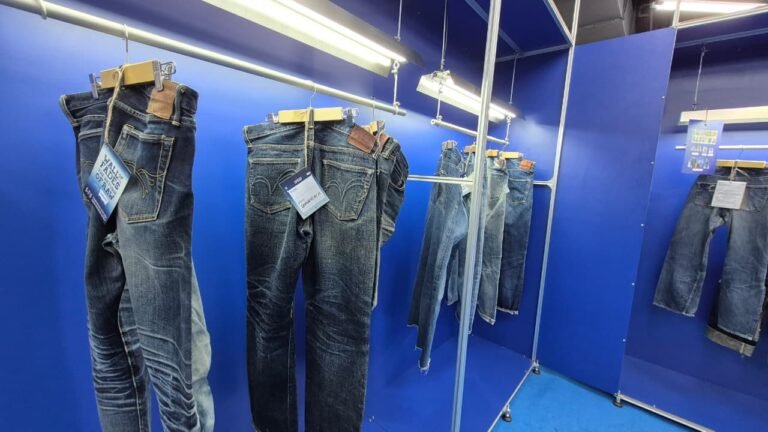
Indonesia is currently actively promoting local pride in wearing their local fashions. This is supported by the emergence of local products, or products made and produced by Indonesians themselves. Various brands are successfully penetrate the Indonesian market, particularly in the clothing and fashion world. The emergence of local brands is starting to compete with imported products and foreign brands that previously dominated the Indonesian market. These foreign brands, which previously enjoyed high prestige due to lack of competition, now have to face fierce competition on various aspects such as price, quality, and the government’s “Proudly Made in Indonesia” (Bangga Buatan Lokal) campaign, which aims to increase the competitiveness of local brands. In this regard, various industrialization efforts in production, branding, and campaigns are key aspects of the rise of the “Proudly Made in Indonesia” trend in clothing.
The industrialization strategy is a view that is considered inevitable for advancing a country’s development process as it is considered as a way to a country’s prosperity more quickly, and the Local Pride campaign is one way to realizing it. With this foundation, almost all countries in the world have pursued and are currently pursuing industrialization strategies, with varying characteristics. Because of the parallelism between development and industrialization strategies, the meaning of development has become almost identical to industrialization, making the two inseparable.
Industrialization comes from the word “industry,” which means the activity of processing or processing goods using facilities and equipment, through machines. Industrialization is a process of socio-economic change that transforms the livelihood system of an agrarian society (agriculture) into an industrial society. Industrialization is part of the process of modernization and social change can develop, the economy is closely related to technological innovation. Industrialization can also be interpreted as a state of society that is more focused on the economy, which includes increasingly diverse jobs (specialization), higher salaries, and incomes. Hence, it involves a movement in human philosophy as people shift their perspective on their social environment toward a more rational one (actions based on consideration, efficiency, and calculation, no longer based on morals, emotions, customs, or traditions). Many factors influence industrial modernization and corporate development. These include a favorable political and legal environment for industry and commerce, diverse and abundant natural resources, and a relatively low-cost, skilled, and adaptable human resource base.
If we try to understand the root meaning of the industrialism itself the scope of discussion will be broader. Industrialization in society implies the shift from traditional to modern production techniques, a transformation that encompasses societal change in all aspects of life. Economically, industrialization refers to the emergence of large industrial complexes where the production of goods and their means of production is mass-produced. In the future, our society will face many changes resulting from the progress achieved in previous development processes, the rapid advancement of science and technology, and the impact of globalization. One thing that cannot be avoided is that national development activities will increasingly be linked to whatever happens in international affairs.
Of course, the increasing production of local products and various innovations are in line with the basic understanding of economics: the higher the demand or interest, the higher the production, resulting in a trend where large-scale production is carried out to meet or meet that demand. The success of local brands with their products in competing with foreign brands is certainly also influenced by various factors. When viewed from the human resources aspect, it is undeniable that Indonesian human resources can be said to be among the best in terms of skill and precision of workmanship. Evidence can be seen from major brands such as Nike and Adidas who choose Indonesia as one of the manufacturing or production plants for the development of their product lines. Furthermore, the materials available in Indonesia are also quite competitive with foreign products such as cowhide, fabric, and so on. The marketing role carried out by local brands has also been optimal in utilizing technology.
Still in line with industrialization theory, the success of local brands competing with foreign brands in the domestic market is also supported by the government. The Indonesian government’s support for the success of local brands, which has become a trend of local pride, is reflected in the Local Pride movement, which the government has intensified through advertisements on television and in other places such as banners and ballyhoo. Furthermore, the government also encourages the purchase of imported goods. Even figures in government and politics such as President Joko Widodo, ministers, and government officials have also exemplified the use of local products. Even the Minister of Tourism and Creative Economy of the Republic of Indonesia, Sandiaga Uno, often invests in startups or brands that are just starting their business.
Keywords: fashion, trend, industry, brand, local



 Reston Dennis Juah
 Noor Ul Ain

 Hassan Barrie
 Hoby Nasandratra Andriamiandrisoa
+ There are no comments
Add yours