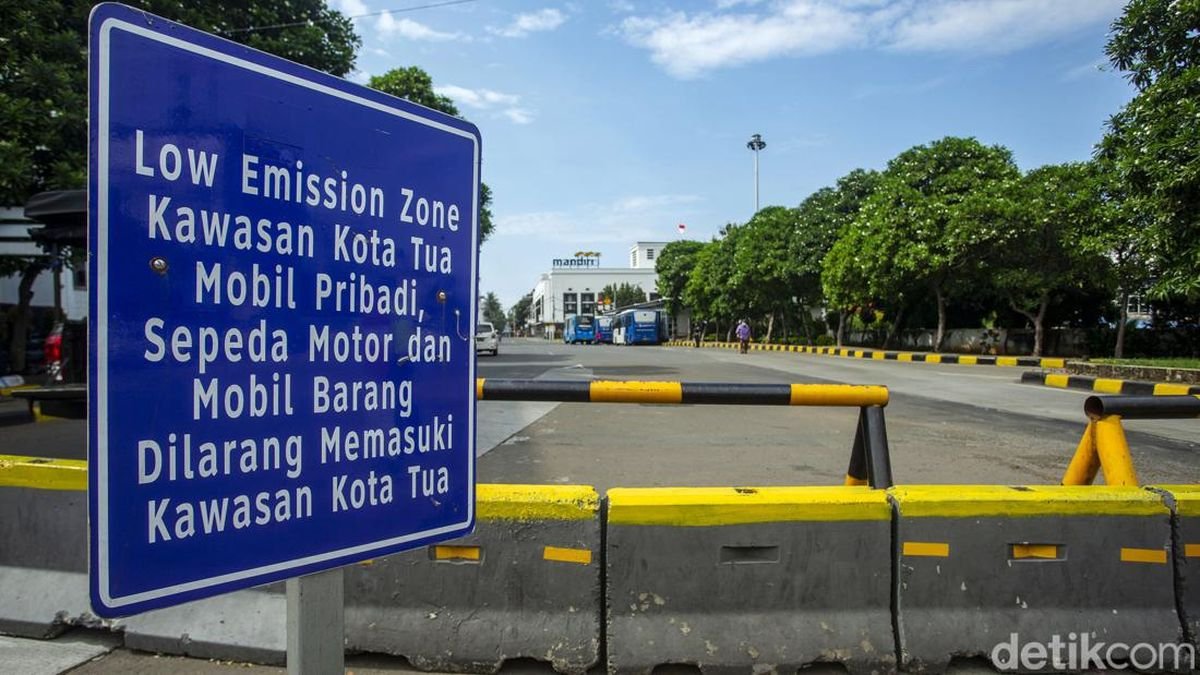

Low Emission Zone or LEZ in short, is a strategy implemented by the government of Jakarta to reduce carbon emissions, mainly air pollution. LEZ restricts access to the most polluting motorised vehicles based on the emission level (e.g., vehicle standard by Euro) or type of vehicle (e.g., heavy-duty vehicle) into a certain area with the main objective to reduce the air pollutant emission from motorised traffic (Nemesis, 2024). The arrangement of the Kota Tua is based on Government Regulation or Undang-undang Number 32 of 2011 regarding the Management and Engineering, Impact Analysis, and Traffic Needs Management, and Governor Decree Number 36 of 2014 regarding the Kota Tua Area’s Master Plan (Hanggara, 2021). The implementation is in the form of the pedestrianisation of six road segments surrounding the inner Kota Tua area with a total area of intervention of 0.14 km2 which only Transjakarta fleets and vehicles with stickers (people living in the area and business owners) are allowed to pass through LEZ (Nemesis, 2024).
There are two main government Institutions responsible for the LEZ, the Environment Agency and the Transportation Agency (Nemesis, 2024). The Governor Decree 576 of 2023 about Air Pollution Management mandates the Environment Agency to lead Jakarta’s air pollution reduction strategy. The Ministry of Environment and Forestry (Kementerian Lingkungan Hidup dan Kehutanan) is responsible for managing air pollution with the Directorate of Management of Air Pollution division by creating relevant policies, standards of conduct, coordination, and evaluation related to air quality management The Ministry of Transportation (Dishub) supports limiting access to motorised vehicles and improving more sustainable modes of transportation.
Parameters used to asses the LEZ, based on the LEZ Roadmap Executive Summary’s are in the table below:
Figure 1: Indicators to determine the possible area of intervention for LEZ.
Based on that table, it can be concluded that the involving bodies are: Citizen/Residence, Transportation-based Organizations (both governmental and private sectors), NGOs, and Private Sectors.
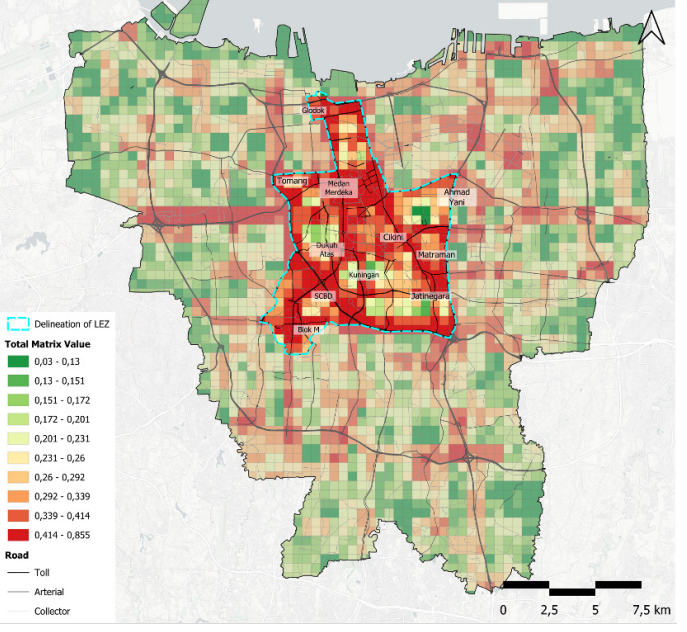
Picture 1: Possible delineation of LEZ in Jakarta, which is the central parts of Jakarta.
The ideal scenario to implement is the non-priced scheme with the automatic system. The non-priced scheme is aligned with the regulation of Law 22 of 2009, where vehicles that do not meet emission standards will be subject to penalty. The automatic system also aligns with the reformation in the Police department, where the automatic system is prioritised. Jakarta already implemented the ETLE (Electronic Traffic Law Enforcement) using cameras that can identify the number plates of vehicles (Nemesis, 2024).
LEZ policy as some sort of social change made by the government as a response to the pushing condition of climate change issue, specifically the condition or air quality in Jakarta that classified as ‘amongst the worst in the world’. LEZ Policy showed indication of transformational sort of social change, as the effort are never-before implemented in Jakarta, or has been implemented with very little effect. Hence, the matter of “impacting and impacted”, which could potentially be referring to the terms of social change that addressing Primary Actors and Supporting Actors (Rayner & Bonnici, 2021). Primary Actors are people who feel and immersed in social problem itself, and the Supportive Actors are people who work to support the addressment of the social problem affecting the Primary Actors.
On a micro-scale, it did some good. If we looking purely at the urban environment aspect, it could be an ‘upgrade’ as it was successfully transformed the core area into a more pedestrian-friendly and comfortable public space where visitors could roam freely by walking. But, decreasing carbon emissions is another thing. Institute for Transportation & Development Policy (ITDP) report shows that the LEZ being implemented in Kota Tua only applied to the concept of a low-traffic neighborhood or traffic zone limitations. The restricted zone in the Old City is relatively small as it functions more as a local road resurfacing or road closure project than a true large-scale emission zone. Because of this limitation, carbon-emitting vehicles could use nearby streets and continue to circulate intensively outside the perimeter, such as Glodok near Kota Tua, or Pancoran near Tebet Ecopark. Based on this, the program itself could be considered too small in compare to the whole West Jakarta to improve air quality, let alone the entire Jakarta as the program intended.
Keywords: emissions, pollutions, policy, transportation
Hanggara, A. G. (2021, February 19). Smart Environment. Retrieved from Smartcity Jakarta: https://smartcity.jakarta.go.id/id/blog/zona-rendah-emisi-untuk-kota-tua-yang-bebas-polusi/
Nemesis, C. (2024). Jakarta LEZ Roadmap: An Executive Summary. Jakarta: Institute for Transporatation and Development Policy.
Rayner, C., & Bonnici, F. (2021). The Systems Work of Social Change: How to Harness Connection, Context, and Power to Cultivate Deep and Enduring Change. Oxford: Oxford University Press.
Syuhada, G., Akbar, A., Hardiawan, D., Pun, V., Darmawan, A., Heryati, S. H., . . . & Mehta, S. (2023). Impacts of Air Pollution on Health and Cost of Illness in Jakarta, Indonesia. International Journal of Environmental Research and Public Health, 1-14.

 Reston Dennis Juah
 Noor Ul Ain

 Hassan Barrie
 Hoby Nasandratra Andriamiandrisoa
+ There are no comments
Add yours