
Climate communication often assumes that better knowledge will lead to better environmental behaviour. If people understand climate change, the logic goes, they will be more willing to act. My experience managing a community waste bank in Depok, Indonesia, suggests that this relationship is far less direct. People may understand that waste is harmful and still put everything into one bin. What often matters is not simply how much people know, but whether environmental action is practical, visible, trusted, and socially meaningful.
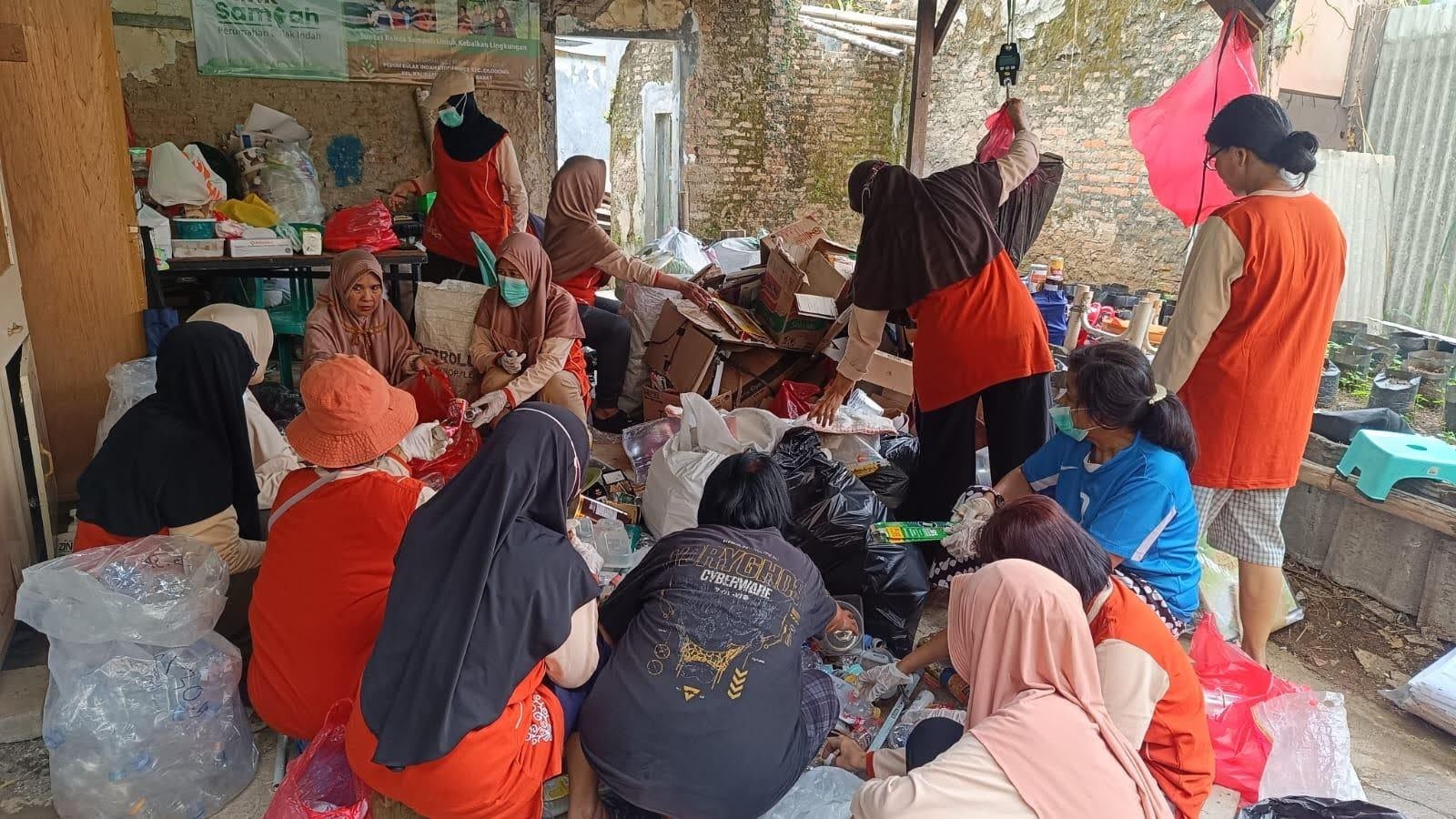
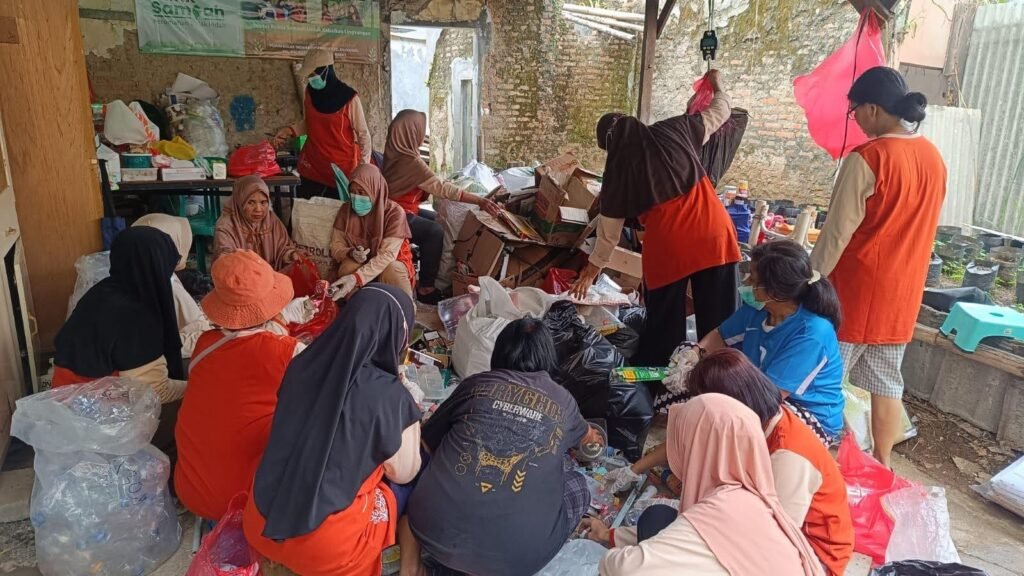
This is the main lesson I have learned from Bank Sampah Perumahan Bulak Indah, a community-based waste bank serving 77 participating households and supported by 15 community members. Regular weighing sessions collect an average of more than 140 kilograms of recyclable materials. The initiative was not born from a discussion about carbon emissions or global climate targets. It emerged from something much closer to home: concern among residents about waste repeatedly accumulating at the neighbourhood’s temporary waste collection point, locally known as a Tempat Penampungan Sementara or TPS.
That distinction matters. Climate change is planetary, but people usually experience environmental problems locally. The challenge of climate communication is therefore not only to explain the global problem. It is to connect knowledge with institutions and routines that allow people to act where they live.
A Local Problem Before a Climate Problem
The starting point of our waste bank was simple. Residents could see that waste was accumulating and wanted an alternative for materials that did not necessarily need to enter the mixed waste stream. Households began separating recyclable materials such as cardboard, paper, plastic bottles, glass, and metal and bringing them to regular weighing activities.
The process may appear disconnected from climate literacy because climate change was not the language that initially motivated residents. Yet this is precisely what makes the case interesting.
Jobst Conrad argues that scientific knowledge does matter in climate discourse, but knowledge does not simply move from scientists into society unchanged. Whether it has influence depends on credibility, framing, social relevance, existing policy concerns, and the attitudes and cultural orientations through which audiences interpret information.
Our experience illustrates this point at a much smaller scale. A statement such as “waste management is important for climate mitigation” may be correct but distant from everyday life. “Our TPS keeps filling up; can we reduce what we send there?” is immediate. The second message gives people a problem they already recognise.
This does not mean climate science is unnecessary. It means environmental communication may work better when scientific knowledge is connected to something people can see and experience. In our case, local concern became an entry point for broader environmental behaviour.
Climate Literacy Is Also About Human Behaviour
This experience also reflects the argument made by Rachael Shwom and her colleagues in Integrating the Social Sciences to Enhance Climate Literacy. They argue that climate literacy has focused heavily on understanding the physical climate system while giving insufficient attention to human behaviour and the social, political, and economic systems connected to climate change. For them, understanding these human dimensions is essential if climate knowledge is expected to inform decisions about mitigation and adaptation.
Waste separation makes this gap between knowledge and behaviour easy to see. Most residents do not need to be told that littering is undesirable or that recycling is preferable to throwing everything away. The difficulty lies elsewhere. Where should recyclable materials be stored at home? Which materials have value? When will they be collected? Will separating them create additional work? What happens after they are handed over?
A communication campaign cannot answer these questions by awareness alone. There must also be a system through which people can act.
This is why I increasingly see the waste bank as a form of communication infrastructure, not merely a collection point. Residents are not only told to separate waste. They are given a repeated mechanism for doing so. They know when materials can be deposited, see them weighed, and receive information about what the community collected afterward.
Environmental communication therefore moves beyond simply providing information. In our case, local concern about waste creates a reason to act, the waste bank provides a practical way to respond, and the reporting system makes the results visible to residents. When this process is repeated over time, environmental behaviour has a greater chance of becoming part of everyday community practice. This cycle is more meaningful than simply increasing awareness because it connects knowledge with action and visible outcomes.
Making Environmental Action Visible
After every weighing activity, Bank Sampah Perumahan Bulak Indah prepares a visual report. The results are uploaded to Instagram and then shared through the neighbourhood WhatsApp group. The report shows participating residents, the amount deposited by each person, material categories, total quantities collected, and photographs of the activity.
In one recent weighing session, for example, 10 residents actively deposited materials and 14 categories of recyclable waste were recorded, totalling 173.63 kilograms. Rather than keeping those figures inside an administrative spreadsheet, we turned them into information that residents could easily see.
This reporting serves an obvious purpose: transparency. Recyclable materials have economic value, so residents have legitimate reasons to know how their contributions are recorded and what happens after collection. But the reports also perform a communication function. They show people that their actions produced a collective result.
The message changes from “please participate” into “this is what happened because we participated.”
That feedback matters because household environmental action is often invisible. Once waste leaves the house, people rarely know what happens next. By reporting the results, the waste bank closes part of that information gap.
Conrad’s discussion of credibility and legitimacy is useful here as well. He notes that knowledge has greater influence when audiences see it as relevant, credible, and legitimate. At community level, those qualities are built through repeated practice. If residents are asked to separate materials, the institution asking them to change should also be transparent about what happens afterward.
Trust, in this sense, is part of environmental communication.
Recognition, Social Norms, and Collective Benefits
Our weekly reports also recognise the three residents who deposit the largest quantities of recyclable materials. Their names and contributions are displayed prominently, sometimes in a podium-style graphic. The purpose is not to create serious competition but to appreciate participation and make environmentally responsible behaviour socially visible.
We should be careful not to claim that this automatically increases participation. We have not conducted an experiment demonstrating causation. Yet the practice highlights something that purely informational approaches often overlook: people make environmental decisions within social relationships.
Residents see neighbours participating. They see names in WhatsApp reports. They ask what types of materials can be deposited. They see photographs of the sorting process. Waste separation gradually becomes something that other people in the neighbourhood are also doing.
This is where Shwom and colleagues’ argument becomes especially useful. Climate literacy requires understanding not only environmental processes but also how social beliefs and human systems influence engagement. If people are treated only as isolated consumers who respond to information or money, we miss the influence of norms, trust, identity, and community.
The economic arrangement of our waste bank also reflects this collective logic. Money from recyclable materials is not immediately distributed to individual households. Instead, it is saved for shared community purposes, such as neighbourhood recreation or purchasing segregated waste bins for arisan, community gatherings, and celebrations of religious or national holidays.
A purely transactional waste bank would treat recyclable materials mainly as an individual economic exchange, where each resident receives money based on the waste they contribute. Our approach is different. The value generated from recyclable materials is retained for shared community purposes, so individual contributions become part of a collective benefit. This does not remove the economic value of recycling, but it changes the meaning attached to that value. Instead of seeing waste only as a source of personal income, residents can also see it as a contribution to activities and facilities that benefit the wider community.
Bringing a Distant Problem Closer
Eline Tabak approaches climate communication from a very different perspective in Science in Fiction. Writing about climate-change novels, she argues that climate communication cannot rely only on disseminating scientific facts and numbers. Climate risks are often perceived as geographically or temporally distant, and communication may need narratives and media that bring those risks closer to everyday human experience.
Tabak also shows how a personal and localised story can communicate scientific ideas more effectively to broader audiences than academic communication alone. A neighbourhood Instagram account is obviously very different from a climate novel, but the underlying communication problem is similar. Abstract environmental problems become easier to understand when they are connected to familiar people, places, and experiences.
This helps explain why many of our messages do not explicitly mention climate change. We use phrases such as Pilah, Setor, Manfaat — Sort, Deposit, Benefit — and Dari Warga untuk Lingkungan Bersih — From residents, for a clean environment.
At first glance, this may not look like climate communication at all. But climate communication should not be judged by how often the phrase climate change appears. Technical terms such as carbon neutrality, methane mitigation, or Nationally Determined Contributions have important roles in policy discussions, but they may have little meaning when a household simply needs to decide what to do with a pile of cardboard.
Good communication translates knowledge into the context where decisions are actually made.
Communication Cannot Replace the System
There is an important limitation to this argument. Community communication should not be used to shift responsibility for environmental problems entirely onto households.
Residents can separate waste correctly, but their effort loses value if the downstream system mixes everything again. Recycling requires collectors, aggregators, transport, markets, and processing facilities. Organic waste requires different forms of treatment. Local governments need infrastructure, funding, and institutions capable of maintaining services.
This is why the social-science understanding of climate literacy matters. Shwom and colleagues warn that misunderstanding social, economic, and political systems can be as damaging as misunderstanding climate science itself.
Communication can encourage participation, but it cannot compensate for a dysfunctional waste-management system. Asking households to “do their part” without providing functioning infrastructure is not climate policy. It is responsibility shifting.
The more useful approach is to see behaviour and systems as complementary. Communication should make responsible action understandable and attractive, while institutions make that action possible and meaningful.
The Verdict
The main communication challenge in community-based waste management is not simply a lack of environmental knowledge. People can know that waste creates environmental problems and still fail to separate it. Knowledge matters, but it becomes more powerful when people can connect it to a problem they recognise, an action they can perform, an institution they trust, and a result they can see.
The experience of Bank Sampah Perumahan Bulak Indah shows how this can happen at a small scale. Concern about an overflowing TPS created local relevance. Regular collection created an opportunity to act. Reporting created transparency. Social recognition made participation visible. Collective use of recycling revenue gave the activity a shared purpose.
This does not mean that one community waste bank will solve Indonesia’s waste crisis or that recycling alone will solve climate change. The lesson is more modest, but also more useful: climate literacy should not stop at explaining the planet. It should help people understand how environmental problems enter everyday life and how collective institutions can turn concern into action.
Sometimes the journey from climate knowledge to household behaviour begins not with a climate report, but with a neighbourhood asking a much simpler question:
What can we do differently with the waste in front of us?
References
Conrad, J. (2009). Climate research and climate change: Reconsidering social science perspectives. Nature and Culture, 4(2), 113–122.
Shwom, R., Isenhour, C., Jordan, R. C., McCright, A. M., & Robinson, J. M. (2017). Integrating the social sciences to enhance climate literacy. Frontiers in Ecology and the Environment, 15(7), 377–384.
Tabak, E. D. (2019). Science in fiction: A brief look at communicating climate change through the novel. RCC Perspectives, 2019(4), 97–104.


 Mwaiwawo Banda
 Jawal Sualisu

 Hanifah Setyaningrum
 Fadhli Fauzan Ilahi
 Seftario Virgo
 Mujibullahi Lawan Shahud
+ There are no comments
Add yours