
It is nothing new for Indonesian musicians to speak out on climate issues. Navicula, known as Green Grunge Gentlemen, spent more than a decade in environmental rallies and consistently integrated eco-awareness into their music until today. The late Glenn Fredly actively campaigned against the reclamation of Benoa Bay and committed to the forest and environmental conservation movement. Musicians’ action for climate change has moved outside their stage and gained more massive attention, driven by global movement and increasing urgency of climate disaster across the country. Starting as individual actions, it has now scaled into an organized network. Indonesian musicians have placed themselves at the forefront of climate communication in the country.
Pestapora 2025: Musicians Resistance to Artwashing
One of the most memorable scandals to the music enthusiast conscious about the climate issues is probably Pestapora 2025. The festival was sponsored by PT Freeport Indonesia and even held a marching band parade with the theme “Tembaga Ikutan Berpestapora”, which the company has reported on large-scale forest destruction and accused on human rights issues to the people of Papua. Thus, the deliberation of partnering with PT Freeport Indonesia while also collaborating with Music Declares Emergency (a climate coalition known for “No Music on a Dead Planet” movement) and inviting climate-conscious performers such as Navicula and Sukatani, triggered social outrage and the feeling of betrayal until the final day of the festival. Dozens of bands withdrew from the festival, while the others responded in different ways.
The Adams and Fstvlst turn their stage into an open public discussion about the organizer’s decision. Rebellion Rose decided to reject the organizer’s facilities for their performance and went acoustic. Bottlesmoker showed their protest by playing the sound of the plants living in a destroyed environment, an immersive way to communicate about the impact of climate change to their audience while simultaneously protesting the decision. The partnership with the mining company was cancelled on the second day, but Pestapora 2025 left a mark of artwashing to the music festival industry in Indonesia. As this issue was extensively circulated online, this phenomena developed critical public awareness of the connection between the use of art and corporation’s environmental records.
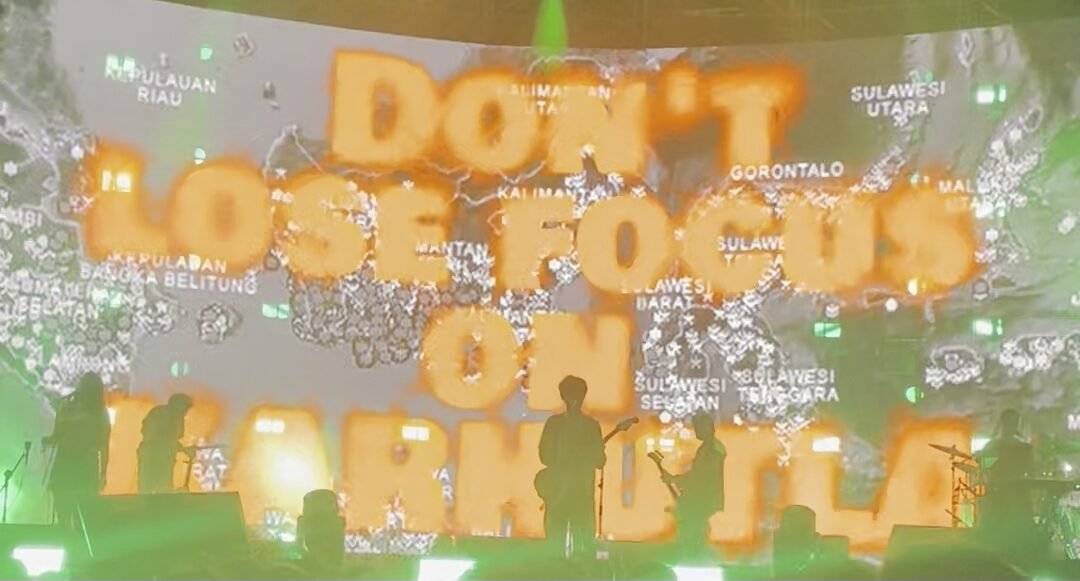
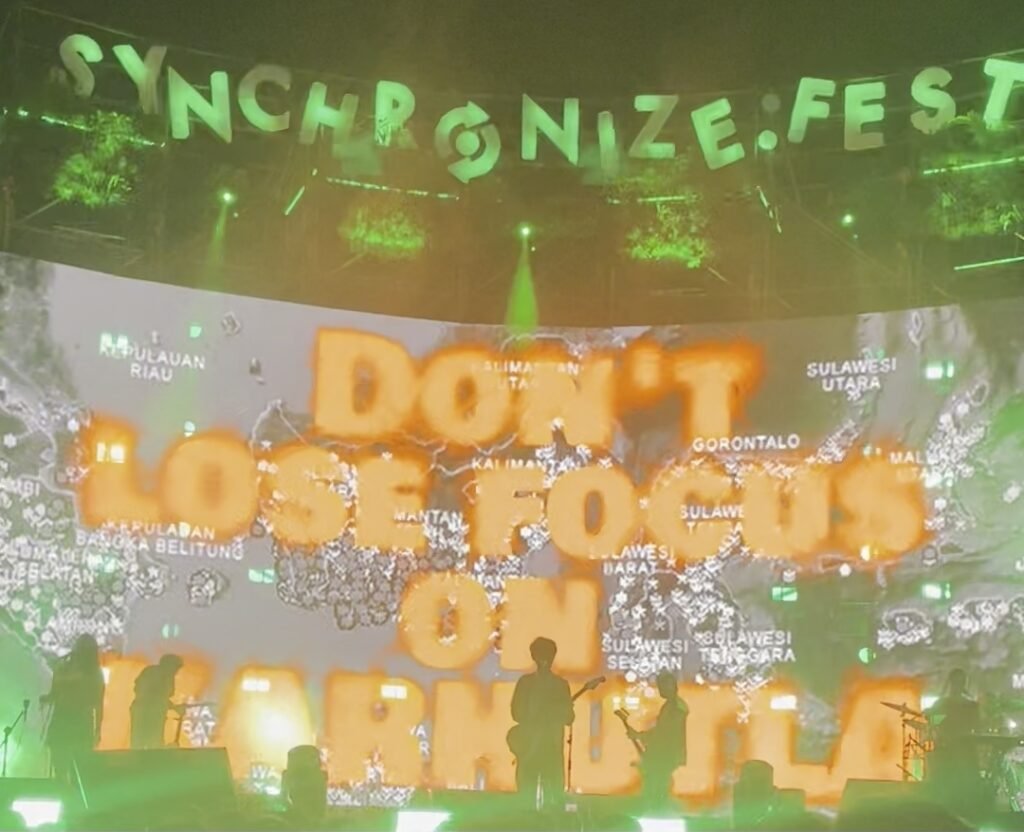
In contrast with Pestapora 2025, social and environmental issues currently unfolding in Indonesia take the spotlight in Synchronize Fest 2026. Criticism regarding inadequate response to the forest fires was the major theme across most stages, conveyed through visual art and musicians’ repertoire between songs. Both events shared a common thread, using art as an environmental protest. Music festivals nowadays can not only be viewed as an entertainment format but also a platform for political action, where musicians have the chance to reveal their stance. For many festival-goers first exposed to the matter, this was a chance to understand climate issues and the impact on people and society, so they can start thinking about what they could do about it. This newfound awareness is expected to develop into broader climate action, such as supporting climate policy or spreading the issue further in their communities. In this case, Indonesian musicians use their stage as a medium to improve climate literacy.
Translating Climate Data into Emotional Narratives
What happened in Pestapora 2025 and Synchronize Fest 2026 were not coming from instinctively action or merely following the majority. To be able to carry a climate message, musicians have to first understand the issue themselves, and it starts with climate data and actual events they face in everyday life. For the musicians who have audiences, this set of knowledge is then translated into pieces that audiences can feel to foster a shared awareness to a wider reach. The objective of scientific climate data is that the public will act once the knowledge is available.
However, more information does not always lead to better understanding, and understanding does not necessarily result in action (Fearns, 2019). Climate data is often presented in complex scientific formats, making it accessible mostly to intellectuals with access to sophisticated knowledge. Communicating climate data requires methods tailored to diverse audiences in order to evoke emotion in ways that factual knowledge alone may not. Climate change can therefore be translated through music, art, film, storytelling, and other cultural forms that offer different ways of engaging the people with environmental issues. Musicians do this kind of translation through their music arrangement or lyrics.
There are several ways to distinguish how musicians integrate climate issues into their work, namely communicate climate change, convey climate change and through acoustic ecology (Prior, 2022). Musical works that communicate climate change translate literal scientific climate data through rhythm and instrumentation, a process known as sonification. The first and widely recognized sonification was an instrumental cello performance called ‘A Song for Our Warming Planet’ in 2013, which turned NASA’s global land ocean temperature data into music that non-experts can feel rather than just read (St. George et al., 2017). Scientist-composer Hiroto Nagai prefers human touch to evoke emotional response, which describes musical work as conveying climate change (Cell Press, 2024). The third category, acoustic ecology, a technique that uses recorded sound from living things and their environment as the primary source (Prior, 2022). The protest carried out by Bottlesmoker in Pestapora 2025 is an example of the acoustic ecology concept.
Indonesian musicians mainly come under a conveying approach. From grunge to rap, they engage respective audiences through provocative lyrics. Navicula describes the relationship of people with nature through their popular song “Di Rimba”, Efek Rumah Kaca criticizes capitalism that exacerbates the climate crisis in “Tiada Tuhan Selain Pemilik Kapital”, Saykoji rap his concern on overconsumption in plastic packaging and its impact in “Plastik”, and the list goes on. The ability to transform climate issues into evocative rhythm and lyrics establish that many Indonesian musicians are climate-literate. They strive to convey climate messages through their songs to make it more accessible and easily build emotional connection with the listeners. Because scientific climate data often fails to engage audiences emotionally, music has the potential to encourage people to care more about the climate issues by inducing mood (Dixon et al., 2024).
Indonesians Music-led Network for Climate Crisis
The role of Indonesian musicians in translating climate data into works of art expands from artist-driven expression to collective coordinated action. The Indonesian Climate Communications, Arts & Music Lab (IKLIM) is the first musicians collective focusing on climate issues. This collective also initiated Music Declares Emergency Indonesia, making it the first country in Asia to join this global environmental awareness movement. As part of their climate-led compilation album making, IKLIM invited musicians to a workshop guided by experts that discussed climate problems in Indonesia, the role of art and culture in climate advocacy, as well as formulates collaborative strategies to drive change. This initiative gains musicians’ capacity to carry forward climate communication across various formats such as streaming platforms, live stage performances, and campaigns. Musicians today not only own songs but also platforms and followers, making them eligible to bring climate information closer to diverse audiences. Repeating the message through their platform, especially promoting their song online could grow the emotional connection to the issue. This is particularly important in advancing climate literacy in Indonesia, as only 20% of Indonesians say they hear about climate change in social media (Leiserowitz et al., 2025).
As an extension of this initiative to drive concrete climate action, IKLIM created IKLIM Fest, claimed to be the first climate-conscious music festival in Indonesia. The festival implemented reuse protocol, adopted solar energy for stage’s sound and lighting, and handed out free plant seed to the audiences. The climate issue was also brought from the stage to the discussion space through talkshow, book review, and movie screening, presented by musicians and environmental activists. ClimateMusic Project also has a similar approach to increase audience engagement. This cross-disciplinary collaborative project invites the audience to share their experience after the Climate concert by Erik Ian Walker, accompanied by the scientist. This way audiences can reflect their personal stance to the raised issue with the objective of motivating action (Dixon et al., 2024). Looking at these initiatives, musicians have the capacity in climate literacy in terms of making the problem personal and emotional awakening. By utilizing organized music-led networks, people are willingly opening their mind for climate issues from artists they trust, learn where information comes from, talk about it with others and finally commit to an action. Although this plausible chain needs to be examined further empirically, music and musicians’ contribution to climate literacy is truly promising in reaching people who disengage to the topic.
References:
- Fearns, V.K.G. (2019) ‘Experiencing Tomorrow’, RCC Perspectives, 4, pp. 89–96. Available at: https://www.jstor.org/stable/10.2307/26760169.
- Prior, H. M. (2022). How can music help us to address the climate crisis? Music & Science, 5, Article 20592043221075725. https://doi.org/10.1177/20592043221075725
- St. George, S., Crawford, D., Reubold, T., & Giorgi, E. (2017). Making data sing: Using music-like sonifications to convey a key climate record. Bulletin of the American Meteorological Society. https://doi.org/10.1175/BAMS-D-15-00223.1
- Cell Press. (2024, April 18). Data-driven music: Converting climate measurements into music. Phys.org. https://phys.org/news/2024-04-driven-music-climate.html
- Dixon, C. E., Goldman, L. S., Crawford, S., & Lease, P. C. (2024). Music as a vehicle for climate change communication: The ClimateMusic Project. In Storytelling to accelerate climate solutions (pp. 265–293). Springer. https://doi.org/10.1007/978-3-031-54790-4_12
- Doaly, T. (2025, October 18). Kolaborasi musisi suarakan krisis iklim. Mongabay Indonesia. https://mongabay.co.id/2025/10/18/koaborasi-musisi-suarakan-krisis-iklim/
- Leiserowitz, A., Zakiyyah, H., Carman, J., Rosenthal, S., Goddard, E., Verner, M., Richards, E., & Marlon, J. (2025). Climate change and energy in the Indonesian mind. Yale Program on Climate Change Communication, Yale University. https://climatecommunication.yale.edu/publications/climate-change-and-energy-in-the-indonesian-mind/toc/2/


 Mwaiwawo Banda

 Mujibullahi Shahud
 Seftario Virgo
 Jawal Sualisu
 Hanifah Setyaningrum
 Fadhli Ilahi
I am no longer sure where you’re getting your info, however good topic. I needs to spend some time studying much more or understanding more. Thanks for excellent info I was on the lookout for this information for my mission.