
Why Climate Diplomacy Is More Relevant in 2026 Than Ever Before
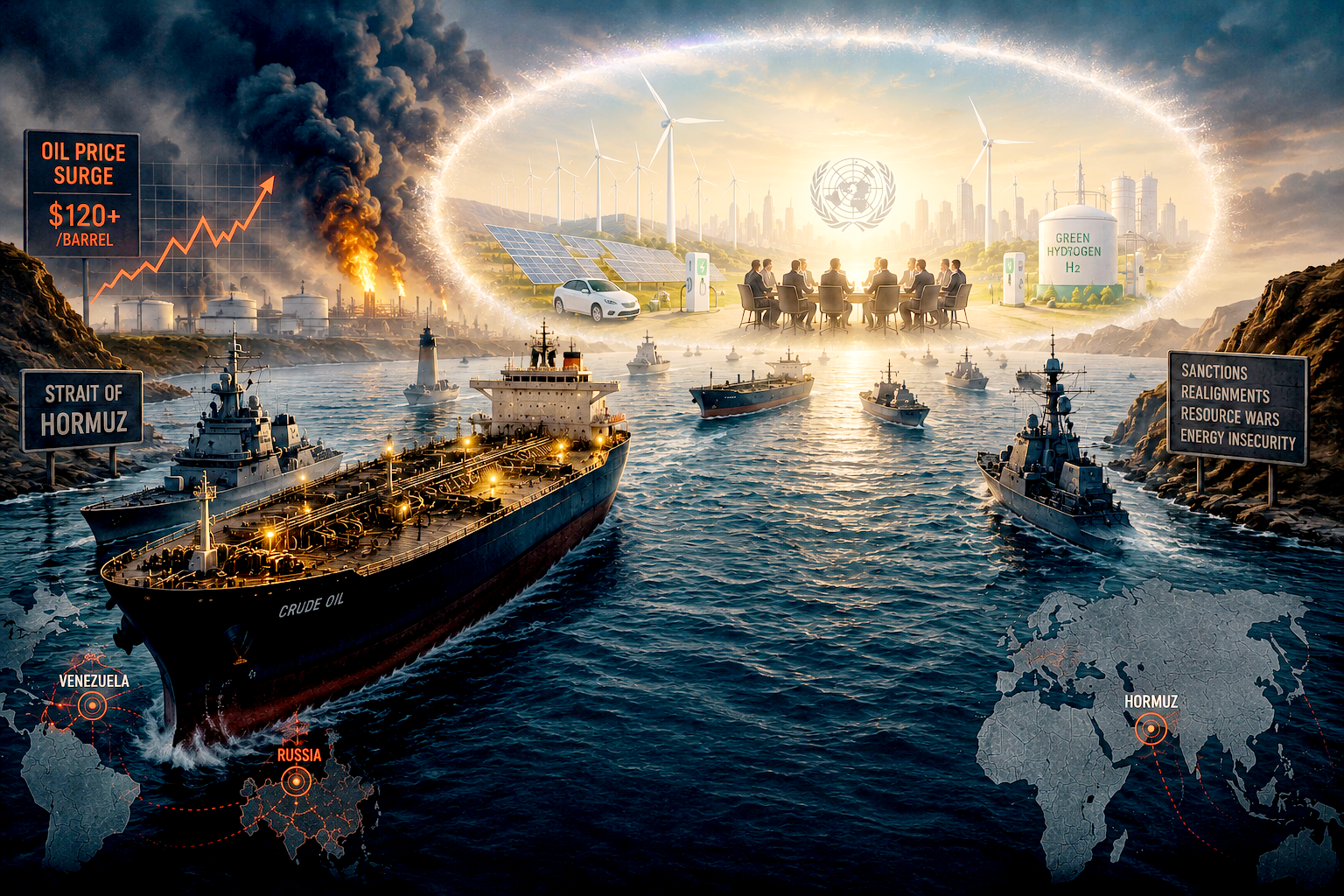
As the world grapples with the consequences of the U.S.-Israel military strike against Iran, the Strait of Hormuz closure and oil prices rise, and as embargoes are lifted on Russian crude, the question arises with uncomfortable urgency especially this May 2026: Is climate diplomacy still relevant?. From an outside perspective, geopolitics in 2026 seems to have slipped back into the nineteenth century’s geopolitical equations of hard power, territorial control, and resource extraction, which we thought were a long way behind us. The U.S. capture of Nicolás Maduro and the subsequent scramble for Venezuelan oil; the realignment of traditional Western allies like the United Kingdom, France, and Canada toward Beijing; and the crystallization of a “Global East” versus “Global West” order all suggest that climate has been relegated to a boutique concern of a bygone liberal era. It’s not just the wrong view, it’s a catastrophically misguided view. Climate diplomacy is not irrelevant in 2026, instead it is the sine qua non of survival as even the crises that are grabbing headlines in the present day are essentially climate-security crises.
Let’s begin diving, the most prevalent myth in our time is that military security and action on climate change are in a zero-sum game. The blockage of the Strait of Hormuz, through which one-fifth of the world’s oil traffic flows, has sparked panic-buying and price hikes that are similar to the 1973 oil shock. But this crisis is not an argument against climate diplomacy, it is in fact the strongest argument for it. Every barrel of oil that is priced or sold at crisis premiums is another big reminder that fossil-fuel dependence is a structural vulnerability, rather than just an environmental issue. The International Energy Agency (IAE 2023) has repeatedly highlighted in its various reports that the energy importing countries are exposed to systemic risks due to disruption in energy supplies from volatile regions. So let us examine this issue very deeply. If nations resort to war over places such as Hormuz, they are fighting for the architecture of a dying energy system. The only viable way forward for long-term de-escalation is in climate diplomacy which emphasizes the need for transitioning to renewable energy, EVs and decarbonizing industry. Otherwise, we are only playing the same game as the resource wars, but with different players, actors and bigger stakes.
As traditional U.S. partners turn to China, it is often claimed that the era of cooperative climate governance, as defined by the Paris Agreement, has come to an end. This analysis is basically trying to confuse the decline of American hegemony with the decline of multilateralism. China’s dominance in terms of solar photovoltaic manufacturing, rare-earth mineral processing, and battery technology means that Beijing is already now the de facto leader with regards to the global energy transition. When the United Kingdom, France, and Canada deepen economic ties with China, it does not mean that these three countries are giving up on climate change, it is just a response to the reality that decarbonization requires Chinese supply chains. Climate diplomacy for 2026, therefore, needs to move beyond the rules-based and Western-led approach to a poly-centric approach of negotiating amongst the Global East, Global West and Global South. This is not the end of climate diplomacy, it is the next phase. Climate communication scholars say that in order to be effective, climate communication needs to make the global phenomenon resonate with the local reality while positioning transitions as opportunities rather than sacrifices (Net Impact, 2026). The realignment presents just that opportunity: the opportunity to decouple climate action from the problems of colonial extraction and to re-center it on equitable technology transfer.
Let’s look at the U.S. intervention in Venezuela, as an example. The claim is this is a stabilization operation, but the back-story is obvious; control of the world’s largest oil reserves. Likewise, the relaxation of the Russian oil embargoes as a result of Europe’s energy desperation reveals that sanctions regimes fall when there is a lack of a coordinated diplomatic solution to fossil fuels. These are not some kind of isolated conflicts; but they are the opening shots fired by a climate-stressed world. Research on climate communication by Harvard T.H. Chan School of Public Health in 2024 put a lot of emphasis on the fact that narratives must harness emotion while offering pathways to empowerment. The emotion here is righteous anger: we are witnessing great powers repeat and doing the 20th century destructive extractive thing again. This is the empowerment that lies here: If used and handled well, climate diplomacy can make these conflicts economically irrational. A world that’s dominated by electric vehicles, run on green hydrogen and grid-scale storage doesn’t need to occupy Caracas or sanction Tehran in order to keep the lights on.
But even with all these there remains some sort of opposing argument. Critics say that 2026 demonstrates that the survival of the nation will always come before the stability of the atmosphere. When bombs are falling in the Middle East, why would diplomats waste a lot of significant political capital on carbon budgets? This particular opposition is fundamentally misguided in terms of the timing of climate change effects. The heatwaves, crop failures and migration pressures that happened, are happening or will happen in 2026 are not abstract possibilities; they are the very factors that are driving the increased militarization and instability. The Syria conflict was preceded by the worst drought in recent history showing how climate stressors become threat multipliers. The current wars are not a distraction from climate diplomacy, they are early symptoms or early warning signs of the absence of climate diplomacy. As Mary Annaïse Heglar (2019) argued in her seminal climate essay, “Home is Always Worth It,” hopelessness cannot be permitted to become helplessness. The chaos of 2026 is not a reason to abandon diplomacy; but rather it is a call and mandate to transform it from its current form of polite conference-room negotiation to kind of hard-nosed (literally), security-centered statecraft.
Climate diplomacy in 2026 is relevant not despite the current geopolitical chaos, but also definitely because of it. The Hormuz closure, the Venezuela crisis, the re-alignment toward China and the disintegration of the post-Cold War world order are not separate from the climate crisis; they are its violent expressions on the arena of traditional power politics. The great challenge of diplomats, communicators, scholars and of course of those who wish to be, is to make that connection as clearly as we can. We need to go beyond the “saving the planet” narrative, and detach climate action from its “soft” image and make it the lifeblood of geopolitical stability, economic resilience and national security. The most effective climate communication does not shy away from or avoid complexity but instead, it translates it into narratives that compel and motivate action (Dahlstrom, 2014). In 2026, the narrative is very clear and unambiguous: either we do everything to try and decarbonize the international system, or we militarize it indefinitely. There is no third alternative. Climate diplomacy is not dead. In fact , it is the only thing standing between us and a future where each and every summer is a war season.
KEYWORDS: Climate Diplomacy, Geopolitical Stability, Fossil Fuel Dependence, Energy Security, Energy Transition





 Reston Dennis Juah
 Noor Ul Ain

 Hassan Barrie
 Hoby Nasandratra Andriamiandrisoa
Super fast withdrawals and an amazing range of slots. It is honestly the most exciting site I have used. Try jilimacao888 today.
The app version is so convenient. I can place my bets while on the move without any glitches. Love using 3winapp daily.