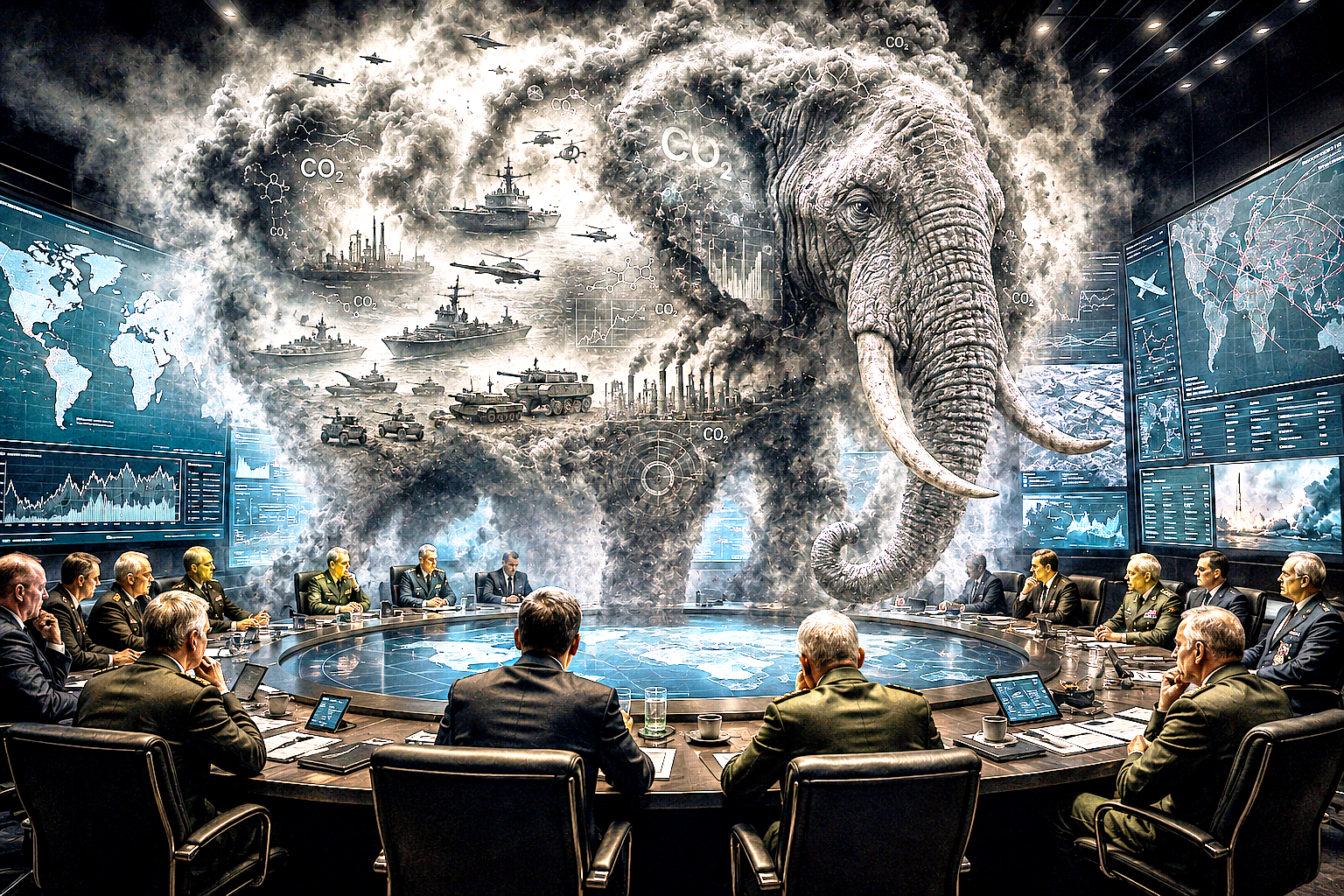

5.5%, that is the annual global GHG emissions from the world’s military forces and their supply chains in 2022, which is equivalent to the total carbon footprint of the aviation and shipping sectors. The armed forces of the world, if they were a country, would be the fourth largest emitter on earth, after Russia and Japan. Nonetheless, this number has never been put on an official negotiating agenda at the UN climate summits over the past 30 years. The reason for the silence is not coincidental, but a diplomatic ploy.
The taboo starts with accounting. Under the 1997 Kyoto Protocol, The United States (U.S.) successfully lobbied to exclude military bunker fuels (used by naval vessels and aircraft operating internationally) from national emissions inventories. In 2015, this exemption was removed from the Paris Agreement and replaced with voluntary reporting. The result? A data black hole. In the latest and most recent reporting cycle, major military powers and key countries that include the United States, China, Russia, India, as well as Saudi Arabia reported 0 (zero) operational emissions. France, the United Kingdom, and Turkey who also despite hosting a lot of significant forces likewise failed to provide any disaggregated military fuel data. It was found that only six countries across the world were rated as being “fair” in their transparency.
This institutional invisibility has a lot of catastrophic consequences. Researchers estimate that the first three years of the Russian invasion of Ukraine have produced emissions equivalent to that of the annual emissions of Slovakia, Austria, Hungary and the Czech Republic. According to a study by Queen Mary University of London (2024), in Gaza, the first 120 days of military action generated more CO₂ than the annual emissions of 26 countries. These are far from footnotes of the climate crisis, they are frontline drivers of it.
So, then, why does this kind of significant issue still continue to remain the unspoken variable in the realm of climate diplomacy? The answer lies in the words of political theorist Rob Nixon which he calls the “slow violence” of structural silencing. Climate negotiations operate on a kind of fiction of shared sacrifice among civilian sectors; energy, agriculture, transport while at the same time exempting the machinery of state violence. Neither COP28, which called itself the “Conference of Peace”, nor COP29, which was titled “Baku Call on Climate Action for Peace”, mentioned the emissions caused by the very militaries they referred to. The diplomatic community has implicitly found itself in the process of creating a variant of greenwashing which I would call “greenwashed militarism: the performance of climate concern that systematically excludes the largest institutional emitters under state control and keeps it out of the picture.
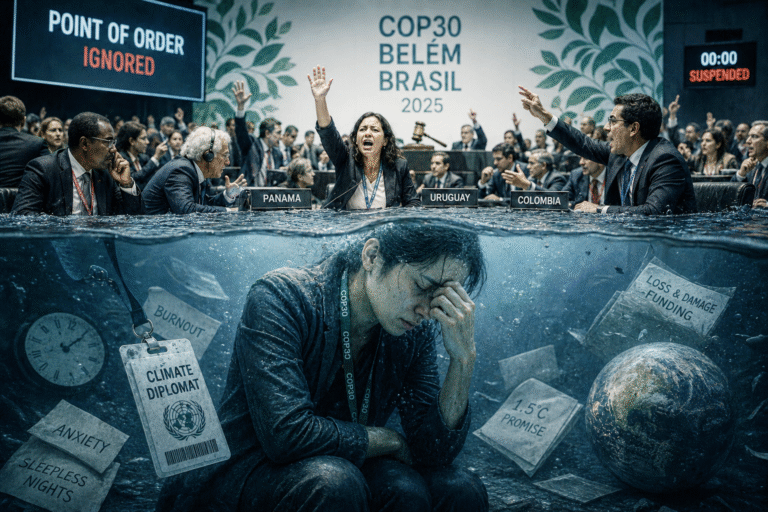
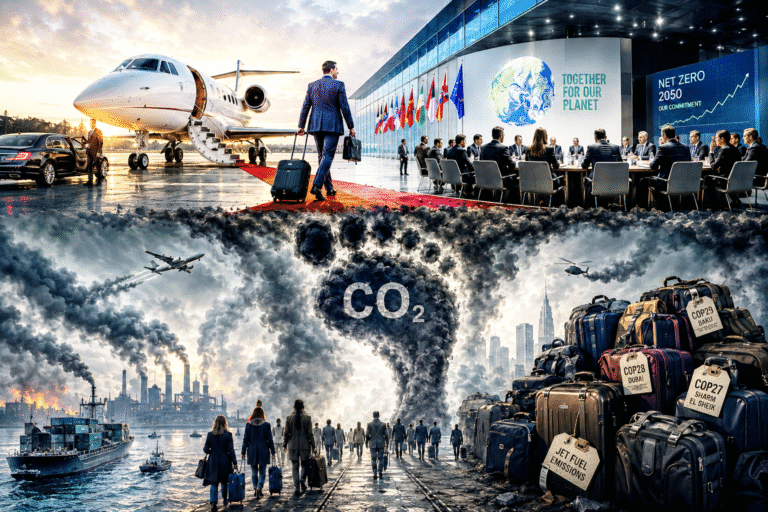
The spiral of silence around military emissions is reinforced by a sort of peculiar yet strange psychological barrier. For example, research that has been conducted on climate communication shows that people avoid discussing topics where they fear being perceived as incompetent or politically naive (Swim et al., 2015). So, trying to question the issue of military carbon footprints triggers exactly this kind of anxiety as it requires challenging national security orthodoxy, confronting bipartisan defense spending, as well as acknowledging the fact that climate action may conflict with militarized foreign policy. Individual carbon footprints are easier to talk about than institutional carbon footprints; easier to shame a civilian on their flight to a climate conference than to count the jet fuel used by one bombing run.
However, the silence is starting to crack and climate communicators have a very big responsibility to amplify the crack. The International Court of Justice (ICJ) proposed in an advisory opinion in July 2025 that it would declare that the use of military force is a contributor to climate change and that states have legal obligations to address environmental harm caused by armed conflicts. The Women and Gender Constituency at COP27 formally called for the UNFCCC to conduct a study on military emissions and for military spending to be cut by 2% per year, measures that would help liberate an estimated $1 trillion for climate finance. These are not some radical ideas, they are fundamentally arithmetic. The money spent on rearmament can be tripled up to go towards renewable infrastructure, which has two effects: one is to cut emissions from the military, and the other is to speed up decarbonization.
Effective climate communication requires what blog-based science outreach has proven to to be most successful, which is in translating abstract data into visceral, local, and also personal narratives. What the military emissions gap reveals is that; this isn’t a distant bureaucratic issue, but rather, the deeper one probes, the more one realizes that it is the carbon cost of the security we are told to trust. It is the uncounted tonnage that lies behind every “defense” budget that outweighs climate adaptation finance. For developing nations that need $387 billion annually in order to assist them to be able to adapt to climate change impacts, the $2.4 trillion spent globally on militaries in 2024 represents not only security, but also stolen survival. As a result , if climate diplomacy cannot count the carbon of war, it cannot claim to count anything at all.
All encompassing, not knowing the emissions of the military is not a taboo. The taboo is that they are unwanted. And as such, breaking this kind of taboo will require nothing less than redefining the entire security issue itself, not as the capacity for destruction, but as the guarantee of a livable atmosphere. This is the dialogue that climate communicators are meant to engage in and it is the time to keep amplifying that kind of conversation.
KEYWORDS: Military Emissions, Climate Diplomacy, Greenwashed Militarism, Carbon Footprint of War, Climate Justice



 Reston Dennis Juah
 Noor Ul Ain

 Hassan Barrie
 Hoby Nasandratra Andriamiandrisoa
Logging in is a breeze and the game selection is top notch. I love how intuitive the layout is for new players. jilibbcomlogin