
Why Climate Diplomacy Is Breaking the People Meant to Save the Planet?
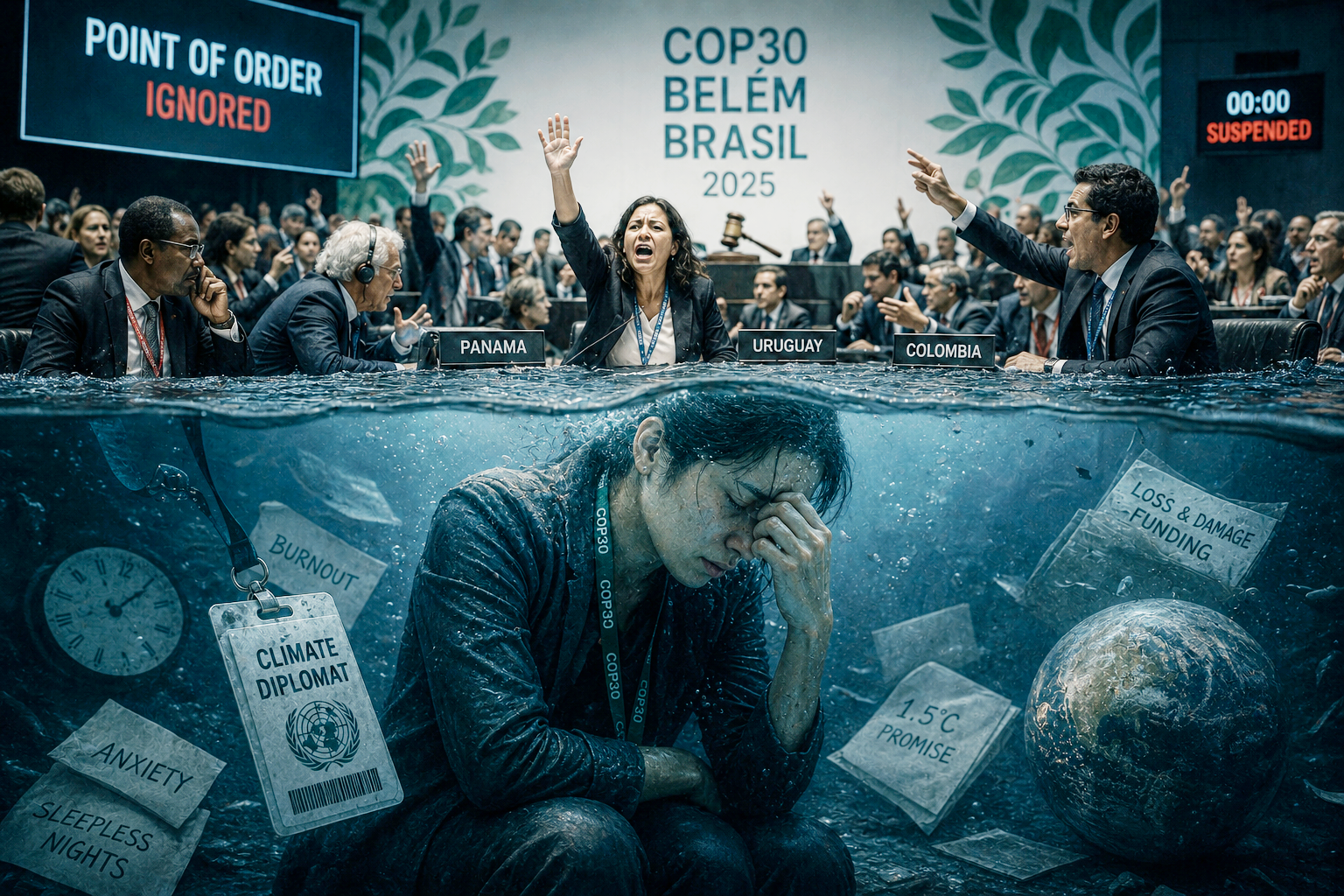
As the delegates left the COP30 in November 2025, something was omitted from the official UNFCCC press release: The negotiating teams from Panama, Uruguay and Colombia stood as arms up in the inverted-V shape for a point of order on the dais, but to no avail as the Brazilian presidency gavelled through decisions that they hadn’t agreed to. Earth Negotiations Bulletin (2025) reported that the plenary broke down into “significant turmoil”, which was enough to necessitate a suspension of more than an hour as the secretariat worked to salvage the situation. What the cameras caught was procedural chaos. They missed, however, something that is far more pernicious; the mental health crisis quietly taking over those tasked with saving the planet.
The COP has been held annually for almost 30 years, growing from a small group of environmental ministers to a massive industrial complex with 50,000+ people, thousands of side events and negotiations that often stretch past midnight . However, a key systematic review of the UNFCCC process, published in 2025, finds an ominous paradox: the more people have joined, the less substance has been in the changes that have happened. They spot and describe a “climate diplomacy fatigue”, which is the institutional exhaustion from the yearly negotiations, and the danger they run into being normalized is to delay action instead of take it. Decision texts have shifted from firm mandates to some forms of highly vague aspirations, deadlines have dissolved into undefined timelines, and successive COPs have recycled past commitments instead of generating or delivering actionable breakthroughs .
However, the literature on procedural drift does not reflect a very big issue, which is the human cost. When the Panama’s delegate raised that particular point of order and led a dramatic procedural revolt against the UN Presidency unilaterally passing a text without financial backing while ignoring the legal right of developing nations to object, she wasn’t just objecting to a text which was later ignored. She was bringing out the accumulated rage of the years of lack of sleep, financial insecurity, and the psychological effects of watching the 1.5°C window close, while the theatre of procedures devoured another year of her life.
The mental health impacts of climate change are very real and not abstract. They are measurable, highly significant and vastly overlooked and underreported in the same settings where climate policy is being crafted. 2 published in Nature Mental Health found that across all COPs from 1995 to 2023, Only 49 mental health actors were identified among the participant’s, a shocking 0.014% of the total COP attendance, and under 1% of the health community participation. At COP28 in Dubai, desnearly 200 health-related epite vents, just over 10 were dedicated to mental health. This is not an oversight issue. It is structural erasure.
And the consequences are very lethal. According to the World Health Organization (WHO), around 1 billion people worldwide suffer from a mental health condition that can be diagnosed, but the proportion without access to treatment is as high as 90% in low-income countries. Climate change acts as a threat multiplier that is exacerbating trauma through direct exposure to extreme weather as well as indirect pathways through displacement, loss of livelihoods and disrupted social determinants of health. In northern Azerbaijan, agricultural communities reported cascading mental health crises as a result of the loss of livestock due to flooding and droughts, that no existing health infrastructure could address.
However, when the same farmers’ representatives come to COP to speak up and to make the case for loss and damage funding, though, they face a dynamic in which they are entering into a negotiation space that itself is a vector of psychological harm. The 2025 Belém conference was characterized by many sleepless nights, last-minute textual ambushes, as well as a closing plenary where objections were literally shouted down. This is not diplomacy. It is a system that is designed to destroy its participants.
Veteran diplomats are crumbling as are young activists. In a 2024 study on youth participation 72% of the youth delegates who participated in the survey stated that financial constraints posed a significant challenge to attending COPs, with 80% of the youth delegates from Africa relying solely on external sponsorship to attend COPs. Even when present, 45% of them felt that their participation was “largely symbolic,” and 40% said they suffered from burnout during or after COP events. The researchers coined a term that should haunt the UNFCCC: “youth-washing”, the performative inclusion of youth without any real influence, which extracts their labour and emotional energy, but denies them any decision-making power .
Not only is this unfair but it is also strategically suicidal. The Intergovernmental Panel on Climate Change (IPCC) had called for a 43%-60% reduction of emissions by 2030 and 2035 respectively to stay within 1.5°C of warming, respectively . But even if fully realised, the third round of Nationally Determined Contributions (NDCs) submitted in 2025 would only see a 2.6% cut from the 2019 levels, a gap that is so wide that it amounts to a policy fiction. We do not need more and more exhausted delegates recycling inadequate pledges. There should be an architecture for negotiation that can support the humans inside it.
What is to be done? The 2025 Systemic Review of the effectiveness of the UNFCCC offers a highly provocative yet also surprising result: Fragmentation, which is frequently described and framed as a weakness of the global climate governance, could be a strength when it is realised through polycentric climate governance arrangements that offer regional leadership and flexibility. I argue that this particular kind of logic needs to be carried over and extended to the human architecture of diplomacy.
First, the UNFCCC should institutionalise the provision of mental health support as an integral part of their operations, not something like a peripheral wellness initiative. This would include having psychologists as part of the negotiation teams, funding of trauma-informed training for delegates from countries that are climate-vulnerable, and introducing rest breaks in current marathon sessions which last 20 hours and sometimes longer.
Second, the term “inclusive participation” needs to be redefined. The current model honors and celebrates the presence of Indigenous peoples, youth, and Global South delegates while simultaneously, on the other hand, centralizing power in the hands of state actors and the high-emitting economies. That shouldn’t be allowed to continue as true inclusion requires redistributing not just seats at the table, but also control over the agenda, the text, as well as the gavel.
Third, we need to address the pertinent issue of “institutionalisation of delay” that the systemic research reveals, the normalisation of the gap between ambition and action, which has created a space for symbolic diplomacy in the COP process instead of structural transformation. This means enforcing it, not speaking of it. It demands that if Colombia says that a COP of truth can’t ignore science, then the answer should not be a gavel but a re-written text.
A mother in Karachi, Pakistan, lies in bed in the sweltering heat, fearing that her toddler won’t be able to breathe when the power goes off again. The people living in Kingston, Jamaica, affected by hurricane Melissa say they have “homes that no longer feel like themselves“. These are the realities of everyday life that climate policies need to address. However, if the people who are writing that policy are traumatized, tokenized and ignored, then that policy will fail. It is already failing.
The chaos that took place at COP30 was not an aberration. It was a symptom. And the symptom point directly to a disease which no emissions trading scheme can cure, a multilateral system that has forgotten the humans that are supposed to be at its center. We need to urgently reckon with what we are doing to the people who hold the pen to save the world from the climate crisis.
For, if they break, the planet breaks with them.
KEYWORDS: Climate Diplomacy; Mental Health; Climate Governance; Delegate Burnout; COP Negotiations.



 Reston Dennis Juah
 Noor Ul Ain
 Hassan Barrie
 Hoby Nasandratra Andriamiandrisoa
Quick registration and even quicker access. I was worried about the connection but this link works perfectly every time. Great job on the optimization. Visit sh777link now.