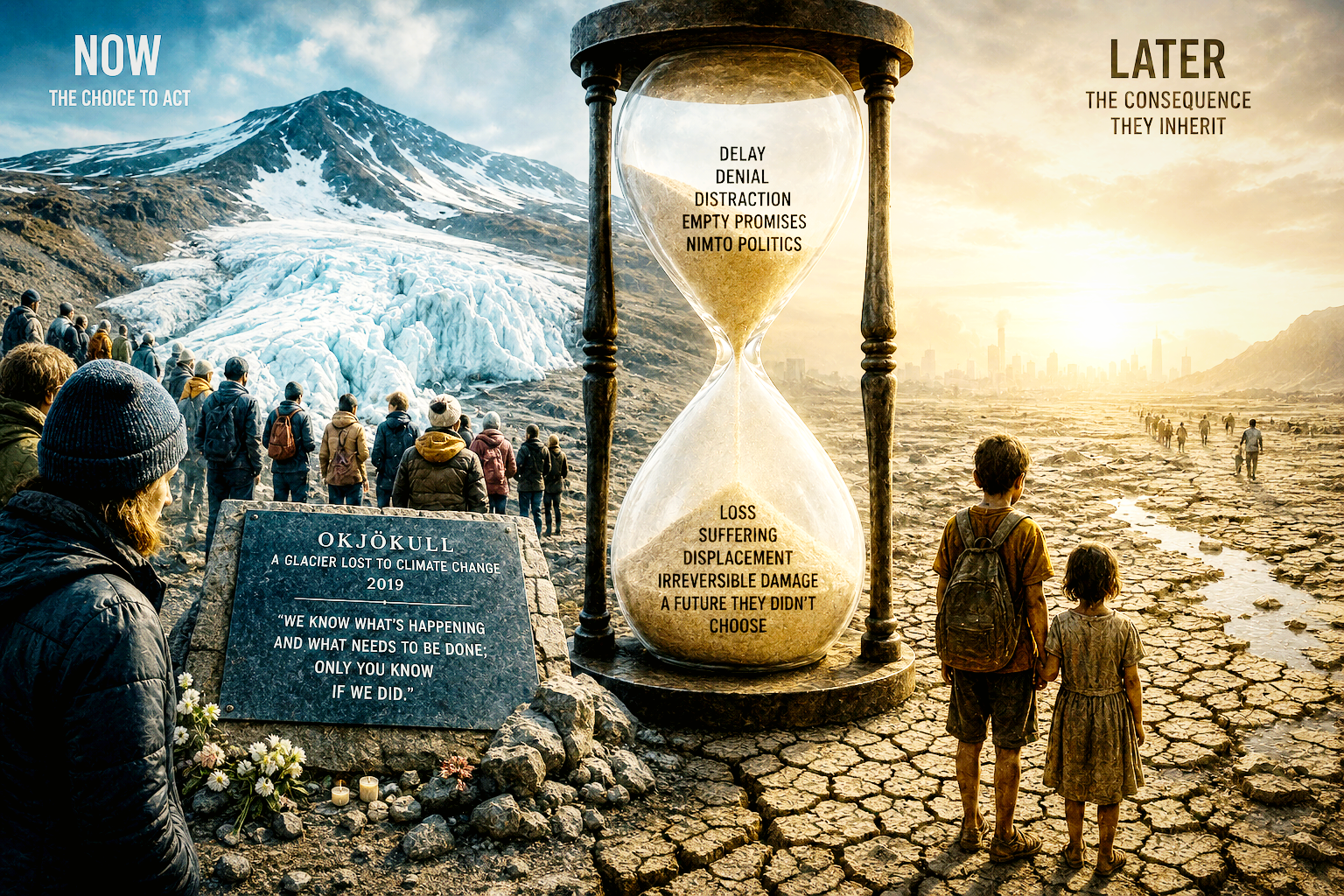

In 2019, mourners came to the site of Iceland’s Okjökull glacier, which no longer exists. There they set up a plaque not for the present, but for the future generations who would come after them: “We know what’s happening and what needs to be done; only you know if we did”. This inscription is disturbing in more ways than for a failure. What it does capture, though, perhaps more powerfully, is a very unique characteristic of climate politics: the ability to shift consequences forward in time. Those who raised the plaque still had the option of delay. They could postpone making some very hard choices as the glacier kept on shrinking. Later generations, however, must deal with the consequences of such postponements, which they did not choose to make.
Much of the literature on climate power has been much focused on the more familiar actors and institutions such as states, corporations, social movements, scientific authorities, and international organisations. These kinds of views are still useful, but they might be oblivious to a more serious imbalance: Temporal power. By temporal power, I mean the capacity to influence the time at which decisions are taken, whose sense of urgency matters, as well as which generations get to ultimately bear or pays the costs of postponement. When framed like this, there’s more to delay than the lack of action. It can function as a political resource in its own right, one that has frequently proved to be very remarkably effective.
The character of climate obstruction has changed a lot over time. In some contexts, explicit denial has been replaced by what Lamb et al. (2020) call “discourses of delay.” These types of arguments tend to rarely reject climate science outright. Instead, they pose the question of whether or not action is necessary now. The responsibility is transferred or diverted to somewhere else. Incremental or non-transformative solutions are promoted. The economic consequences of intervention are more highlighted than the consequences of postponement. While each of these arguments present themselves differently, they all seem to follow the same temporal logic: action is always better deferred until later (Lamb et al., 2020). The fossil fuel industry’s shift from outright denial to greenwashing, technological optimism and strategic blame shifting are both evidence of this trend.
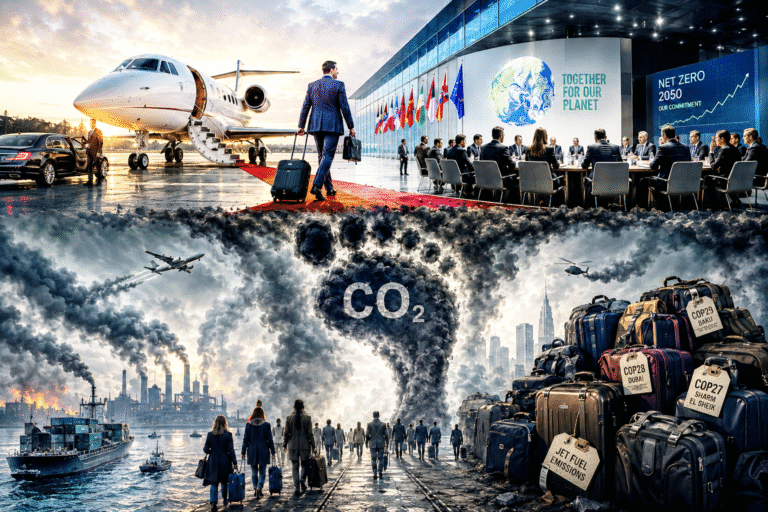
Delay can, however, be more than just a rhetorical strategy. It can also operate as a structural privilege as well. German government’s calls for further easing of CO₂ regulations and plans to advocate further concessions for the automotive industry that go beyond the European Commission’s proposals in 2026 , is not just stylishly prolonging the already delayed decision-making process; it’s playing politics with time Likewise, the “NIMTO” approach (Not In My Term of Office) shows a preference to link climate policy to electoral cycles instead of ecological realities. The impacts are very tangible. According to a modelling study, the cost of mitigation in the U.S. would rise by approximately 75% if the country were to wait until 2030 to implement net zero policies (Energy Innovation, 2021). Other research indicates that once some climate tipping points are exceeded, it will be much costlier to act. The cost of delay is therefore very high, but more often than not, the people who make the decision to wait are not the ones who have to pay for it.
There is also a very unequal distribution of temporal power. In most cases, richer nations, especially in the Global North, have the infrastructure, financial resources and adaptability to cope with short-term delays. Not many communities of the Global South do. In this instance, temporal power meets what has been termed ‘epistemic violence’, as described by scholars such as Spivak (1999) and Tunn (2025), which is the process of systematically devaluing certain types of knowledge and experience. When Indigenous fire management practices are dismissed as something very anecdotal or unscientific while attention shifts toward future technological solutions, a situation more than a disagreement over expertise is taking place. A particular timeline is being privileged, one that often privileges interventions far away rather than interventions that are available locally. In this kind of situation, then, decisions regarding knowledge can be decisions regarding time as well.
There are also issues of gender and race that taint this picture. Studies of adaptation labor have described various forms of invisible labour associated with adaptation that involve strengthening flood protection, making adjustments to farming practices, caring for family during heat events or purchasing water during droughts. A significant portion of this work is low-paid, unpaid, and socially undervalued and is overwhelmingly done by women and other marginalized groups (Johnson et al., 2023). While the world’s political leaders negotiate emissions targets at international conferences, someone else is working thoroughly to manage the many practical consequences of climate disruption in everyday life. Their labor effectively subsidizes collective delay. Surprisingly, the Working Group II report of the IPCC does not contain much discussion of labour; the only significant reference to labour is in the context of labour productivity losses due to heat stress, but not in the context of adaptation itself (Johnson et al., 2023). Whether it is intentional or even not, such kinds of significant omissions can obscure the fact that postponement already generates substantial social costs.
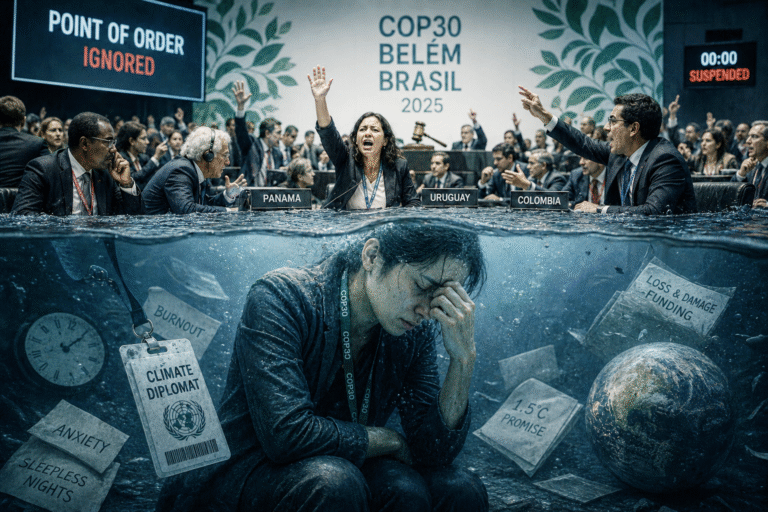
So, If waiting itself constitutes a form of power, then impatience may as well represent a certain form of resistance. Climate grief, sometimes called ecological grief, climate anxiety, eco-anxiety and solastalgia, can be seen as an emotional rejection of delayed timelines. According to a survey conducted in Finland, 34 % of respondents reported climate grief and 24 percent reported climate guilt with 31% youth (15 -30 years old ) reported feeling climate guilt while 18 % of those aged over sixty-five said they felt climate guilt (Pihkala, 2019) Such conclusions shouldn’t be overgeneralized, but they suggest a generational gap in climate responsibility and climate vulnerability experiences. Younger individuals might feel that need of urgency more strongly because they are more likely to live longer with the repercussions of current choices.
Grief, however, is not reducible to despair. Emerging research points to its capacity in order to motivate collective action. Individuals that are grieving environmental loss often engage in solidarity activities, and anger at political or corporate actors can lead to mobilisation and advocacy. In this light, the funeral for Okjökull was a more than symbolic gesture of mourning. It was an open defiance of the notion that environmental losses is an issue that can simply be dealt with in some future time. Collective mourning, as Proust (2023) puts it, moves emotional responses into the public sphere, in such a way that the emotion becomes a political claim. As such, grief when expressed collectively, may therefore be very pivotal in disrupting the logic of delay by insisting that loss is not a future problem but a present reality.
Kari Norgaard’s concept of “climate silence” provides another way to make us understand how temporal power operates. Drawing on Steven Lukes’ notion of the third dimension of power, climate silence functions not through coercion but through the normalization of certain assumptions. One of those assumptions is that there is still ample time. Markets will adapt. New technologies will come into being. It will first be done by someone else. These narratives appear to have differences in their content, but they all share a common effect, making postponement seem like a reasonable option.
In the light of all these considerations, the politics of climate change might well have to take time more seriously as a site of contestation. The central question is not simply “what” should be done, but also “when” should it be done and “who” should make the decision on the speed at which response should take place. Such a major transition would require a more critical consideration of NIMTO politics, greater recognition of adaptation labor, and a more serious engagement with knowledge forms that are de-prioritised by the lure of future-oriented technological promises. It would also involve acknowledging that expression of climate grief is not just an emotional response, but it could also be a political objection to timelines set or imposed by others.
The plaque at Okjökull is more than just an apology for the melting glacier. It directs attention toward a choice. The message it conveys is not only that people were aware of what was going on but that they had the means to act and kept delaying their response over and over again. The question that remains is, will that continue? If, at heart, temporal power is the power to be able to postpone consequences, then, climate politics may be more about whether societies continue to view waiting as a privilege or come to think of waiting as a responsibility that can no longer be postponed.
KEYWORDS: Temporal Power; Climate Diplomacy; Discourses of Delay; Climate Grief; Adaptation Labour.


 Reston Dennis Juah
 Noor Ul Ain

 Hassan Barrie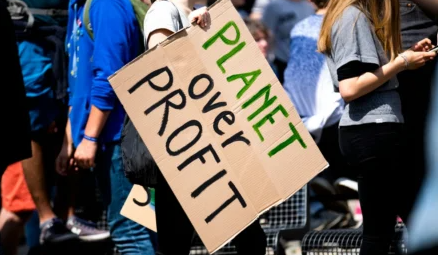
 Hoby Nasandratra Andriamiandrisoa
+ There are no comments
Add yours