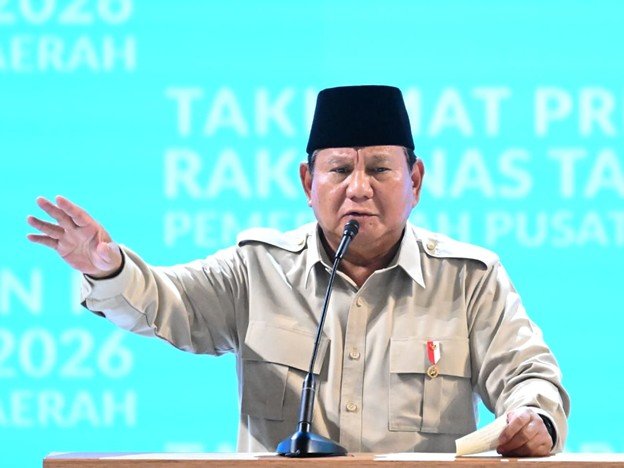

President Prabowo Subianto gathered senior journalists at his residence in Hambalang, Bogor, West Java, in early 2026. Unlike a similar gathering that took place in 2025, this time it was not only journalists who were invited to converse. Economists and other public figures also participated in the meeting.
In the conversation that was broadcast the day before Eid al-Fitr, on March 19, Prabowo touched on the issue of energy sovereignty. He felt that Indonesia needs to transform into a country that adopts total vehicle electrification. He also expressed a desire for the electricity source powering it to be replaced by solar energy, no longer by coal as is currently the case.
For supporters of green energy in Indonesia, Prabowo’s statement sounded encouraging. There was finally a plan to shift away from the dirty energy that has been poisoning Indonesia’s air for the past several years.
However, there was also a feeling of it being too good to be true upon hearing this statement. Given the many businesspeople or oligarchs with coal mining businesses in Prabowo’s circle of power.
Hashim Djojohadikusumo, Prabowo’s younger brother, controls Arsari Group, which has business units in the mining sector. Several ministers and officials in Prabowo’s cabinet also have affiliations with the coal industry.
Beyond that, contradictions between words and actions have occurred several times, particularly when Prabowo makes statements about the energy transition.
When delivering a speech on the 2026 State Budget (RAPBN) before members of parliament on August 15, 2025, Prabowo announced an ambitious target. He wanted 100 percent of energy generators in Indonesia to fall into the renewable energy category within 10 years (Kompas.com).
A month later, in September 2025, Government Regulation Number 4 of 2025 on National Energy Policy was issued, targeting a renewable energy share in the national energy mix by 2030 of only 23 percent. In the 2060 projection, the renewable energy share is also not targeted to reach 100 percent, but 72 percent (den.go.id).
When delivering a speech at the G20 Summit in Brazil in November 2024, Prabowo stated a commitment to accelerating the early retirement of coal-fired power plants. He also affirmed Indonesia’s commitment to fulfilling the Paris Agreement (Detik.com).
That statement felt contradicted by the cancellation of the early retirement plan for the Cirebon-1 coal-fired power plant, announced by Coordinating Minister for Economic Affairs Airlangga Hartanto in December 2025 (Kompas.com). Airlangga argued that the power plant’s age was still relatively young and that they were looking for other older coal-fired power plants to retire instead. Yet the early retirement program for Cirebon-1, with a capacity of 660 megawatts by 2035, had been a symbol of Indonesia’s energy transition commitment.
The contradiction of Prabowo’s statement at the G20 is also visible in the PLN Electricity Supply Business Plan (RUPTL) 2025-2034 document launched by the Ministry of Energy and Mineral Resources on May 26, 2025. There are plans to add coal-fired power generation capacity of 10.3 gigawatts (esdm.go.id). The Minister of Energy and Mineral Resources Bahlil Lahadalia even stated that coal is not a forbidden commodity while questioning the commitment of other countries to the Paris Agreement (CnbcIndonesia.com).
The series of contradictions between Prabowo’s statements as president and the government’s subsequent positions certainly creates public confusion. Furthermore, this style of communication creates policy uncertainty.
Yet in Indonesia’s Second Nationally Determined Contribution (SNDC), there is a stated investment need of Rp 7,555 trillion to achieve emission reduction targets. Given this enormous investment requirement, the Indonesian government should be creating conditions that make investors comfortable, one of which is policy certainty. However, the contradictions between Prabowo’s statements and the government’s positions demonstrate the opposite.




 Reston Dennis Juah
 Noor Ul Ain
 Hassan Barrie
 Hoby Nasandratra Andriamiandrisoa
Really enjoying the selection of games here. Everything is well organized and the mobile version works like a charm. Check out phxgjili.