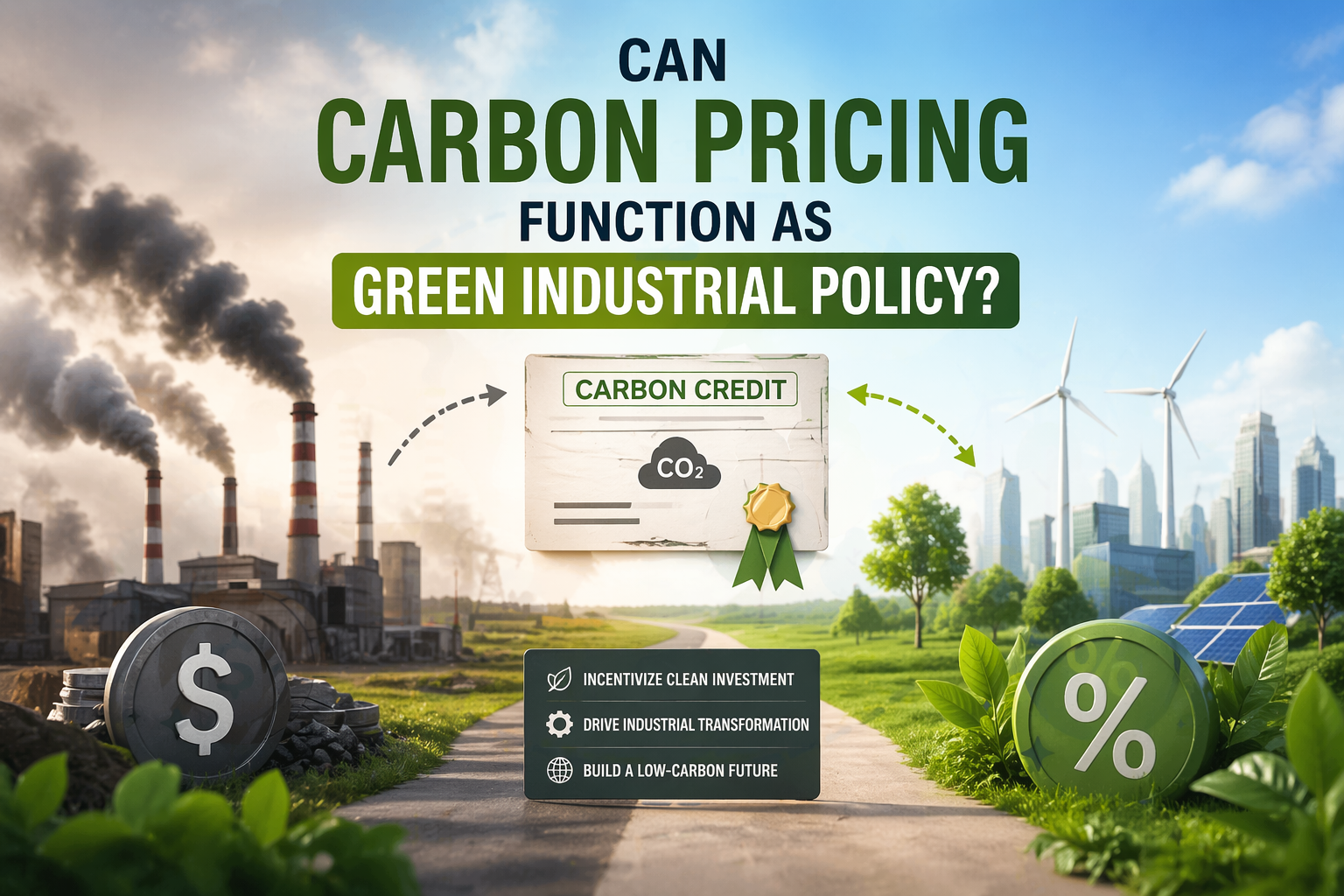

Whether or not carbon pricing can be used as green industrial policy is a question of how carbon pricing is defined, and how it is used in the policy mix. In its traditional narrow sense, carbon pricing is not industrial policy. It is a market mechanism that seeks to address a negative externality by raising the price of carbon emissions while being neutral about technologies, companies and industries. But when used as part of a broader suite of complementary policy instruments and objectives, carbon pricing can empower green industrial policy. In this context, carbon pricing can be used to influence industrial restructuring, investment decisions and the emergence of low-carbon industries.
Firstly, carbon pricing can be a form of green industrial policy in that it provides a long-term signal for industrial transformation. Increasing the costs of carbon-intensive production over time, it signals that a carbon-intensive way of doing business is becoming less profitable. This impacts their expectations of future returns and therefore affects their investment decisions in the present. We know carbon pricing does not explicitly favor specific technologies or production methods, but it does set up a market environment in which low-carbon technologies and methods become more profitable. This is a key aspect of green industrial policy, which seeks to influence the direction of industrial development towards environmentally sustainable activities, rather than addressing short-term market imperfections.
In the European Union, the EU ETS is an example of carbon pricing’s impact on industrial decarbonization. Companies have been compelled to reduce emissions and improve efficiency through narrowing ETS emissions cap. This does have different effects across different industries. However, the scheme has led to changes in investment behavior. This is especially realistic in scenarios where firms anticipate high carbon price in the future. This indicate that even though carbon pricing does not operate in a targeted way, it can still influence industrial behavior in a way that is consistent with green industrial policy.
Secondly, carbon pricing does enhance the impact of state intervention which is complementary to green industrial policy. Identifying where public support is needed the most is an important aspect of industrial policy. Carbon pricing can help identify this by revealing the true cost of carbon. In addition, it can help in assessing where the greatest challenges are for industries transitioning away from carbon-intensive activities. This enables more targeted industrial policy, such as subsidies or support for innovation to overcome these obstacles. It also helps avoid simply compensating for the distortion caused by carbon emissions. So, carbon pricing enhances the effectiveness and consistency of green industrial policy.
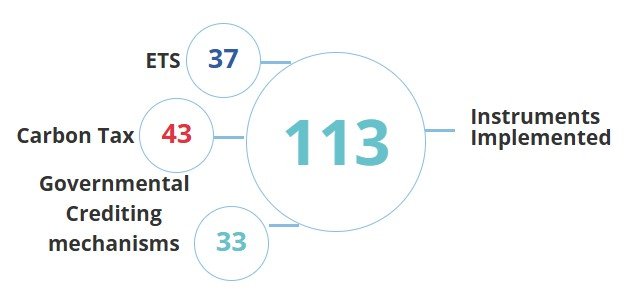
Figure 1: Number of Carbon Pricing Instruments around the world, 2026
Source: https://carbonpricingdashboard.worldbank.org
Thirdly, carbon pricing can raise revenue which can be used to support green industrial policy. For instance, auctioned allowances under ETS does raise substantial revenues. This can be used to invest in green industrial policies to fund innovation, infrastructure and clean technologies. The EU ETS revenues are reinvested in the Innovation Fund for industrial decarbonization in Europe, which is a group of energy-intensive industries. Carbon pricing thus directly connects to industrial transformation. In other words, the money from carbon pricing is allocated for the transition towards low-carbon industry.
Furthermore, this connection is reinforced with other carbon pricing measures. The Carbon Border Adjustment Mechanism (CBAM) is an example of carbon pricing that has a clear industrial policy objective. It does extend the carbon pricing regime to imports by putting a carbon cost on certain imports. The main purpose of CBAM is to prevent carbon leakage. It also shifts the competitive playing field to favor low carbon production, making the carbon price of imports and exports the same. EU-CBAM helps EU industries, which are at risk from carbon pricing, to keep the carbon pricing incentives in place. This provides the opportunity for more climate-friendly industrial policy and reduces pressure for less ambitious climate policy.
CBAM can also boost green industrial policy with its revenue generation. The revenue generated by the CBAM can then be used for green industrial investments, innovation, or to support transitioning regions and industries. This increases the value of carbon pricing as an investment vehicle, instead of just a cost, to spur industrial transitions. CBAM shows how carbon pricing can be plugged into strategic industrial policy through its combination of external trade and domestic industrial policy.
Another mechanism through which carbon pricing can help green industrial policy is carbon crediting. Whereas emissions trading schemes target emissions reduction in the sectors covered, carbon credits can drive additional emissions mitigation or carbon removal that is strategically relevant but not yet economically viable. Carbon credits that are robust and related to industrial decarbonization or carbon removal activities can raise funds for new industries. Used strategically, carbon credits enhance carbon pricing by providing support for innovation and initial investments, and thus speed up the development of industries that are critical for long-term climate targets.
Indirect carbon pricing, in the form of taxes, subsidies and tax incentives, complement the industrial effect of carbon pricing. Subsidy reform and energy taxes on fossil fuels boost the price of carbon, complementing emissions trading systems. Subsidies and tax credits for renewable energy and other clean technologies also decrease the cost of investment and the perceived risk. This is critical in capital-intensive industries where price signals may not be enough to stimulate large-scale change. Indirect carbon pricing can be used to channel carbon prices into industrial realities by linking price signals with long-term decarbonization targets.
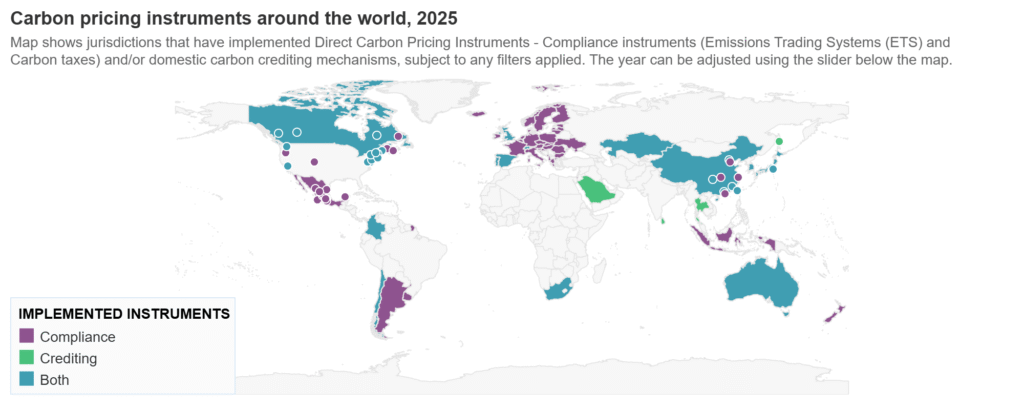
Figure 2: Map illustrating jurisdictions worldwide that had implemented direct carbon pricing instruments as of 2026.
Source: https://carbonpricingdashboard.worldbank.org
The interaction between the EU ETS and the Green Deal Industrial Plan (GDIP) demonstrates that carbon pricing applies pressure to companies to decarbonize. Industrial policy instruments can then support companies to decarbonize without losing competitiveness, as long as they are well coordinated with carbon pricing.
It shows the potential of carbon pricing as green industrial policy in the context of an overall policy package. Carbon pricing provides the overall direction to change by punishing emissions. But complementary instruments like CBAM, carbon credits and indirect pricing policies provide companies with the financing and incentives to transition to low-carbon options. Carbon pricing, instead of being an alternative to industrial policy, offers a framework that can improve the effectiveness and efficiency of industrial policy.
Key words: Carbon Pricing, Green Industrial Policy, Decarbonization, Carbon Boarder Adjustment Mechanism





 Reston Dennis Juah
 Noor Ul Ain

 Hassan Barrie
 Hoby Nasandratra Andriamiandrisoa
+ There are no comments
Add yours