
One of the greatest challenges of our time, climate change, is threatening our environment, health, and economy. Climate change has been attributed to greenhouse gas (GHG) emissions, essentially due to human activities such as burning fossil fuels, deforestation and land use changes. Increase in GHGs leads to increase in global temperature, severe weather patterns, melting of polar caps, sea level rise, changing rainfall and other local effects of atmospheric circulation. These in turn affect agriculture, water resources, and human health and settlements. These explain the need for international, national, and regional cooperation to reduce GHG concentration in the atmosphere. Switching to renewable energy sources, improving energy efficiency, and promoting sustainable land use to reduce GHG emissions are among the top strategies believed to have the potential to reduce global GHG emissions.
India is a globally relevant actor in both climate policy and politics. In fact, as a lower-middle-income country, India accommodates the largest portion of the world’s population vulnerable to climate change impacts. As a fast-growing emerging economy, India plays a minor contribution to past emissions, but a significant contribution to current emissions. But their contribution on per capita basis is relatively not significant, because they have the largest population in the world. In international negotiations, India has been playing significant role, and has gradually adopted a more elastic approach to the climate regime. Gradually, they internalized climate considerations in their domestic policies. Starting from its Nationally Determined Contributions, leadership roles in forum like COP meetings, International Solar Alliance, its domestic frameworks such as National Action Plan on Climate Change, renewable energy targets, and its recent initiatives such as Green Hydrogen Mission, Electric Vehicle push, Afforestation and carbon sink program.
India’s Nationally Determined Contribution (NDC) submitted to Paris Climate Change Agreement aims to, among other things, reduce its GDP emission intensity by 33-35 percent between 2005 and 2030, increase the share of non-fossil fuels-based installations in electric generation capacity to 40%, and enhancement of sequestration to 2.5 to 3 Gt-CO2-equivalent by 2030 through an additional forest and tree cover. India achieved two of these targets ahead of time. By 31st October, 2023; the cumulative electric power installed capacity from non-fossil fuel-based energy resources was 43.81 percent of the total cumulative electric power installed capacity. And in December 2023, India confirms to UNFCCC a 33 percent reduction in its GDP emission intensity between 2005 and 2019 (Ministry of Environment, 2023). The percentage of India’s population with access to electricity increased from 60 percent in 2000 to 99.6 percent in 2022 (Suresh, 2024). This is an indication that India’s NDC was ambitious. Even with increased electricity access and demand, they were able to achieve two of their targets well ahead of time.
Building on the successes recorded with its NDCs, India came with fresh commitments during COP26 in 2021. The Panchamrit basically means the five pledges by India at COP26. The five pledges include that: by 2070, India would attain net zero; by 2030, 50% of the installed power capacity shall be powered by non-fossil fuels; by 2030, carbon intensity of the economy shall be reduced by 45%; creation of an additional carbon sink of 2.5 to 3 billion tons of CO2 equivalent through an enhanced natural carbon sink; and 50% of its electricity demand will come through renewable energy by 2030. The purpose of the updated NDC is to increase the contribution from India to the goal of the Paris Agreement of strengthening the global response to the threat of climate change. But the update given at COP26 takes India’s global climate pledges to even more ambitious levels.
India is now the third-largest greenhouse house emitter with low per capita emission. The share of the energy sector, transport sector, and industry sector in the greenhouse gas emission of India is as follows: 52.7 percent, 12.9 percent, and 24.1 percent respectively. The renewable energy sector has witnessed some steady growth over the last decades (IEA, 2022). India’s renewable energy sector is the fourth most attractive renewable energy market in the world. Government of India is committed to increase the use of clean source of energies, and already they are undertaking various large-scale sustainable power projects and also promoting green energy at a high scale.
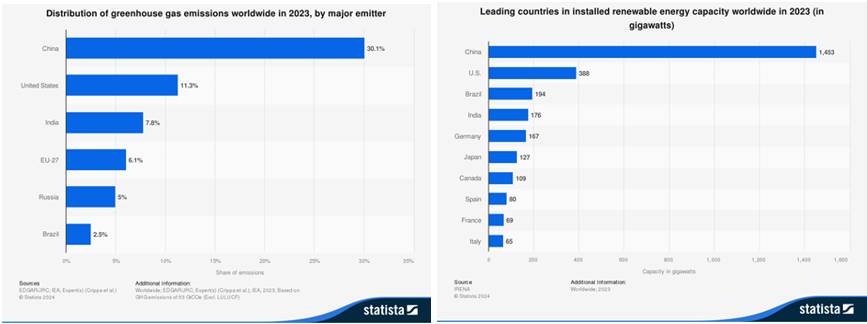
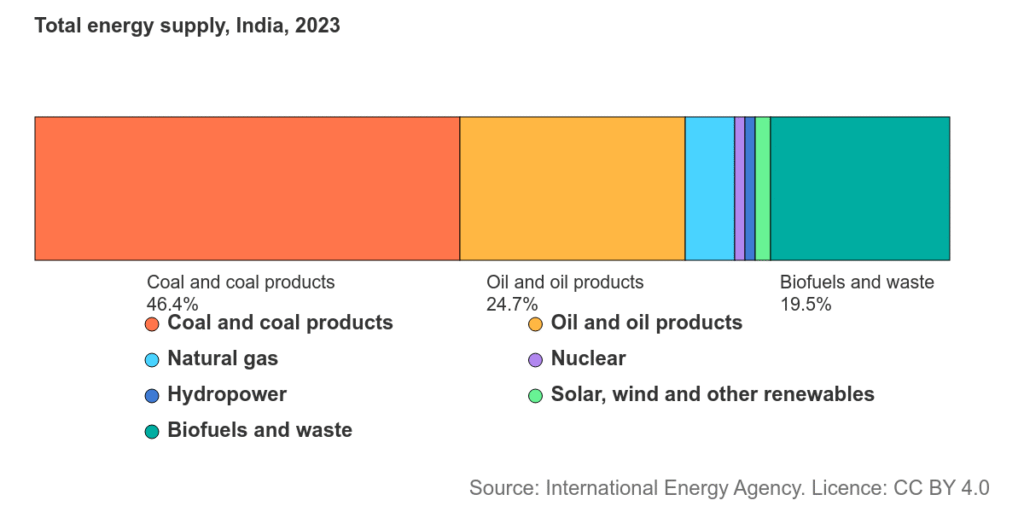
This progress is partly due to the architecture of India’s energy governance, such as the mixed ownership within its generation, transmission, and distribution of the electricity grid. The transmission, though, is still largely through the interstate Power Grid Corporation of India Limited for the interstate grids but always seems to attract the need for private participation in parts. Distribution remains very much a matter of state-controlled companies, even though some privatized ones have set into motion in and around cities such as Delhi and Mumbai. The biggest challenge will also be incorporating renewables into the grid by upgrading green energy corridors. However, 60 percent of the nation’s domestic energy is from fossil fuel origins, and fossil fuel sources accounted for nearly 70 percent of India’s total primary energy supply. Thus, their share in global emissions reaches 7.4 percent. They are thus the second-biggest emitter in the South Pacific, only below China, according to (IEA 2022), mainly because they are huge consumers of coal, which runs most of its generated electricity. Hence, India is best-placed at gaining more ground, as their policies are tailored not only to the national context but to the local.
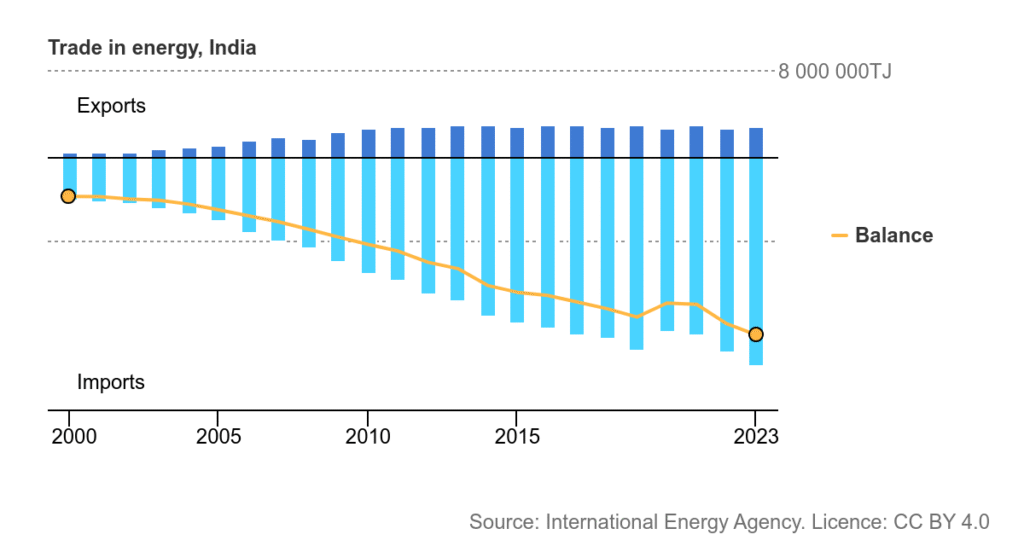
However, the country still faces major challenges in decreasing its reliance on fossil fuel. Some of the challenges are associated with renewable energy technologies, while others are because of modern realities in the marketplace, regulation, and infrastructure. For example, the cost of installing solar and wind energy infrastructure could make lenders more susceptible to perceiving renewable energy as high risk, despite the fact that it is much cheaper to install than fossil fuel. Other challenges include new energy transmission needs, barriers to entry, power generation depends on uncontrollable natural resources, power quality, resource location, information barrier, politics, and over supply of renewable energy technology. With all this said, India is a net importer of energy and is one of the most vulnerable countries to climate change, with an economy and technology rapidly developing, India will most likely be motivated to transition to renewable energy sources and they have the capacity to achieve their targets on emissions.
Key words: Renewable Energy, Fossil-fuel, GHG Emissions, Per Capita Emission




 Reston Dennis Juah
 Noor Ul Ain
 Hassan Barrie
 Hoby Nasandratra Andriamiandrisoa
+ There are no comments
Add yours