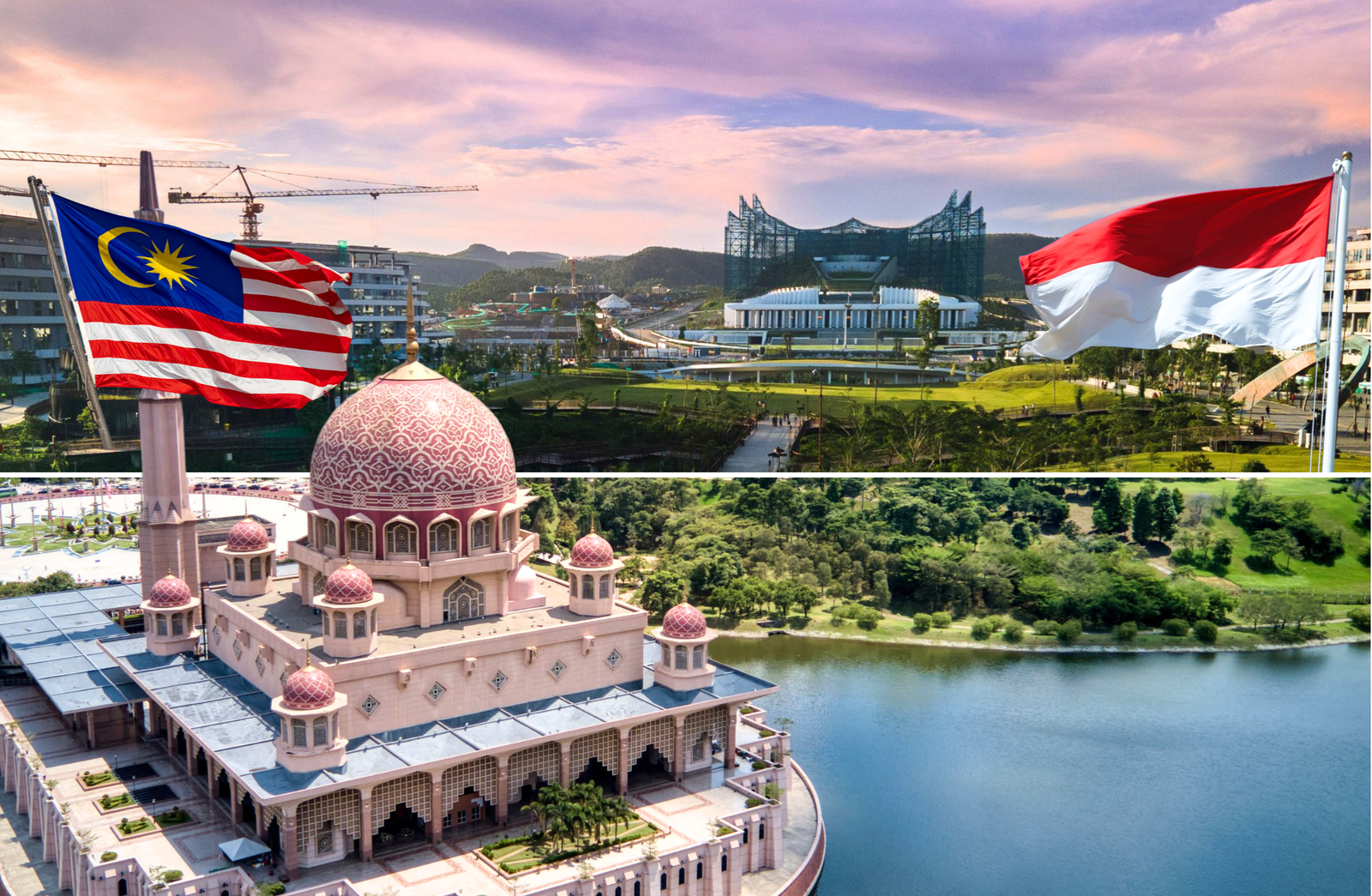

Both Nusantara and Putrajaya are new cities designed to take over the functions of the former capitals of their respective countries. Nusantara is Indonesia’s new capital city located in East Kalimantan province, which is currently still under construction since being launched as a strategic national project in 2019. The main objective of moving the capital to Nusantara is to distribute the burden on Jakarta as the center of government and economy, as well as to support more equitable development outside of Java. The same spirit was also prompted by the relocation of Malaysia’s administrative capital to Putrajaya. The development of Putrajaya was also based on the desire to balance and disperse development outside of Kuala Lumpur and the Klang Valley. The Putrajaya development planning project itself began in 1993 and was completed around 2011. Both new capitals were also designed with “green” principles in mind, with Nusantara using the “forest city” concept and Putrajaya using the “garden city” concept. This article reflects on and compares the development process of the two cities, with a focus on the lessons Nusantara can draw from Putrajaya. Their impacts are also discussed from a socio-environmental perspective, highlighting the presence of social justice in the development process. Several frameworks help guide the analysis, including rational choice theory, urban climate policy and land use, mitigation and adaptation, and social-climate justice.
The People Left Behind
There was criticism surrounding the development of Putrajaya, mainly on the social impact it caused on the original inhabitants of the land. According to Narayanan, during the city’s development process, several communities that had lived there for years were forced to be displaced and resettled. Most of them used to be plantation workers who were relocated to Taman Permata low-cost flats in Dengkil. These displaced families lost their productive land, which they once used for agriculture and additional income. The study by Narayanan found that more than half of the displaced community are unemployed. This is because most of them do not have other skills that would enable them to be employed outside of agriculture. As a result, most of them work for low wages as cleaners, factory workers, truck drivers, and so on. In general, the quality of life of the communities affected by the development of Putrajaya has declined dramatically after about 18 years of relocation. This could be due to the lack of involvement of the affected communities in the early stages of the project design. In fact, relocation is not the only thing that needs to be done. Resettlement programs must be based on careful consideration and planning. The need to provide adequate assistance for housing, training, capacity building, and land ownership issues should be addressed in the resettlement plan. Compensation must also be provided fairly and transparently. All of these resettlement measures need to be implemented properly so that the affected communities continue to be guaranteed a decent life after they are relocated to new areas.
This displacement issue is a critical one, as Nusantara is currently facing the same problem, especially with regard to indigenous communities. Several studies have pointed out that public participation is still severely lacking in the decision-making process, particularly in relation to the impact and benefits of projects on local communities. Currently, there are around 16,000 indigenous people whose livelihoods are threatened by the development of Nusantara. It is likely that they will also experience displacement, similar to the plantation worker community in Putrajaya. Learning from Putrajaya’s shortcomings in delivering social justice, Nusantara needs to make greater efforts to avoid the potential losses experienced by communities that have disproportionately less power in this particular case.
A City Built for Cars, Not People
Lastly, one of Putrajaya’s most significant shortcomings is its mobility planning. Urban mobility planning is essential when building a city. According to the World Bank, mobility planning is essential because mobility and transportation play an important role in economic movement and reducing greenhouse gas emissions. Mobility planning is also important to ensure the efficiency of city residents’ mobility to ensure the comfort and accessibility of the city itself. A piece of criticism from Khan says that Putrajaya is a city built for cars, not people. According to him, this is because Putrajaya was designed with wide roads, roundabouts that are considered “oversized,” and distances between precincts and amenities that are too far apart. This not only has a negative impact on the comfort of city residents, but also has a detrimental effect on the environment. This is because dependence on cars for transportation contributes to higher GHG emissions. This is also not in line with the original concept of Putrajaya as a “Garden City,” which should be more environmentally sustainable.
Borhan et al. also highlight how public buses are very unpopular as a mode of transportation in Putrajaya. The reasons for this are long travel times, which discourage people from using them; poor frequency and punctuality; lack of accessibility, such as a lack of bus stops; poorly available information; and safety factors, where bus drivers sometimes violate rules by driving above the speed limit. Despite buses being a more environmentally beneficial option, unfortunately, they have not yet become a reliable mode of transportation in Putrajaya. This is an important note for Nusantara to take into account in order to develop better mobility planning and urban public transport planning to achieve the goal of an environmentally friendly “Forest City.”
Keywords: Nusantara, Putrajaya, urban planning, social justice, climate policy



 Reston Dennis Juah
 Noor Ul Ain
 Hassan Barrie
 Hoby Nasandratra Andriamiandrisoa
Great rewards and even better customer support. I had a small issue with my account and they sorted it out in minutes. Big thanks to vntc88.