
Water is a problem of more than just development. It’s, more and more, a climate issue. The correlation between rising sea level and increase in El Niño cycles is very small in Indonesia, which is a big archipelago in the middle of the monsoons.
In this article, PAMSIMAS, the water programme in Indonesia, is not only considered as a sanitation programme, but also as a first-line climate adaptation infrastructure. That framing, which is now being pushed by the former Foreign Minister of Indonesia, Retno Marsudi, as Special Envoy to the United Nations on Water is very important in terms of money-flows, policy-making and who is ultimately protected.
In Indonesia, Climate Threat is already impacting Rural Water.
Let’s begin to look at issues with the facts on the ground. With over 50% of the population already climate change exposed to drought, flooding and sea level rise, Southeast Asia is one of the most climate change prone areas, and Indonesia is right in the middle of this climate change exposure area (Kurniawan et al., 2024). Climate hazards between 2019 and 2023 have impacted approximately 6.6 million Indonesians, of which 68% have been impacted by floods, 31% by droughts.
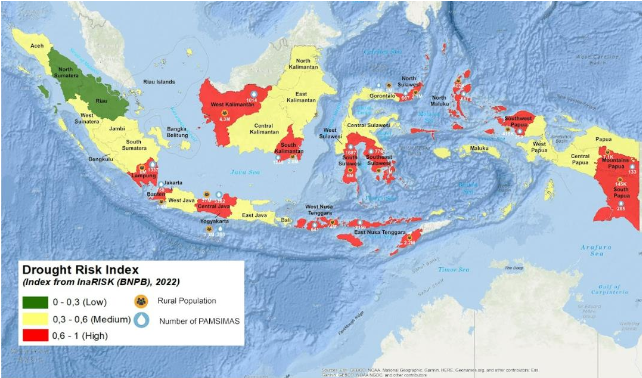
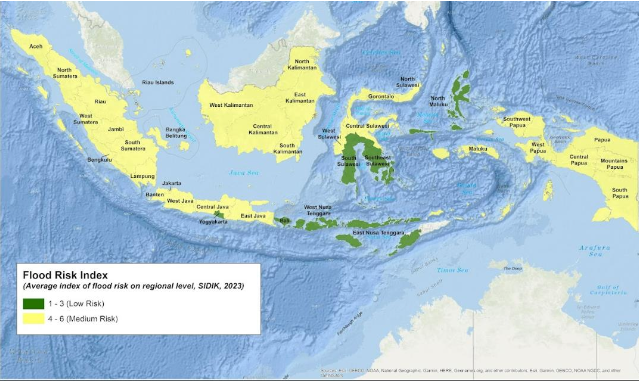
Source: (Daniel et al., 2023)
What this means is the ‘too much, too little’ effect on water policy that the researchers were able to identify. This could lead to increase in flooding and drought which may be detrimental to rural population using shallow wells, surface springs or gravity water lines.
High resolution climate projections for Java suggest that rainfall in the wet season is increasing and in the dry season is decreasing, and drying of the lowlands is a serious hazard for a significant portion of the population in Java. Heavy rainfall extremes will rise in upland areas which will lead to flash flooding and landslides downstream, while compound drought and heat are likely to be a more frequent threat in lowland Java (Hendrawan et al., 2024).
It is not too far off the prediction. They have drawn the picture for village water boards all across Indonesia, which are already facing circumstances, which without the help of technical assistance and smaller financial margins are difficult to deal with.
What is PAMSIMAS? And How Climate became a Last Resort?
Penyediaan Air Minum dan Sanitasi Berbasis Masyarakat (PAMSIMAS) is the flagship programme in the area of water and sanitation services in Indonesia. To date, PAMSIMAS has been able to reach some 25.6 million people in over 37,000 villages in 37 provinces of Indonesia, in partnership with the World Bank, until December 2022 (Daniel et al., 2023).
This is done by ensuring that there are elected village water boards (KPSPAMS or BPSPAMS) that also help in the day to day activities, decide on the water tariff and carry out repairs without requiring frequent inputs from the central government. In this instance it’s an entirely new decentralised model. The communities determine their need of water, the kind of water system they desire (public taps or deep borewells or gravity-fed pipelines), make payments for the water system and assist in labor for the system. Community ownership is the key that has enabled PAMSIMAS to work at scale.
However, it’s the next one that is important. PAMSIMAS did not take the change of climate into account when it was originally developed. In view of this, capacity mapping, threat and risk mapping as well as embedding adaptation in the planning and current state of PAMSIMAS need to be done to ensure that PAMSIMAS is also climate change resilient, as the threat is becoming real.
A large gap in the architecture. A program was designed for a stable climate, but this isn’t the same world any longer and this program is being used by over 25 million people.
Extreme weather, such as heavy rains and floods, and contamination have been causing damage to water infrastructure. Both these (contamination from floods and less flow during droughts) directly impact what PAMSIMAS is aiming to provide to rural populations (Daniel et al., 2023).
A Climate Challenge that Climate makes Worse.
PAMSIMAS is known to have sustainability issues, apart from climate change. Villages, supported by PAMSIMAS to establish facilities and infrastructure, have problems with the management of these facilities and are on the verge of abandoning some of the villages due to a lack of resources. After program, there are not sufficient resources available in communities and village governments to follow-up.
In practice, this implies that, despite the investment that has been made, due to a long dry period, a pump starts to malfunction, or a pipe rusts or a spring dries up and the village can no longer afford to repair it. The tariff system is conceptually elegant, but is vulnerable to rates being set too low to allow a significant reserve to be built up in the face of significant technical failure and is managed by the community.
This problem will be structurally worsened by climate change. More severe and longer dry seasons in the regions, like East Nusa Tenggara (NTT), parts of the Sulawesi and eastern Java will lead to more frequent failures of the system which the tariff buffers at the community level are unable to buffer. To some extent, this would be a climate stress test of the financial architecture of PAMSIMAS, which it has not formally received so far.
Retno Marsudi: Framing Shift on Global Level.
That’s where the role of Retno Marsudi can be seen, not only as a domestic policy-maker, but as a global agenda-setter.
In November 2024, Retno Marsudi was appointed Special Envoy by UN Secretary General António Guterres to lead and advocate for the issue of water and sanitation at the highest level, convening diverse stakeholders with different viewpoints and amplify the role of the UN system and mobilise action and financial resources to overcome the water crisis globally (United Nations, 2024).
By appointing the former Minister of foreign affairs as the UN Special Envoy for Water, Indonesia has more opportunities to influence the global water regime, linking the international agenda to the national agenda (Chotimah & Holland, 2025).
Marsudi’s work on this is an attempt to shift the water from a climate stressed region that is not seen as potential for recovery, to a known answer to the climate challenge, which can access climate funds. Marsudi pointed out that the role of innovation (to deepen technical, institutional and nature-based solutions), financing (to bridge the gap on investments) and political commitment (to place water on the political agenda) are all important (ECLAC, 2025).
In August 2025, Marsudi was named a Champion for Water Investment with the Global Outlook Council on Water Investment, which was set up during the Africa Water Investment Summit. The Council will be the leading political and investment dialogue about water, tracking progress, leveraging investments and facilitating action and policy coordination between the G20, the United Nations, multilateral development banks and the private sector, to shift water from a “crisis sector” to an “opportunity sector.” (Smart Water magazine, 2025)
The reframing is closely linked with the context in Indonesia. Water infrastructure can be reframed, as climate infrastructure and thus be lifted up to a vastly larger stream of climate finance, including via the UNFCCC architecture, the Green Climate Fund and bilateral climate partnerships. PAMSIMAS and other such programmes would be considered a source of funding for adaptation in the context of climate instead of competing in limited development aid packages.
The 100-0-100 target and what climate risks.
The national development framework in Indonesia has formulated the target for safe drinking water as 100, for the urban slum areas as 0 and proper sanitation as 100 (100-0-100 target). PAMSIMAS is the key instrument to achieve the first and third pillar of this target, and will reach the rural and peri-urban population.
The data obtained from the Central Bureau of Statistics (BPS) in 2024 shows that the population without access to safe drinking water is currently 73 percent and the number of people who don’t have sanitation facilities is around 20 million. The situation is aggravated by deforestation and climate change, which poses a risk to the water quantity and quality (Chotimah & Holland, 2025).
Because the gap from current access to 100% is the population that is served by PAMSIMAS, the climate vulnerability of PAMSIMAS directly impacts on Indonesia’s efforts to achieve its own national development targets, let alone SDG 6.
Water policies in Indonesia, such as PAMSIMAS, are linked to international policies, such as the 10th World Water Forum which took place in Bali in May 2024, where the Ministerial Declaration was issued, emphasizing the need for a Global Water Fund to support water-stressed areas facing financial constraints (Chotimah & Holland, 2025). The policy is a linkage, through linkages like local PAMSIMAS program and Bali Declaration, now Marsudi is able to mobilise it from her UN platform.
Gender Dimension is no invincible.
Any water policy analysis in Indonesia in the context of climate change is incomplete without considering gender, and therefore, cannot be considered as add-on.
It is well recognised that women’s participation in water, sanitation and hygiene (WASH) services provision, management and safeguarding has the potential to unlock WASH services. Women are frequently the ones managing household water use, and can be agents and leaders in WASH entrepreneurship (Priadi et al., 2025).
However, in practice PAMSIMAS has not always fulfilled this. A study on gender aspects of the programme has resulted in the following conclusions: In the village water board the key decision making positions in terms of technical aspects of the programme are occupied by males, whereas the females are involved in administrative and financial aspects of the programme. This is pertinent to climate resilience because women and children fetch water are the most vulnerable to water scarcity; and it’s not them who plan infrastructure.
Local governments responsible for PAMSIMAS should try to link with the women groups through Women Empowerment Office (Dinas Pemberdayaan Perempuan) and monitoring and evaluation system should be realistic and anticipate the gender transformative values (Priadi et al., 2025).
Not only is it a gender equity issue. It’s a “-effectiveness” argument of the program. Unless most climate exposed people are included in climate adaptation, it won’t be complete.
What Needs to Change: A Policy Argument.
The are three concrete shifts.
The first step is to make climate risk assessment an integral part of PAMSIMAS design and monitoring. The research collaboration KONEKSI between research institutions UTS, UGM and UI has resulted in the development of a Rural Water Supply Climate Risk Monitoring Tool (RWS-CRMT) and assessment tool (RWS-CRAT). The tools need to move from pilot to being national requirements for new PAMSIMAS implementation and sustainability review of programs. The policy recommendations based on the results of this research are: test a monitoring and assessment procedure responsive to GEDSI that is climate resilient; and test the feasibility of the monitoring and assessment procedure at the national level implementation in the existing PAMSIMAS programme (UTS, 2023).
Secondly, a buffer of climate resilience is needed in the financial structure of PAMSIMAS. Current community-managed tariff model does not take into account costs associated with failures of infrastructure due to climate change. Regional governments needs special mechanism to support communities from loss of infrastructure resulting from the climate event, if the community tariff can’t cover the reconstruction of the infrastructure (e.g., international climate funds). It is “workable”. It would just be a matter of political will and/or frame at international level which Marsudi can do in the UN.
Third, water is not a problem that can be handled as a solitary problem of a sector, but a problem in the NDC implementation framework in Indonesia. There are adaptation targets in addition to the large emission reduction targets in the Enhanced NDC of Indonesia. Agricultural resilience, food security and urban planning – all of which rely on water security – are included in the NDC. But PAMSIMAS are not especially mentioned with regard to planning of implementation of NDC. That’s a no-man’s land that needs to be occupied.
Conclusion: No infrastructure is enough.
PAMSIMAS is certainly a success. Over 37 thousand villages have been visited, over 25 million people served and decentralised model is now deemed as a model throughout the world. However, the programme was designed for a climate which no longer exists.
Indonesia’s presence of Retno Marsudi in UN provides a unique opportunity to be able to influence the international agenda on climate finance for rural water systems, including the importance of considering community-based water systems, including PAMSIMAS, as climate infrastructure, which is eligible for climate finance. A key inflection point is the UN Water Conference in 2026 that Marsudi is actively preparing for.
What’s at risk is that this is a rhetorical framing. There have been many water diplomacy claims but at the community level, they do not provide infrastructure. But will the money to support the use of water from other countries be released to the village water boards, whose springs have already dried up this year in Sulawesi, NTT and East Java?
That’s the policy question that should be followed.
Keywords: PAMSIMAS, Climate Adaptation, Rural Water Supply, UN Special Envoy on Water, Gender-Transformative Policy
References.
Chotimah, A. Q., & Holland, I. (2025). Indonesia’s Water Diplomacy and Leadership in Achieving SDG 6: A Strategic Approach to Sustainable Development. International Journal of Science and Society, 7(1), 2025. https://doi.org/10.54783/ijsoc.v7i1.1387
Daniel, Wulaningtyas, A. H., Satriani, Devi, E. F., Willetts, J., & Kumar, A. (2023). Community-based rural water supply: Indonesia country risk profile. https://www.uts.edu.au/globalassets/sites/default/files/2024-02/ugm-uts_2023_rural-water-supply-and-climate-change—indonesia-country-risk-profile.pdf
ECLAC. (2025, October 9). Ms. Retno Marsudi-UN Special Envoy for Water calls for innovation, financing and political commitment at the 5th Regional Water Dialogues 2025. https://www.cepal.org/en/notes/ms-retno-marsudi-un-special-envoy-water-calls-innovation-financing-and-political-commitment
Hendrawan, V. S. A., Mawandha, H. G., Sakti, A. D., Karlina, Andika, N., Shahid, S., & Jayadi, R. (2024). Future exposure of rainfall and temperature extremes to the most populous island of Indonesia: A projection based on CORDEX simulation. International Journal of Climatology, 44(10), 3529–3547. https://doi.org/10.1002/joc.8537
Kurniawan, T. A., Bandala, E. R., Othman, M. H. D., Goh, H. H., Anouzla, A., Chew, K. W., Aziz, F., Al-Hazmi, H. E., & Khoir, A. N. (2024). Implications of climate change on water quality and sanitation in climate hotspot locations: A case study in Indonesia. Water Supply, 24(2), 517–542. https://doi.org/10.2166/ws.2024.008
Priadi, C. R., Ghaudenson, R., Zahra, A. A., Kumar, A., Danisha, D., Insani, K., Iqbal, K. M., Widyawardhani, S. P., Rahma, A. A., Felaza, E., Nijhawan, A., Wulaningtyas, A. H., Paramita, D., Al Afghani, M. M., Howard, G., & Willetts, J. (2025). Towards a gender-transformative climate-resilient rural water supply: women’s involvement, roles, and rights in community-based water management in Indonesia. Journal of Water Sanitation and Hygiene for Development, 15(10), 806–818. https://doi.org/10.2166/washdev.2025.030
Smart Water magazine. (2025, August 20). Retno Marsudi to champion Global Outlook Council on Water Investment. Smart Water Magazine. https://smartwatermagazine.com/news/smart-water-magazine/retno-marsudi-champion-global-outlook-council-water-investment
United Nations. (2024, September 13). Secretary-General Appoints Retno L.P. Marsudi of Indonesia Special Envoy on Water. https://press.un.org/en/2024/sga2315.doc.htm
UTS. (2023, August 31). Future proofing a basic social service: climate-resilient community-based rural water supply. University of Technology Sydney. https://www.uts.edu.au/case-studies/future-proofing-basic-social-service-climate-resilient-community-based-rural-water-supply


 Reston Dennis Juah
 Noor Ul Ain

 Hassan Barrie
 Hoby Nasandratra Andriamiandrisoa
Best JILI experience I have had so far. The graphics are crisp and the gameplay is fair. Highly recommend ph288jili to everyone in the PH