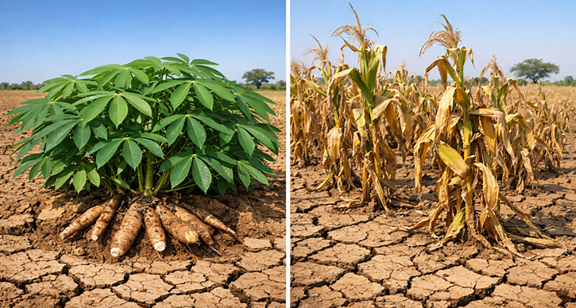

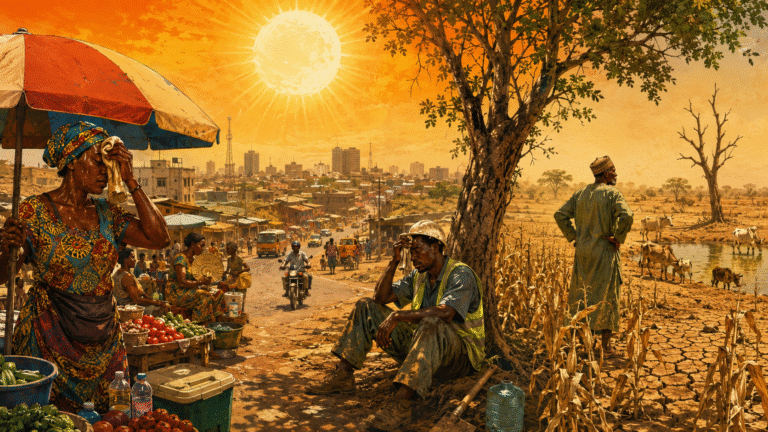
In many parts of Africa, climate change is now a daily reality that affects farms, harvests, food prices, and rural livelihoods. Longer droughts, unpredictable rainfall, higher temperatures, and poorer soil quality are putting great pressure on rain-fed farming systems, which many smallholder farmers depend on (AYANLADE & OLUWATIMILEHIN, 2021; Descheemaeker et al., 2025). As a result, several countries are re-evaluating their dependence on hybrid seeds and farming methods that require many inputs. Although these methods have led to higher yields under stable climate conditions, they often perform poorly as rainfall becomes erratic and temperatures rise. In contrast, cassava and similar resilient crops require fewer inputs and maintain productivity under marginal conditions (Jarvis et al., 2012).
Indigenous crops like cassava (Manihot esculenta) are now being studied more closely because they are known to be resilient. Cassava is a good example of how crops well-suited to local conditions and supported by traditional farming knowledge can improve food security and support adaptation to climate change in Africa.
Change and Agricultural Vulnerability in Africa: Climate change is already making it harder to grow food in sub-Saharan Africa. Higher temperatures, longer droughts, more frequent floods, and unpredictable rainfall are reducing staple-crop harvests, especially maize, which does not grow well in hot, dry conditions (Descheemaeker et al., 2025; IPCC, 2023). Studies show that maize harvests in some parts of the region could drop by as much as 22% by 2050 if greenhouse gas emissions stay high.
Smallholder farmers, who grow most of Africa’s food, must contend with these problems despite often lacking access to irrigation, insurance, or reliable weather forecasts (AYANLADE & OLUWATIMILEHIN, 2021). This makes them vulnerable and reveals a key weakness of modern farming methods that rely heavily on external inputs: they depend too much on stable weather and expensive resources, so they struggle in unpredictable weather.
What was Overlooked? The Value of Indigenous Crops and Local Knowledge: For decades, efforts to modernise farming in Africa have focused on hybrid seeds and farming methods that need many chemical inputs. This approach has mostly ignored crops and knowledge that local farmers have developed over generations (Descheemaeker et al., 2025). Many indigenous crops, like cassava, were labelled as “subsistence” or less valuable, even though they grow well in poor soils, inconsistent rain, and dry conditions.
Cassava (Manihot esculenta) is a good example of a crop with hidden strengths. It grows well in poor soils and still yields reliably when there is not enough water—a time when crops like maize often fail (AYANLADE & OLUWATIMILEHIN, 2021). Farmers can leave cassava roots in the ground and harvest them as needed, so they act like a natural food bank during droughts or hard times. In many parts of Africa, such as West and Central Africa, people also eat cassava leaves as a healthy vegetable, adding variety to their diets (Amelework et al., 2021).
Local communities have learned a lot about how to grow cassava, make it safe to eat, and store it well. This traditional knowledge makes cassava even more useful for adapting to climate change. However, official farming policies have often failed to make good use of this local expertise (Descheemaeker et al., 2025).
Cassava as a Climate-Resilient Crop: Cassava (Manihot esculenta) is distinctive among staple crops for its ability to withstand harsh climatic conditions. Unlike maize, which suffers when it is too hot or dry, cassava can still produce steady harvests even during long dry periods and in poor soils. Cassava has deep roots and special features that help it survive in dry conditions. Farmers like cassava because they can leave it in the ground and harvest it when they need food, which is helpful during droughts or hard times. Studies in Nigeria show that cassava harvests are linked to rainfall and temperature during the growing season (AYANLADE & OLUWATIMILEHIN, 2021). Because of these strengths, cassava is an important crop for food security as the climate becomes less predictable in sub-Saharan Africa (Descheemaeker et al., 2025).
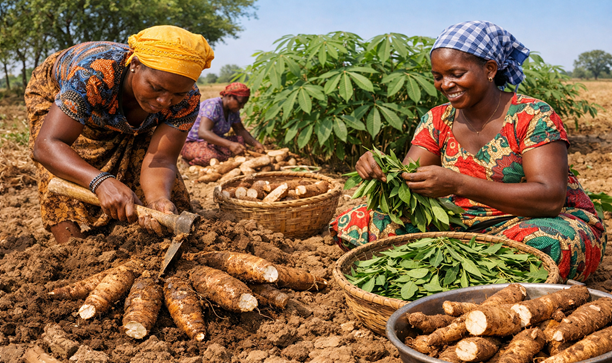
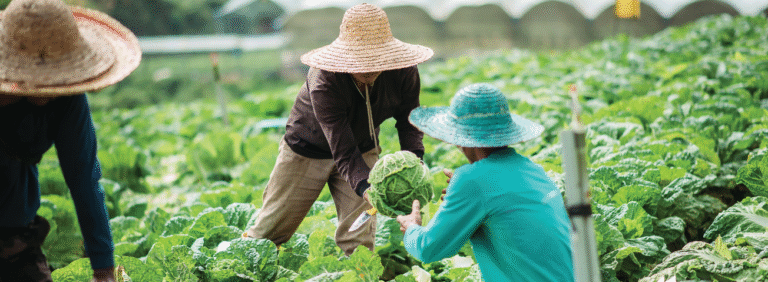
Figure 1 Smallholder farmers harvesting cassava — a crop sustained by generations of traditional knowledge and practices
Towards More Inclusive Climate-Smart Agriculture: Many current climate-smart agriculture (CSA) programs in Africa still focus mainly on technology, like hybrid seeds, chemical fertilisers, and irrigation systems. These programs often do not value the importance of growing diverse crops and using local farming knowledge (Descheemaeker et al., 2025).
A better approach would include strong, local crops like cassava in national farming plans. Crops like cassava help small farmers rely less on expensive outside supplies and make it easier for them to cope with changing weather and drought. The FAO points out that farming methods that draw on local knowledge and grow many types of crops—known as ecological agriculture—are highly effective at helping farmers adapt to climate change. These methods also protect the environment and make food supplies and rural life better (Lim et al., 2011, pp. 4–6).
To make this work, climate information needs to be shared in ways that local people trust and understand. There also needs to be more international teamwork to fund efforts that protect crop variety. Mixing modern science—for example, developing cassava varieties that resist disease—with traditional farming methods can create robust farming systems that are productive and fit local cultures.
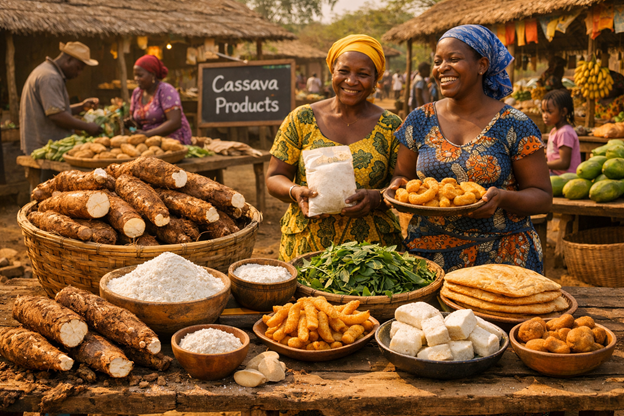
Figure 2 From field to table: Cassava supports food security, nutrition, and rural livelihoods in a changing climate
Ultimately, climate change is forcing a fundamental rethinking of African agriculture. While input-intensive hybrid systems delivered productivity gains under relatively stable conditions, their limitations have become evident amid increasing uncertainty. Cassava illustrates how indigenous crops, supported by local knowledge and ecological practices, provide practical pathways toward greater resilience, food security, and improved rural livelihoods.
The best way forward is not to choose between modern science and traditional farming, but to combine the strengths of both. Sharing climate information clearly and working together internationally will help make these mixed approaches part of regular farming. This will make sure policies meet the real needs of small farmers and that global support helps build truly strong food systems in Africa.
Keywords: Cassava Resilience, Indigenous African Crops, Climate-Smart Agriculture, Traditional Knowledge, Food Security Adaptation, Hybrid.


 Reston Dennis Juah
 Noor Ul Ain
 Hassan Barrie
 Hoby Nasandratra Andriamiandrisoa
The login is seamless and the games load instantly. It is perfect for quick sessions during my break. Visit fh777login for a smooth ride.