
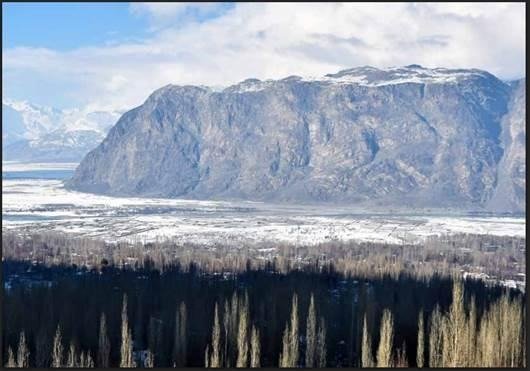
Located in the mountainous region of Pakistan, Gilgit-Baltistan is one of the most significant cryosphere regions outside the Polar Regions, with a glacier area of 16,933 km² and supplying water to the Indus River system (Kalair et al., 2019). Beyond mountain livelihoods, glacier instability is also directly related to Pakistan’s food security, as more than 90% of the nation’s agricultural production comes from irrigated land. The snowpacks and glaciers were expected to remain reasonably stable throughout the year, with water released as snow and ice melted during spring and summer. However, the average global surface temperature from 2011 – 2020 reached 1.09°C, higher than the reference period of 1850 – 1900, with mountain areas warming at a higher rate due to elevation-dependent warming (IPCC, 2023; Krishnan et al., 2019). Recent studies suggest that the cryosphere in the Hindu Kush Himalayas poses a dual challenge: it changes rapidly and often irreversibly, and in hot weather, glaciers and snowfields raise river levels and create unstable glacial lakes. In contrast, heavy monsoon rainfall poses compound risks, including flash floods, landslides, riverbank overflow, and glacial lake outburst floods (Wester et al., 2023). Excessive and unpredictable glacial retreat depletes water supplies during the sowing season and causes severe damage to fields, roads, bridges, irrigation systems, and hydropower facilities. This is also an indicator of the susceptibility of local adaptation in traditional irrigation systems (kuhls) in the region. Kuhls are man-made gravity-fed channels that carry meltwater from higher-elevation streams to the terraced fields of approximately 70,000 hectares (Ashraf et al., 2021). However, these channels are prone to landslides, flash floods, sediment loads, and glacial retreat. In May 2022, a glacial lake outburst flood disrupted the Karakoram Highway, destroyed the Hassanabad Bridge, damaged houses and power plants, and cut off an important pathway between Pakistan and China (Tariq, 2022). This incident was an alarming reminder that climate hazards are no longer local disasters but also affect the nation’s trade, mobility, energy, and tourism.
From Water Stress to Food Insecurity
In the past, high-elevation farms were protected from the reproduction of pests and pathogens by a cold barrier created by consistent freezing temperatures and long winters. However, anthropogenic climate change raises temperatures and causes glacial retreat, spreading pests, invasive insects, and fungal crop diseases to higher altitudes, where crops are not naturally resistant, leading to rapid infestation, accelerated pest generations, and severe crop damage. These stressors have a cumulative effect and create more biotic pressure from exotic pests and abiotic chronic water shortages that affect the local production system, food security, and livelihoods. In Nagar District, the mixed-methods approach surveyed 430 farmers, with 87.7% reporting negative impacts of climate change, such as higher incidence of crop disease, lower crop yields, and limited irrigation water access (Ali et al., 2024). Climate stress poses additional challenges to the agricultural sector in Gilgit-Baltistan, which is already under pressure due to limited land areas, mountainous topography, and dependence on meltwater, thereby affecting production and worsening the already fragile livelihood. Moreover, the glaciers, including the Baltoro glacier, the Passu glacier, the Hunza glacier, and the surrounding landscape, are attracting a large number of domestic and international tourists, which is also a source of income for the communities that do not have any other means of earning money. However, if tourism is not managed, it could cause an increase in black carbon emissions, over-exploitation and degradation of water, generation of solid waste, and unsafe construction activity on debris fans and flood-susceptible slopes.
Adaptation Must Combine Local Wisdom and State Capacity
For effective adaptation, the region needs public investment, early warning systems, scientific monitoring, and local knowledge. UNDP has successfully demonstrated that disaster risk reduction can be achieved through modern technology and being prepared at the community level in vulnerable regions through its GLOF-II projects (UNDP, 2025). Seasonal water storage solutions, such as glacier grafting and ice stupas, are being developed locally in certain high-altitude areas to store water in villages during winter and support spring planting. Besides, small reservoirs should be developed, drip irrigation introduced, water-resistant crops cultivated, and hazard mapping conducted to limit development in landslide and debris-flow areas. The current costs will be felt in the future through damage to infrastructure, loss of crop output, displacement, and rising interprovincial tensions regarding water.
Keywords: Glacial retreat, Gilgit-Baltistan, Climate change adaptation, Food security and irrigation, Glacial Lake Outburst Floods (GLOF), Traditional irrigation systems, Sustainable tourism
References:
Ali, I., Shah, A. A., Alotaibi, B. A., & Ali, A. (2024). Assessing the impacts of climate change on high mountain land-based livelihoods: An empirical investigation in District Nagar, Gilgit-Baltistan, Pakistan. Heliyon, 10(21).
Ashraf, A., & Ahmad, I. (2021). Prospects of cryosphere-fed Kuhl irrigation system nurturing high mountain agriculture under a changing climate in the Upper Indus Basin—Science of the Total Environment, 788, 147752.
Intergovernmental Panel on Climate Change. (2023). Climate Change 2023: Synthesis Report. Summary for Policymakers. https://www.ipcc.ch/report/ar6/syr/downloads/report/IPCC_AR6_SYR_SPM.pdf
Kalair, A. R., Abas, N., Hasan, Q. U., Kalair, E., Kalair, A., & Khan, N. (2019). Water, energy, and food nexus of the Indus Water Treaty: Water governance. Water-Energy Nexus, 2(1), 10–24.
Krishnan, R., Shrestha, A. B., Ren, G., Rajbhandari, R., Saeed, S., Sanjay, J., … & Ren, Y. (2019). Unraveling climate change in the Hindu Kush Himalaya: rapid warming in the mountains and increasing extremes. In The Hindu Kush Himalaya assessment: Mountains, climate change, sustainability and people (pp. 57–97). Cham: Springer International Publishing.
Tariq, H. (2022). A bridge collapsed in Pakistan due to a glacier lake outburst flood. Columbia Climate School / GlacierHub. https://news.climate.columbia.edu/2022/05/13/bridge-collapse-in-pakistan-due-to-glacier-lake-outburst-flood/
Wester, P., Chaudhary, S., Chettri, N., Jackson, M., Maharjan, A., Nepal, S., & Steiner, J. F. (Eds.). (2023). Water, ice, society, and ecosystems in the Hindu Kush Himalaya: An outlook. ICIMOD. https://articles.unesco.org/sites/default/files/medias/fichiers/2024/10/HI-WISE_REPORT_Water_Ice_Society_and_Ecosystems_in_the_HKH-2023.pdf


 Reston Dennis Juah
  Noor Ul Ain
 Hassan Barrie
 Hoby Nasandratra Andriamiandrisoa
Theo cảm nhận cá nhân thì 188v con phù hợp cho ai thích giao diện đơn giản. TONY06-29
NlGvpjrLZmbscDYO
Tôi thấy tỷ lệ thưởng khá tốt cricfy app TONY07-08
I gotta bookmark this site it seems extremely helpful handy
Điều mình thích ở pikashow download là có nhiều trò chơi được cập nhật thường xuyên nên trải nghiệm không bị nhàm chán. TONY07-20
cKTXrmInSXlNqPzLxNbreNNp
The VIP rewards are actually worth it here. I feel valued as a player and the promotions are constantly updated. Check out rpvip5h5 for the best perks.
Feeling like a real VIP with the rewards and the exclusive service provided here. The winning streaks are unbelievable. Join sgcvipslot
The slot variety here is insane. I hit a decent jackpot on rajamaniaslot yesterday and the withdrawal was a breeze!