
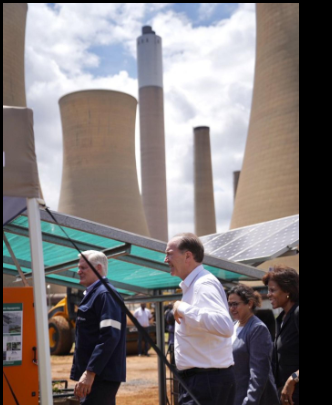
Figure: Komati Power Station in Mpumalanga has become a key test case for South Africa’s just energy transition, showing both the promise and difficulty of moving from coal to clean energy. (Source: UN, 2022).
Climate policy sounds convincing in international delegations, where governments agree on targets such as reducing emissions by transitioning to renewables and fulfilling climate finance. However, for countries whose economy entirely depends on fossil fuel consumption, such as coal, oil, and natural gas in the highest emitting sectors, including industrial and transport sectors, the transition to renewables is not an abstract policy pathway but a matter of changing people’s lifestyle in terms of losing jobs, expensive energy, etc. That is why the idea of “just transition” continues to evolve. A just transition ensures equity and an inclusive shift to a low carbon economy by creating jobs for those negatively affected by climate policies. It emphasizes that the government should shift from fossil fuels to renewable energy by creating a trustworthy, cost-effective environment that protects and includes those most affected by this transition. In other words, climate policy must be environmentally responsible and socially fair.
South Africa faces this challenge of ‘just transition’, since the country is one of the world’s most coal-dependent major economies, and coal has long powered its electricity system. However, for many residents in coal-dependent areas, particularly in Mpumalanga, coal is a source of job creation rather than just a fuel. The closure or restriction of coal power stations has impacts on coal miners, power station employees, taxi drivers, and small businesses that rely on local wages. The Just Energy Transition Partnership (JETP) was initiated at COP26 in Glasgow in 2021, with South Africa and a coalition of international partners. The European Union and its partners from France, Germany, the United Kingdom, and the United States first pledged US$8.5 billion to help the country decarbonize its energy sector (Republic of South Africa, 2022). The funding was intended as a combination of grants, concessional loans, commercial debt, and equity rather than free funding. This appeared to be a climate-diplomacy success, implying that developed countries supported a developing country’s energy transition. However, the situation within the country has been more complicated, with most of its population questioning the impact of the funding on the workers and communities. For instance, civil society groups have raised concerns about the over-dependence on loan-based climate finance, as it can exacerbate the country’s debt and development pressures. This demonstrates the importance of local-level communication in climate policy. Without clear explanations and participation of local communities, there will be reduced public trust in the government (GIGA, 2024). To foster trust in climate diplomacy, governments and donors have to provide information on the money spent, concessional lending, benefits, and restrictions.
The closure of the Komati coal power station provides a symbolic example. Komati has been offered as a land not only to continue using existing coal facilities but also to transition them to clean energy sources such as solar and battery storage. In 2023, the World Bank approved a $497 million project to phase out the 56-year-old Komati coal plant. The project aimed to utilize the land space for solar energy, battery storage, and create jobs and development opportunities for the local community (World Bank, 2023). However, there has been some uncertainty and frustration reported because new opportunities, including employment, training, and local investment, have not been achieved quickly enough to replace what was lost. That’s where many plans for transitioning to solar get complicated: a new solar project does not automatically replace a job that was once coal-related, because there are different skills required, they may be located in different areas, and they often pay less. This implies that these opportunities need to be planned, trained, built, and timed. In 2024, South Africa had spent only a portion of its donor-funded climate program, with implementation hindered by complexity, politics, and the inability to coordinate numerous actors (Reuters, 2024).
A more effective communications strategy should start at the community level with the participation of workers, local leaders, unions, women, youth, and small businesses. Communities need to be asked when it comes to who will be retrained, who will be supported, when projects will begin, what types of jobs will be available, and who will be held responsible when promises are not fulfilled. They shouldn’t be told after plans are made. This is important because people don’t support climate policies when the aim is to cut carbon emissions rather than a local plan. They support it if these policies improve their lives, keep their families safe, and help their children have a future. In South Africa, the most persuasive climate message is not simply “we must cut emissions.” It is “we must build an energy system that is cleaner, more reliable, more inclusive, and fairer than the one we have now. Reuters reported in 2024 that South Africa had spent only a fraction of its donor-funded climate program, with implementation slowed by complexity, politics, and the difficulty of coordinating many actors.
South Africa has struggled with electricity insecurity, unemployment, inequality, and pressure on public finances. A clean energy transition will only gain durable support if it stands a stronger chance of securing sustained public support as it relates to energy security, industrial development, skills development, public health, and local investment. South Africa’s JET investment plan needs to transition away from a trade-off between climate action and development to attract investment, create industries, strengthen energy security, and support climate resilience. is connected to these everyday concerns. In its own planning, South Africa has framed the transition not as a trade-off between climate action and development, but to attract investment, create industries, strengthen energy security, and support climate resilience.
References:
Republic of South Africa. (2022). South Africa’s Just Energy Transition Investment Plan (JET IP) for the Initial Period 2023–2027. Presidential Climate Finance Task Team.
A. (2024). Why Just Energy Transition Partnerships are not enough. https://www.giga-hamburg.de/en/publications/giga-focus/why-just-energy-transition-partnerships-are-not-enough
Focus on coal miners, power grid as South Africa spends just sixth of climate aid. https://www.reuters.com/world/africa/focus-coal-miners-power-grid-south-africa-spends-just-sixth-climate-aid-2024-09-26/
Factsheet: Eskom Just Energy Transition Project in South Africa. https://www.worldbank.org/en/news/factsheet/2023/06/05/factsheet-eskom-just-energy-transition-project-in-afe-south-africa


 Reston Dennis Juah
  Noor Ul Ain
 Hassan Barrie
 Hoby Nasandratra Andriamiandrisoa
Hey there just wanted to give you a brief heads up and let you know a few of the images aren’t loading properly. I’m not sure why but I think its a linking issue. I’ve tried it in two different web browsers and both show the same outcome.